

5 Sports Bikes With High Resale Value
The story of the secondary automotive market is one of depreciation. The vast majority of new vehicles plummet in value from the moment they roll off the factory floor. Technology marches on, styles change, and performance improves, usually leaving used vehicles dwindling into obscurity. Millions of dollars are made and lost trying to guess which cars and motorcycles are investments and which are just money pits.
It's hard to tell what will hit, what will miss, and what might become a future classic. Some motorcycles are born for greatness, garnering special editions, celebrity endorsements, European designers, and limited production runs. Others are hardcore homologation race bikes that only an aficionado could love. And still more seem prosaic upon release, gaining cachet only as time marches on.
Whatever the case, let's dive into the history of motorcycles to unearth five sport bikes that, for whatever reason, are getting love in the aftermarket as evidenced by their resale value.
1994 -1998 Ducati 916 Senna
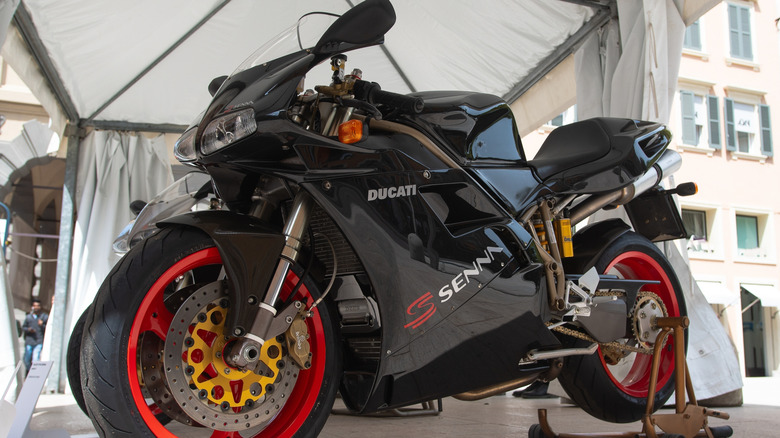
Debuting in 1994, the Ducati 916 was aimed at the steep racetrack competition coming from the likes of the Honda Fireblade. It launched with a 916 cc 90-degree fuel-injected V-twin engine (not to be confused with a parallel-twin) making 114 horsepower at 9,000 rpm and 66 lb-ft of torque at 7,000 rpm.
The performance was impressive, but its aesthetics marked it as something special. Designer Massim Tamburini eschewed the sleek full-fairing look of Japanese sport bikes for an elegant, exposed-frame design. Nods to its racing pedigrees included a single-seat setup and undertail exhaust. With a base MSRP of $14,495 in the U.S. at its debut (over $30,000 today), it was clearly a premium machine.
During its production run from 1994 to 1998, Ducati introduced performance models such as the Strada, SP, and SPS. But it would be the limited editions that have caught the eyes of collectors. Owners of Ducati, Claudio and Gianfranco Castiglioni, were friends with F1 driver Ayrton Senna, himself an owner of a Ducati 851. In March 1994, Senna inked a deal with the motorcycle company to build 300 916s to Senna's specs. It was an instant hit, so much so that Ducati commissioned a second and third run in 1997 and 1998, with the late driver's brother Leonardo involved in the process.
Today, a Ducati 916 Senna edition is one of the rarest Ducati motorcycles around, and they aren't building any more of them. A 1995 Ducati 916 Senna fetched £45,000 (~$60,000) in 2023. Granted, that was a never-before-used specimen, but it hints at how these bikes have grown in cachet in recent years. Other sales have well-loved base model 916s exceeding their original MSRP 30 years later — a rare feat for any vehicle.
1994 Honda RC45
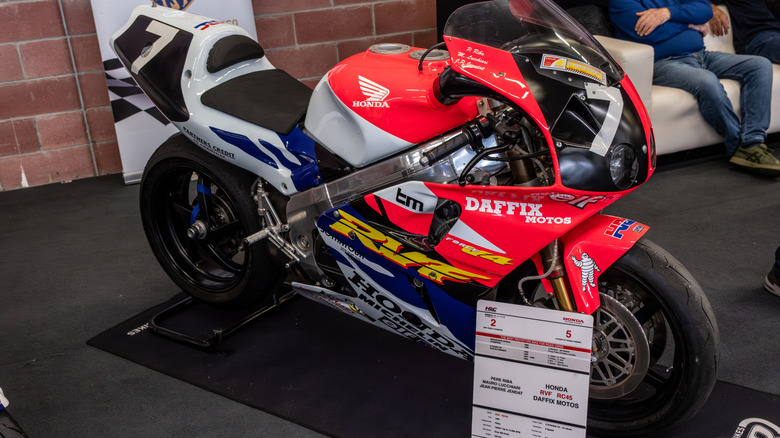
Homologation cars and motorcycles are great because the only reason they exist is for the parent company to go racing. That means that even though the versions that hit the street tend to be more prosaic than their track-destined counterparts, they're usually pretty noteworthy. The Honda RC45 is no exception.
The RC45 was always going to be special. Today, its endearing wide-eyed headlights date it as a child of the '90s. Developed from the earlier RC30, the RC45 used a 749 cc V4 engine with a 12,500 rpm red line. Upon release in 1994, the U.S. edition boasted 101 horsepower (down from the 118 hp European-spec rating). It was blisteringly fast and almost violent in its dedication to getting low in the corners. It wasn't the bike for weekend cruising. It was race-pedigree, through and through, and its limited production numbers mean that if you scooped one up brand new in 1994, you might have something special on your hands, as Honda only built around 200 between '94 and '95.
Already wildly expensive at $27,000 brand new (approximately $60,000 today), these rare, raceified sports bikes can be found on the secondary market today. However, if you think you're going to find a junker, think again: Iconic Motorbike Auction's listings of sold RC45s start at just under $30,000 and soar to over $100,000 for ultra-low mileage and historically significant specimens.
1989-1995 Kawasaki Ninja ZX-7RR
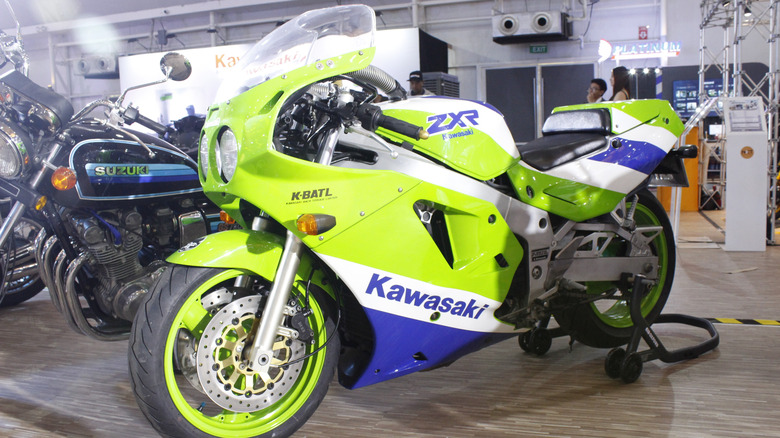
The Ninja is nothing less than sport bike royalty. Revolutionizing the super-sport world with the 1984 GPz900, Kawasaki's modern Ninja line remains a major player in the segment. It should come as little surprise that some models have appreciated in value in recent years.
Enter the ZX-7R. With roots in the World Superbike Championship, its lime-green Kawa paint and deliciously '90s design evoke the glory days of riders Scott Russell and Aaron Slight. Built to replace the GPX750R, it was known as the ZXR-750 outside the United States. It used a twin-spar aluminum frame wrapped around a 748 cc four-stroke engine good for 112 hp at 11,700 rpm and 56 lb-ft of torque at 9,500 rpm. That all added up to an astonishing top speed of 167 mph.
The base ZX-7R was in production for a long time, so it is not as rare as some bikes, but the ZX-7RR model is the one attracting the most attention in the secondary market. Kawasaki produced only 500 homologation-edition 7RRs. Iconic Motorbike Auctions has recorded several ZX-7RR sales ranging from $15,000 to a Doug Chandler-raced edition for $70,000.
2005 MV Agusta F4 1000 Tamburini
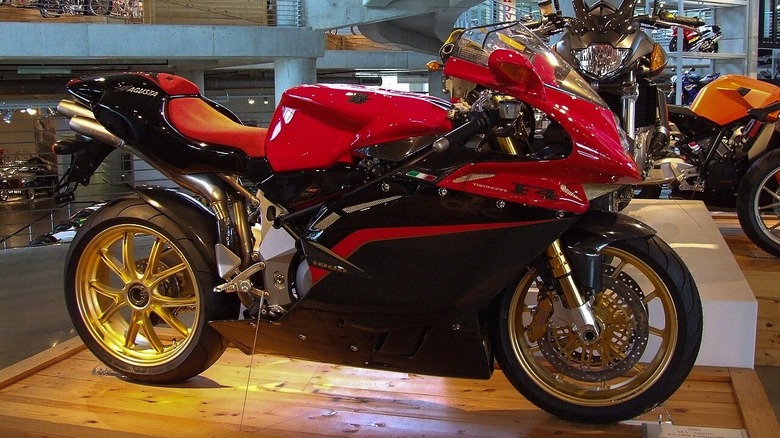
Founded by Italian aristocrat Count Giovanni Agusta in 1907, Agusta initially built aircraft for the Italian government before turning to more terrestrial endeavors. MV Agusta was founded in 1945 to build motorcycles after Italy was no longer permitted to build aircraft following the Second World War.
MV Agusta is a luxury performance motorcycle manufacturer known for some of the most expensive motorcycles on the planet. Its models tend to hold value unusually well. It introduced the F4 at the turn of the millennium, beginning a production run that included multiple displacements, editions, and models before concluding its production in 2018.
Regarded more as rideable pieces of art than homologation racers, special edition MV Agustas demand a premium from the jump. Perhaps the most notable example is the limited edition 2005 MV Agusta F4 1000 Tamburini. Originally priced at $42,695, the special Tamburini edition of the already limited-production F4 1000 S was bound to attract interest in the secondary market.
A barely-used Tamburini with 424 kilometers on the clock fetched $38,500 at auction on Bring a Trailer in 2022, while a 2021 auction on Iconic Motorbikes set the mark with a $43,000 price tag for a super-rare 0-mile specimen. That bike might be an outlier, but 100% of MSRP for a 20-year-old motorcycle (albeit a rare one) is just one indicator that collectors are eyeing these bikes.
1992 to 1999 Honda Fireblade 900RR

It's impossible to predict which bikes will become future classics upon release. When Honda introduced its vaunted Fireblade series in 1992, it shifted the paradigm. It weighed just 457 pounds — a whopping 75 pounds lighter than the competing Yamaha FZR1000. With usable power and handling prowess, it was comfortable on the street — a welcome change from the hardcore race-homologation bikes that populate this list.
The Fireblade 900RR competed well, but it wasn't an obvious future classic. The '90s were a fiercely competitive time in big-displacement sport bikes, after all. But 30 years on, things might be beginning to change. The modern Honda Fireblade is a well-regarded motorcycle, and its antecedents may be poised for some more love from the market. With an initial MSRP of $8,299 in 1992, auction sites are seeing more buyers willing to pay higher prices for this relatively run-of-the-mill motorcycle (compared to designer and limited-edition models). Perhaps the nicest thing about the Fireblade is that at the time of writing, its prices are climbing, but so far they remain accessible.
Iconic Motorbikes Auctions records a number of sales, ranging from $3,000 for a project bike to $25,000 — triple the original MSRP — for a mint-condition example with no miles on the odometer. Those numbers won't make anyone's eyes pop compared to some of the six-figure motorcycles we've examined. Still, it's an indicator that the historic significance of this motorcycle may be catching the eyes of those who wanted one brand-new but didn't have the scratch at the time.