

EGO Vs Greenworks: 3 Things To Consider Before Picking Between These Brands
We may receive a commission on purchases made from links.
When starting a collection of cordless power tools, you'll probably prefer to invest in a single power tool brand. After all, each brand has its proprietary technologies. This means that if your tools, chargers, and batteries are from the same brand, expanding your power tool collection becomes more cost-effective and easier. Given the numerous major tool brands available on the market, determining which one is right for you can be quite challenging. That's especially true when choosing between Ego and Greenworks, as both offer similar arrays of cordless power tools for professional and household needs.
Now, Ego may not have the same long history as some top brands like DeWalt, which is just over 100 years old. But that doesn't mean it doesn't produce some of the best power tools on the market. In fact, it's one of the major powerhouses that produces electric outdoor tools that are prized for their performance, durability, and industry-leading battery technology.
On the other hand, Greenworks is one of the newest players in the market that's quickly turning out to be a significant player in the power tool game. This is primarily because the brand's green power tools are easy to spot and consistently found in professional settings and homeowners' garages. Plus, most of its products are affordable, and they're available at many brick-and-mortar stores like Lowe's, Costco, Walmart, Best Buy, and much more. With that in mind, given that these brands have their perks and cons, here's how they compare on various aspects.
Greenwork's power tools appear to be cheaper than Ego's power tools
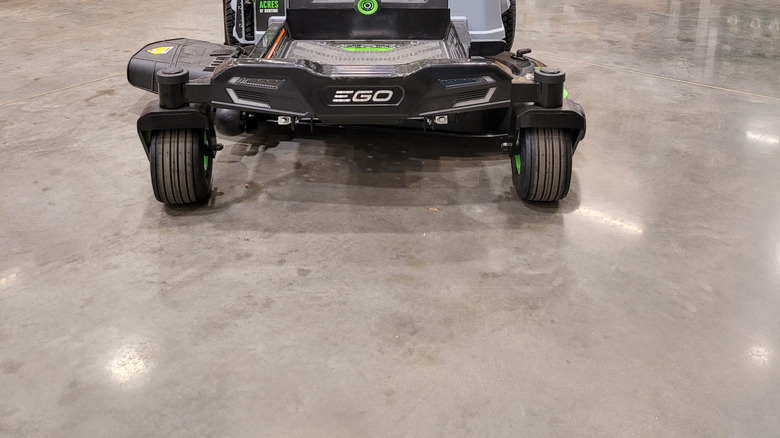
Wholly owned by the Chinese-based power tool company Chevron, Ego is one of the most recognizable tool badges in cordless electric outdoor equipment. After all, when compared to other major power tool brands, its outdoor power tools often rank at or near the top in terms of power output, but this comes at a serious cost. Given that price is often one of the first noticeable differences buyers notice when comparing brands, Ego power tools tend to come with hefty price tags. Of course, for those who use products like the EGO POWER+ 21" Self-Propelled Mower to earn a living, paying a premium fee for a powerful, high-quality product might be justified. But for others, especially those who use mowers a few times a year, not so much.
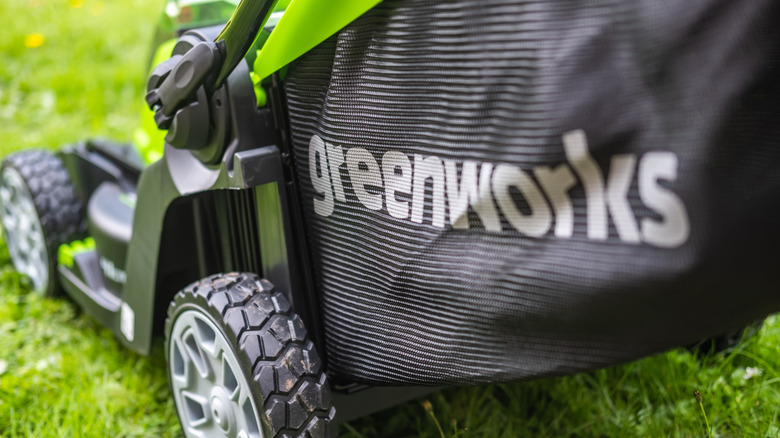
Greenworks, on the other hand, which is owned by Globe Tool Group, generally falls around the middle of the pack when it comes to price. Sure, it is not the cheapest power tool brand on the market, nor is it far from the most expensive. But it's perfect for homeowners who want to expand their garage work arsenal with affordable corded and cordless power tools. In fact, when you compare both brands' outdoor tools, you'll notice that Greenworks' cheapest Chainsaw is the 40V 12-inch Gen2 Cordless Battery Chainsaw that retails at $170, while Ego's cheapest is the POWER+ 12-inch Compact Chainsaw, which is available for $280 on Amazon.
How these power tool batteries differ
When it comes to power tool batteries, both Ego and Greenworks batteries share some similarities. Both utilize lithium-ion technology to power their tool lines, and both design their batteries to deliver impressive performance. However, despite these similarities, they exhibit significant differences, particularly in terms of voltage capabilities, platform structures, and overall performance.
Ego is well-known for its Arc lithium 56V battery that touts a few perks over batteries made by other brands, such as Greenworks, Milwaukee, and Ryobi. Generally speaking, when compared to Greenworks 80V batteries, Ego 56V batteries will generate less pure power. But if you're wondering what's so special about Ego 56V batteries, it's the fact that Ego claims that its batteries deliver as much actual usable power as 80V batteries. In fact, this is evident by the 52-inch ride-on lawn mower capable of trimming a 4-acre lawn on a single charge.
Additionally, these batteries feature a phase-change material and an arc design that serves as a thermal management system, protecting the battery cells from overheating during heavy use. Greenworks, in contrast, offers a wider range of options across voltage tiers. It features a 24V battery, which is ideal for lightweight tools like augers, 40V and 60V batteries that deliver long-lasting power and performance, and 80V batteries perfect for high-performance outdoor power tools like the 21-inch GEN 2 Cordless Battery 4-in-1 Push Lawn Mower.
Which brand offers the best warranty?
If you're shopping for a power tool, you'll most likely look for traits like performance, durability, battery power, and quality. But besides that, you'll also want to consider details concerning their warranties. Power tools are quite expensive, and, like other tech devices, they can break or fail due to defects or wear and tear. This is why warranties are so important; they offer financial protection in case a tool fails to work as intended or malfunctions.
With that said, not all major power tool brands offer the same warranty. Ego, for example, offers a five-year limited warranty on its cordless power tools designed for home use and a one-year warranty for tools meant for professional use. That's quite a bit longer than most power tool brands, such as DeWalt, which offers a three-year warranty that also includes a 90-day money-back guarantee and a one-year free service contract. Besides that, Ego also offers a three-year warranty on its Power+ batteries and chargers, and this covers common problems that power tool batteries experience, which arise under normal usage and not from misuse, abuse, or improper storage.
Greenworks offers many warranties, but some notable ones include a standard three-year warranty for cordless power tools and batteries and a four-year warranty for Greenworks Pro products and batteries. It's worth noting that, as with Ego, these warranties cover all power tools purchased from authorized sources. Plus, you'll want to register your tool online and save your receipts, just to ensure that you qualify for the warranty when the time comes.