

5 Exciting Apple MacBook Pro Changes That May Be Coming In 2026
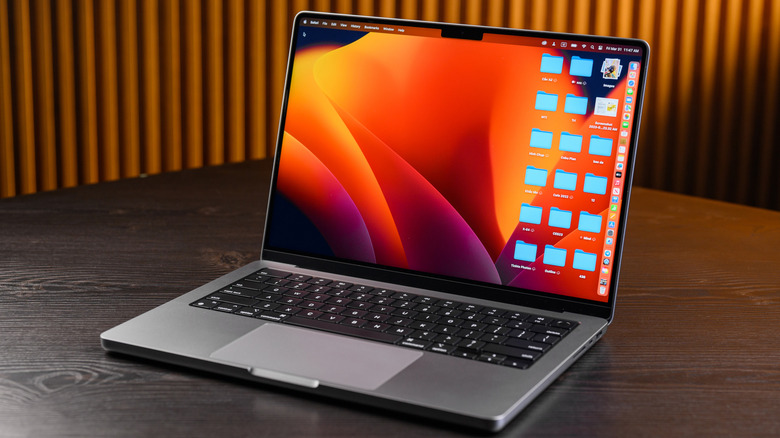
Apple has a new generation of MacBook Pro laptops primed for a late 2026 debut. This one is an overhaul that has been years in the making and highly anticipated, as well. It couldn't come sooner, though, given the state of the competition. The laptop industry is in a rather exciting spot right now. And if the products we saw at CES 2026 are any indication, shoppers will have more choices (and fewer compromises to make) in the years ahead. Intel's new Panther Lake processors have offered a glimpse of meaty performance gains and higher battery efficiency on Windows machines. Qualcomm's next-gen Snapdragon X2 series processors, on the other hand, are breathing down the Mac's neck to steer the cause of Windows on Arm. Dell is bringing back the iconic XPS lineup this year, while Lenovo is giving a repair-friendly internal design overhaul to the ThinkPads. Asus even gave a dual-screen treatment to a gaming laptop, while Dell is prepping the most affordable Alienware laptop.
Simply put, there is plenty of excitement in the Windows ecosystem, as the experiments have gotten bolder than ever, while the results are fittingly exciting. Needless to say, Apple must really wow Mac loyalists with a laptop that can send a strong message: A MacBook that can cement Apple's position as the maker of utterly powerful silicon, fitted inside a machine that is expectedly reliable as well as a specimen of top-tier engineering. The M6 generation MacBook Pro laptops could just deliver on that computing daydream. So far, industry watchers and media pundits have predicted a massive overhaul for the upcoming 14-inch and 16-inch flagships, both inside and out. And on the less savory side of things, a price hike as well. What follows is a primer of what to expect from Apple's next.
A fresh design language

The last time Apple updated the MacBook Pro's aesthetics was in 2021, introducing a curvier look with a notch on top. It proved to be a controversial design element. The next-gen model, which Bloomberg claims might arrive late in 2026, will bring a fresh design language. "The new machines, code-named K114 and K116, will also have thinner and lighter frames and run the M6 line of chips," the outlet reports.
Now, details are pretty slim on exactly what direction the company is taking with the design. The "Pro" models have been engaged in a back-and-forth with sharp sides and curved edges over the past decade or so. The 2015 MacBook Pro was the last model with a rounded base, while its successors went slimmer and flatter in appearance until 2021, when the M1-series refresh brought curves back into vogue. With the upcoming refresh, it's hard to predict where Apple goes, and in particular, how it stands out. That said, it would be interesting to see if Apple gets a tad generous with the port selection. What seems to be locked is the display aesthetics. According to Bloomberg, the notch is going away.
The boat-shaped cutout will be replaced by a punch-hole cutout, which means the camera will appear to be floating in a sea of pixels alongside the top edge of the screen. The most exciting part of all this speculation is the functionality woven around it. Bloomberg's Mark Gurman claims that the camera hole on the upcoming MacBook Pro "will be similar in concept to the Dynamic Island on the iPhone." If that turns out to be true, we can expect a whole bunch of software experiences designed around the laptop's webcam cutout.
OLED, at last
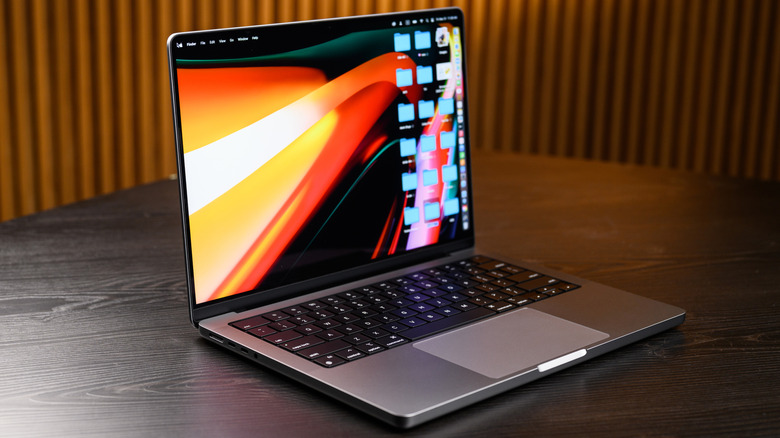
Apple is one of the most conspicuous absentees from the OLED laptop segment. Over the years, almost every major PC brand has shifted to OLED panels on its premium laptops. The likes of Asus have even made laptops with foldable OLED screens, while Lenovo made a gaming laptop with a rollable OLED display that goes from a 16-inch format to a 24-inch canvas. Apple, on the other hand, has bucked the trend. The closest Apple has gotten to an OLED-like experience is the mini-LED 120Hz screen on the current crop of MacBook Pro machines. This year, the status quo might finally change.
"The MacBook Pro, meanwhile, is set to become the first Mac with an OLED screen in its next redesign," Bloomberg reported in October 2025. Now, this won't be your run-of-the-mill OLED panel. The outlet notes that the OLED screen destined for the flagship laptop is "the same standard used in iPhones and iPad Pros." That means we are looking at a Tandem OLED panel, which first appeared on the M4-series iPad Pro in 2024.
Compared to a traditional OLED screen, the tandem variety actually sandwiches two OLED panels into a singular structure. The result, according to Apple, is improved brightness, class-leading dynamic range, and more precise control at the pixel-level. It's also natural to expect that Apple will use the ProMotion tech to offer a 120Hz refresh rate on this screen when it's deployed on the MacBook Pro. The bigger question is whether Apple will enhance the resolution, too. There are already Windows laptops out in the market with up to a 4K screen, but the jump in resolution also comes with the burden of a higher power draw. Yet, given the battery efficiency of MacBooks, it won't be surprising to see Apple take the 3K or 4K plunge.
Cellular connectivity

One of the most perplexing misses from the MacBook's arsenal has been the lack of cellular connectivity. Yes, this functionality is nowhere close to mainstream on the other side of the computing ecosystem, but big names like Lenovo have offered 5G on laptops since 2019. But it looks like Apple is finally ready to push laptop-bound cellular connectivity into the mainstream, and it seems the company was merely waiting to build its own modems.
"With its own modem in the pipeline, Apple is investigating the idea of bringing cellular connectivity to the Mac for the first time," Bloomberg reported back in 2024. The report further clarified that the plans wouldn't materialize until 2026 at the earliest, subject to Apple's progress with in-house modems. Well, the situation has changed a lot, and in Apple's favor, to be specific.
Just over a year ago, Apple introduced the iPhone 16e, the first phone to feature a self-developed C1 modem. This was followed by the upgraded C1X modem, which appeared inside the iPhone Air. Ben Bajarin, CEO of research and consulting firm Creative Strategies, told CNBC that Apple's modem is not at the same performance level as Qualcomm's, but when it comes to power efficiency, it's the better choice.
Considering the fact that Apple used the same fundamental design and internal engineering for the MacBook during the past five years, it would have been difficult to simply sneak in a cellular modem. But now that Apple is redesigning its flagship laptop and arming it with next-gen silicon, it's pretty likely that we will see a cellular modem finally make an appearance on the MacBook Pro. Whether Apple goes all-in with a 5G mmWave-ready module remains to be seen, but even if it's limited to the slower 5G Sub-6 GHz range, it'd be a welcome move.
Here comes the touchscreen Mac

Apple has historically been against the concept of touchscreen interactions on a Mac. "After an extended period of time, your arm wants to fall off. It doesn't work, it's ergonomically terrible," Steve Jobs, co-founder and former chief, famously said. His successor, Tim Cook, didn't entertain the idea, either. But it appears that the attitude has mellowed over the years. Back in 2023, Bloomberg reported that Apple had started considering the idea of Macs with a touch-sensitive screen. Two years later, the outlet reported that Apple was prepping a revamped MacBook Pro armed with a touch-sensitive screen, and that it could arrive toward the end of 2026 or the beginning of 2027.
Notably, this new wave of Apple laptops will serve as a test bed to check how users receive the idea of touch interactions on macOS, after giving them a taste of using iPadOS like a full-fledged laptop. "Apple isn't actively developing additional touch-screen Macs. Instead, it's waiting to see the market's reaction to the touch version of the MacBook Pro," says the report from last year. It would be interesting to see whether Apple also makes any major changes to macOS in order to make touch-screen gestures more intuitive and functionally rewarding.
However, the inclusion of a touch-sensitive screen (and a thinner design tagging along) will come with an unpleasant surprise. Apple is reportedly reinforcing the hinge on the upcoming laptop so that when users tap on the screen with their fingers, the display lid doesn't wobble. These changes, alongside the supposedly higher cost of an OLED touchscreen, will reportedly raise the price of the laptop by a few hundred dollars. A price hike is also likely for other reasons. Thanks in no small part to the AI data centers, the price of memory modules has skyrocketed, and PC brands have accordingly started raising the prices.
A next-gen silicon
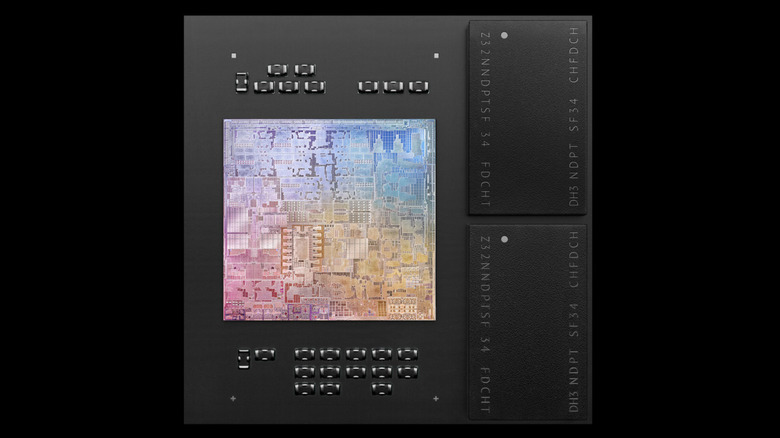
The status of the OLED MacBook Pro is rather curious. Apple is yet to introduce laptops with the M5 Pro and M5 Max variants, and has only launched a refreshed MacBook Pro with the baseline M5 silicon. It seems rather rushed that Apple would drop an entirely new breed of laptops with next-gen M6 series processors in the same calendar year. Irrespective of the release window, the silicon will be a generational leap.
The current crop of M5 processors is built atop TSMC's 3-nanometer process node, and all industry watchers are predicting a shift to the more advanced 2-nanometer node for the M6 series processors. Broadly, shifting to a smaller fabrication node brings a simultaneous gain in raw performance and efficiency. So technically, the M6-series MacBook Pro laptops should offer more firepower while drawing a lesser amount of energy, opening the doors for gains in battery mileage.
The shift to a 2nm process node will also put it in the same league as Intel, which has already revealed processors based on the smaller 18A node. These processors, slotted in the Panther Lake class and marketed as the Core Ultra Series 3 lineup, are already here. As far as the gain in raw performance goes, at least going by Intel's own progress, the M6 series MacBook Pro machines should be 15% faster at the baseline, climbing up to a 60% jump for the beefier SKUs with more cores.
Intel is also making a 27-hour battery mileage claim for machines equipped with Panther Lake processors. Those numbers are already within Apple's grasp, as the M4 and M5-series laptops already tout a 24-hour battery life. Coupled with the anticipated efficiency gains of the M6 series processors, we can expect the next-gen MacBook Pro models to match, or even surpass, the new benchmark Intel has set for Windows machines.