

16 Car Accessories You Should Never Use, And Why

We may receive a commission on purchases made from links.
You don't have to be a conventional car enthusiast to get the urge to spruce up your vehicle and distinguish it from the millions of other cars on the road networks all over the world. Your car can be an extension of your personality, and you can change up the standard layout you get when you drive it off a dealer's lot with accessories to better reflect your tastes. Accessories can range in function from purely aesthetic to performance-enhancing, which is why there's such a large market for car accessories. The industry is valued at just over half a trillion dollars and is projected to grow even more in the future.
However, just because you like how an accessory looks or performs isn't enough to bring it into your car's ecosystem. There are factors you need to consider, both from a safety and legal perspective. Some accessories can get you in trouble with law enforcement. Others could actively endanger you, and you'd never know it until something happens. So, let's dive into 16 such accessories that you should never use, both to stay on the good side of the law and to keep you and your passengers safe.
Seat covers

Seat covers are great for two reasons: they protect the upholstery of the manufactured seat from wear and tear, and they can transform an otherwise unremarkable interior into a snazzy one. From a perspective of pure valuation, at the bare minimum, seat covers help keep your seats from deteriorating.
If you're using the regular seats as they come, you'll find that they age over time. That's due to the leather's exposure to sun rays — and of course, there's the matter of stains from drinks and food that could degrade the upholstery quality. Seat covers keep things springy clean and maintain at least some resale value, and some even offer a degree of temperature control.
So, what's the catch? As part of safety regulations and the evolving industry benchmarks, car manufacturers are installing airbags in certain areas of the interior, and the seats are included in this equation. With seat covers deployed snugly over the manufactured seating, the airbags are restricted from deploying to cushion any impact in the event of an accident. In fact, airbags could even be harmful in such a scenario. The deployment could alter the shape of the seat cover, and the awkward position could expose passengers to more injuries.
Steering covers
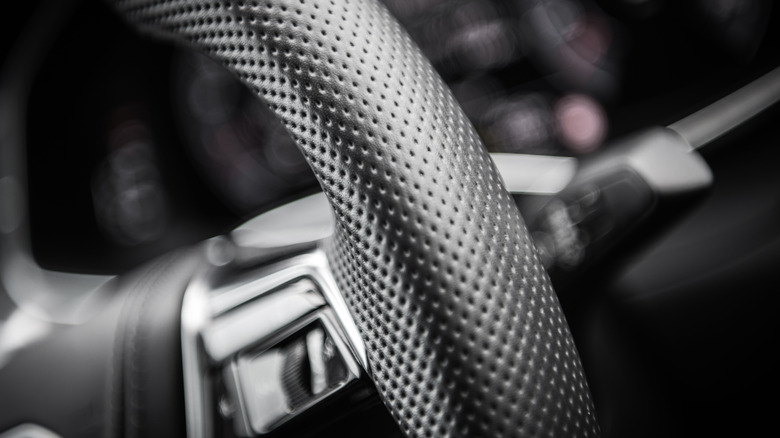
Just like seat covers, steering covers are made primarily to protect the fabric of the steering from wear and to match the aesthetic tastes of the driver. While the concept may sound dandy on paper, the reality is different. Depending on the quality of material used, covers could even cause more damage to the steering than would occur in regular daily use.
Wear isn't the only risk that steering covers bring, however. If you purchase an ill-fitting cover, it's not impossible for the material to slip free, which could make you lose control of your car in a split second. SlashGear has a valuable trick for putting on steering covers. Similarly, the feel of the exterior material is just as important. Ideally, you want a cover with a good grip that you don't have to second-guess its reaction to your steering motions. If you insist on using a steering cover, those made with rubber or silicone are good for grip. Those materials won't absorb sweat or feel slippery.
Non-OEM floor mats
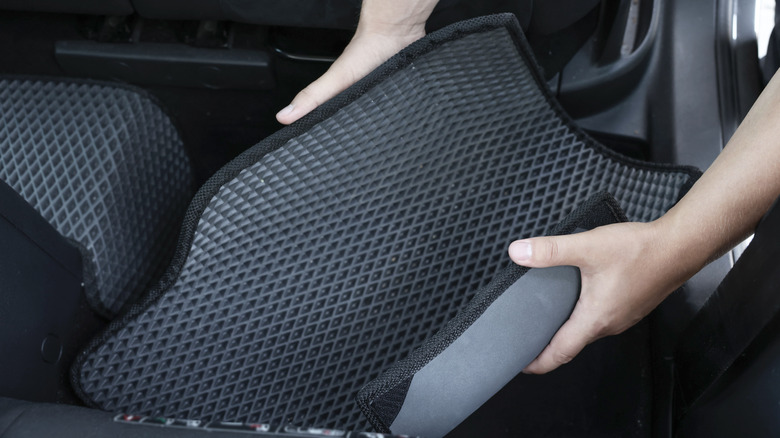
This one boils down to mostly personal taste. For whatever reason, floor mats tailored by original manufacturers can just feel off from your standards of what you would want in your cabin. With this in mind, it's no surprise there's a market for non-OEM floor mats out there. However, there's a reason automakers outfit their vehicles with these accessories as a default option — each car has unique specifications and dimensions for carpets to fit just right.
When you go for non-OEM floor mats, whether for style or cost reasons, you run the risk of them not fitting your car's floor, which could result in dangerous scenarios when driving. The carpets could get caught under the brake pedal, for example, which would hamper your ability to slow down. As you can imagine, this could easily lead you to lose control of your vehicle, so the safety cons outweigh the pros for this accessory.
Bright LED headlights

It's no news that headlights are essential for driving at night; you need to see the road in front of you clearly. However, there's a distinct difference between needing to see what's in front of you and potentially blinding other road users, and LED bulbs in particular pose a risk in this regard.
While LED bulbs may be considered to be among the best in terms of sheer luminescence, in reality, they can have a negative effect on other drivers and pedestrians. Compared to the halogen bulbs in older cars, LED headlights are much brighter and have a more focused glare. That causes a tangible strain on the eyes. We've got a tip that can reduce LED glare from your headlights to reduce this effect.
A survey carried out by the RAC in the U.K. showed that about 60% of drivers feel the LED glare problem is getting worse on the roads. Given that it takes older drivers roughly nine seconds to recover from glare, the roads are significantly more uncomfortable (and potentially dangerous) when LED headlights are blasting on the asphalt.
Headlight darkening kits
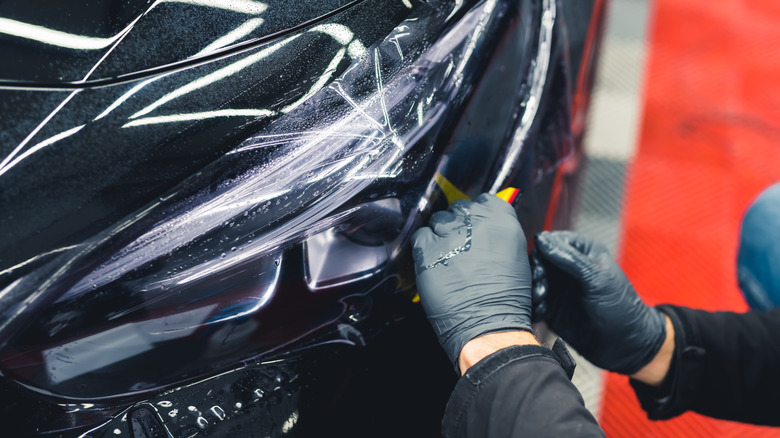
On the flip side, while headlights are capable of being too intense, there's also the phenomenon of them not being intense enough. For stylistic reasons, presumably to give your car a more sporty appearance, you could opt for a darkening kit. Not to cramp your style, but your vehicle's safety compliance should supersede its aesthetic appeal in your list of priorities.
Just as you need to see what's ahead of you, other drivers need to see you coming. The easiest way to ensure you're visible is through your headlights. If your lights aren't as intense as they need to be, the chances of another driver not seeing you go up, and so does your accident risk.
Beyond perception, from a legal standpoint, tinting your headlights is illegal in most states if it results in a change of color. In fact, only a few states, like Arizona and California, allow fog lights to be tinted to selective shades of yellow.
Dashboard covers
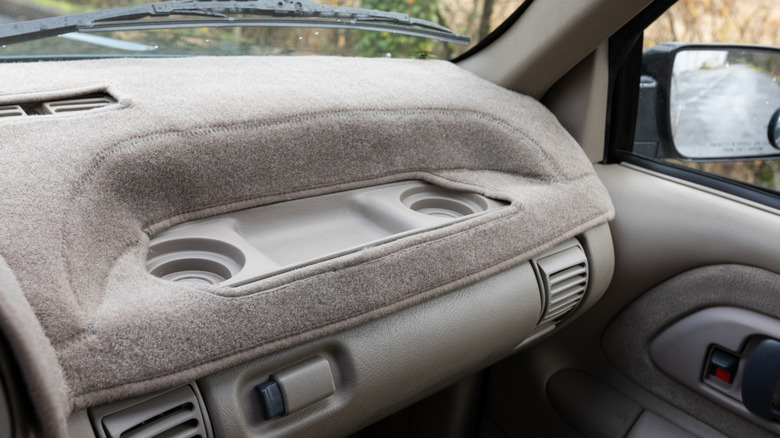
Like seat and steering covers, the basis of appeal for dashboard covers remains the same dual purpose: protecting the quality of the manufactured material and cranking the default stylistic outlook up a notch. The cover acts as a barrier between ultraviolet rays from sunlight and the dashboard, which prevents fading and cracking.
However, dashboard covers pose the same safety risk as those used for seats. Airbag deployment is not as straightforward, and could even be injurious to occupants — particularly that of the front passenger. The passenger airbag deploys from the dashboard in the event of a crash, and with a cover sitting on top of it, there are a handful of scenarios that could play out.
First, the airbag could turn the cover into a weapon. The force at which the airbag is deployed might hurl the cover at the face or torso of a passenger at speed, which could potentially result in injuries. Secondly, it might deploy at an awkward angle — if it even deploys at all.
Musical car horns
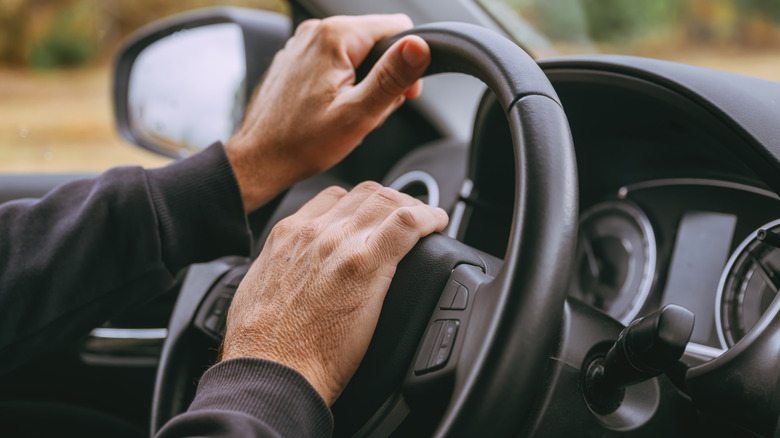
For the average driver, the thought of changing their horn configuration might never cross their mind, and that's why you're likely to hear a monotonous blare of sound in a traffic jam. However, chances are you've come across a vehicle with an almost musical tune to its hooting. The notes typically linger for a little while after the initial blare, and can turn driving from a serious task to a near-whimsical joyride. The problem is, the sound can get excessively loud, and nearly every state in the U.S. has noise ordinances pertaining to car horns.
Also, there's the risk of the horn deviating from its actual purpose: to alert other road users. If the sound the horn blares is not instantly recognizable as a car horn, it could confuse other drivers and delay the expected reaction to hearing the default cautionary sound. Following this train of thought, it's not out of the realm of possibilities for car crashes to occur with musical horns.
Lift kits
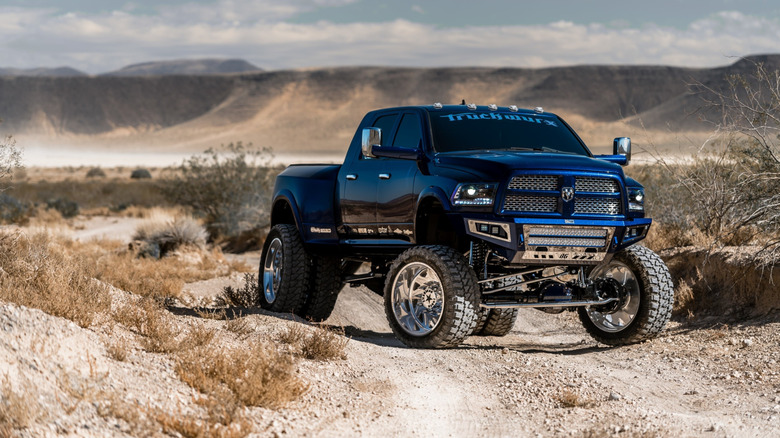
If you go off-roading consistently, or you live in an area with exceedingly rough terrain, you probably know how important it is for your car's overall health to gain a few extra inches of ground clearance. That's why lift kits are so popular. Despite the popularity, states like California place a limit on frame height. Interpreting some statutes could get tricky, so you'd need to tread carefully to make sure you don't run afoul of the law. The laws are there for a reason — to protect other road users and yourself.
If your lift kit extends your vehicle height by too many inches, your bumper will no longer line up with the designated crash zones of regular cars. That could spell disaster for other cars in any form of collision. The more personal danger that comes with liberal lift kit use is that it can alter your car's balancing mechanisms significantly. The higher center of gravity that lift kits bring could increase rollover risk when going around bends.
Additional cup holders

Most cars come with cup holders installed in the space between the two front seats, just below the arm rests. That's because automakers understand the hustle and bustle of everyday life, and sometimes drivers like to enjoy a cool drink or hot beverage while on the go. While it's still not recommended to engage in such activities, if you're going to have refreshments, you might as well do it safely.
The problem arises when drivers install additional cup holders in their cabins. Logically, the main reason for this need is that the number of available spaces in the default configuration doesn't tally with the number of seats. Unfortunately, due to space restrictions, the additional cup holders are holstered in awkward places like air vents just to fit.
That's a recipe for disaster in the reactive playground that is driving — a particularly harsh swerve could cause the precarious fitting to come loose and spill liquids all over the car floor, or worse, on you. At high speeds, that microsecond of distraction could prove costly.
Dummy seatbelt buckles

The importance of seat belts in cars can't be overstated; in scenarios where you need to really pump the brakes and come to a quick stop or even in an accident, they hold car occupants in place, preventing serious injuries. According to scientific studies, seat belts help to cut injury risk roughly in half in car accidents.
So, why are dummy seat belt buckles even a thing? Some car occupants don't like the restrictive feel of wearing seat belts for a variety of reasons: a long day at work, being plus-sized, or just generally wanting to relax. Ordinarily, if your car's in motion and the front seat belts aren't fastened, your alarm system is going to emit a series of annoying chimes to alert you to that oversight.
Dummy buckles earn their bread and butter here — you simply plug the seat belt into the unholstered buckle, and your car system is tricked into thinking the seat belt is properly deployed. As you can imagine, this is especially dangerous because the car occupants are provided no safety at all.
Steering knobs
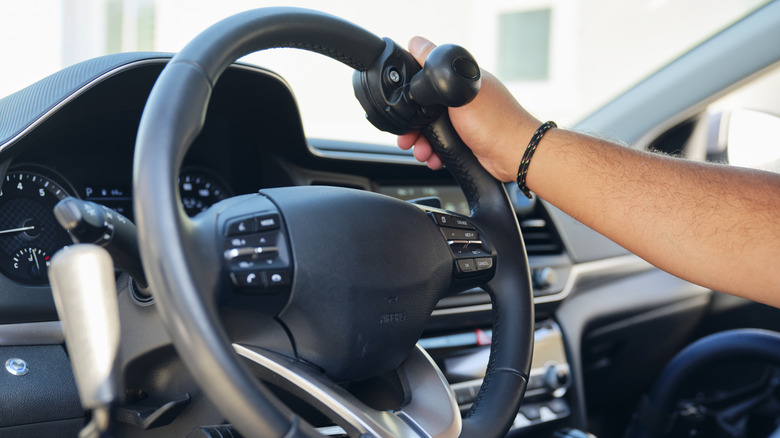
The history of steering knobs goes back to the mid-1930s, when they were invented primarily to allow drivers to fully turn the wheel with one hand. With the advent of power steering in the '50s, their previous ubiquity faded, although some drivers today — especially those with driving accessibility challenges — still find them pretty useful.
From a legal standpoint, the steering knob isn't innately illegal, but the regulations on the technology vary from state to state. Some states, like Michigan, impose clear restrictions on the types of knobs that are acceptable on its roads. If you can properly navigate the legal complexity, the real danger of using steering knobs lies in the structural design.
If installation requirements are not followed to the letter, steering knobs can break off while in operation. That makes for a control nightmare as the driver has to scramble to grip the actual steering — precious time during which a lot of damage can occur. If you absolutely require the driving assistance steering knobs offer, go for it with the right installation protocols.
Roof racks
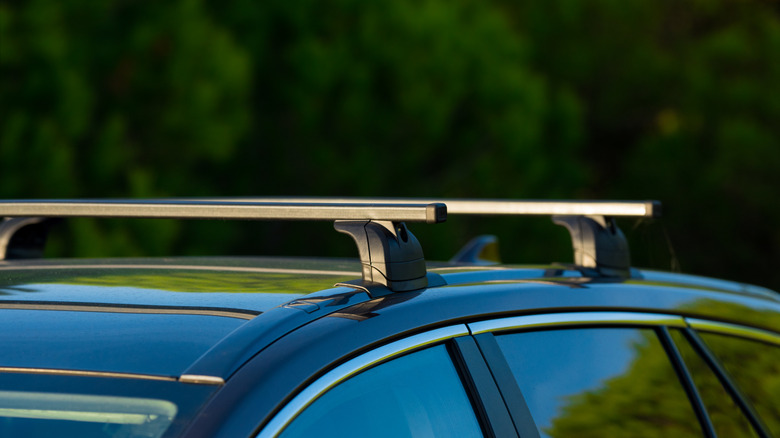
If you've ever needed to haul something particularly large, chances are you've heard of roof racks. The principle is simple; your car isn't built to transport certain items in its confines, no matter how you fold the seats to create space. That's where roof racks come in — external frames mounted on your roof to do the hauling.
Their use case isn't limited to large items. If you're on a road trip, and you've got passengers as well as ample luggage, you can quite simply use the roof to make things more roomy. However, while the practice of using roof racks isn't expressly illegal, there are laws pertaining to the security of your luggage. 15 American states have legislation on improperly secured loads, and all penalize drivers for any load that drops from the roof. If you're going to use a roof rack, you'd do well to know the law of the state(s) you're driving through, and also follow the stipulated rooftop weight limit recommended by manufacturers for your car.
Decorative steering wheel decals
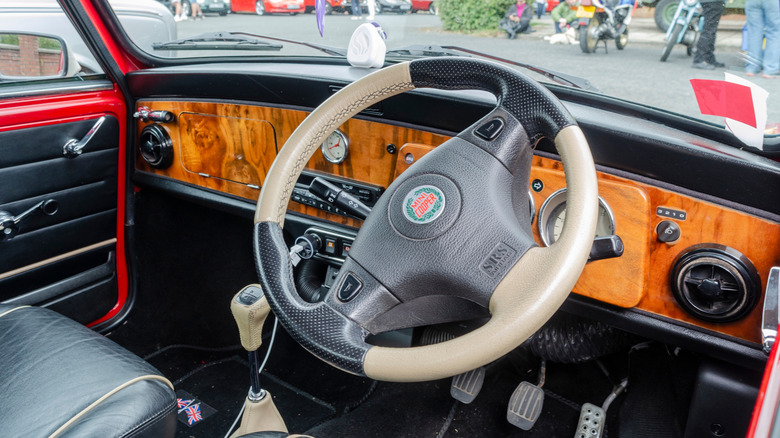
Earlier, we touched on why using steering covers can be a bad idea. You see, the automaker's setup might be a bit too trite and ubiquitous for some drivers, and in an effort to spruce things up with decor, all sorts of ideas manifest. To be perfectly honest, not all these ideas are good ideas, just as every item on this list so far shows.
Steering wheel decals fall into the same category and can be even more injurious to your health. These decals are decorative stickers, which are often lined with shiny jewelry like rhinestones, and are applied to cover the automaker's logo on the steering wheel.
While this isn't expressly illegal, the National Highway Traffic Safety Administration (NHTSA) has strongly advised against using aftermarket steering decals. Here's why: there have been cases of aftermarket emblems adorned with jewelry flying off their fixed positions in a crash. At least one driver has been reported to have lost vision in one eye as a result of this risk.
Underglow lights
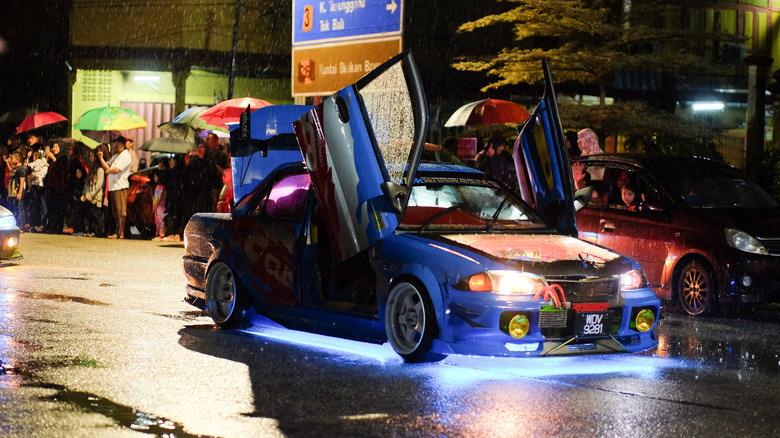
There's an undeniable aura that underglow gives cars. It's unique, it speaks volumes about how much you value your ride, and it adds extra lighting that could be useful on dark roads when driving at night. At least one of the above reasons could inform your decision to install underglow lighting in your car.
Despite the aesthetic benefits, you might want to hold that thought. First, from an electrical angle, an improper installation could drain your battery and land you in an awkward situation. Secondly, from a legal point of view, underglow is outrightly prohibited in nine American states. You're not home and dry in the other 41 either; light color restrictions are aplenty due to concerns over the degree of distractions certain colors cause other drivers.
Almost across the board, underglow is not permitted to be flashing, blue, or red. If you must use underglow, you'll have to be well-versed with current legislation and take extra care not to flash them too brightly for your own safety.
License plate accessories
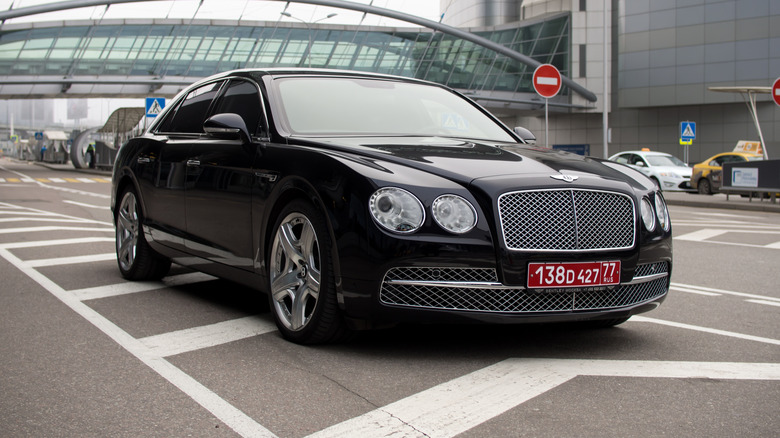
Number plates can be a polarizing topic; some drivers barely spare a thought for them, and others place tangible value on them. License plates in Dubai, for instance, can get as expensive as 55 million dirhams (around $15 million) because there's a value on the number assigned to plates. That's a little tangential to the present discussion, but the point is that drivers can attach enough value to license plates to want to interact with them meaningfully.
This desire typically manifests in decoration — or even covering — to beautify or preserve the metal piece, as the case may be. However, you may be surprised to learn that most license plate accessories are actually illegal; even simple license plate frames can be contentious in the eyes of the law. In fact, Florida introduced a new law in October last year to ban any item obscuring or altering license plates in any form. To stay on the good side of the law, avoid license plate accessories.
Loud exhaust mods
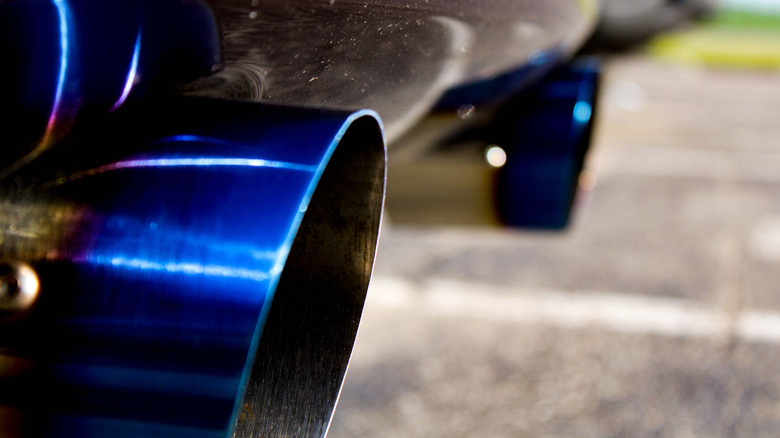
This one's particularly common for the sports car enthusiast — you want to rev your engine and hear it roar like the beast you've tuned it to be. The problem is, stock vehicles fresh from the dealership have something in the way of that sound. All cars come equipped with a muffler that's designed to limit exhaust noises, and if you really want to hear your car growl at the slightest push of the pedal, you're probably thinking of getting a mod to remove it (or at least let more noise pass through).
However, such a move could easily land you in hot water with the law. A quick overview of exhaust laws in the U.S. shows that almost all states prohibit excessive noise, along with mods that increase exhaust volume. In California, for instance, there's a 95 dB limit on exhaust sounds. If you're going to get mods done, you'd need tons of state–specific legislative research — and even then, you could still get written up for being louder than usual. Best to stay on the safe side and leave the exhaust work to the manufacturers.