

Chevy LT1 Vs LT2 Engines: What's The Difference?

The Chevrolet Corvette is America's oldest and most recognizable sports car, and has been powered by some of GM's most famous engines. From the original "Blue Flame" inline-6 to the 350-CI small block, the 427 to the modern LS engines, you're spoiled for choice when it comes to quality engines in these cars. Two engines in this lineup, the LT1 and LT2, are some of the latest and (debatably) greatest among these, powering the C7 and C8 Corvettes, respectively. And, for the sake of clarity, the LT1 is different than the LT-1 with the hyphen in the name, which was a small-block V8 that powered some early '70s muscle cars.
The Corvette arguably broke free of the sports car mould when it transitioned to a mid-engine layout, becoming something of a budget supercar in principle. Nevertheless, it retained the naturally-aspirated V8, meaning the LT1 and LT2 aren't so different, at least on the surface. They might even seem like basic iterative designs, given the single number change between each engine.
However, each model features several key differences apart from just the engine's location in the car. From less restrictive exhaust to revised cam profiles, flywheels to dry-sump lubrication, the LT2 boasts a range of subtle and dramatic changes that make it a superior engine for performance driving, not just a more powerful one. Factors like weight, center of gravity, and dependability all play important roles in the Corvette's role as a quasi-supercar, and the LT2 was designed to accentuate these. What, then, defines the LT2 against the LT1, at the anatomical level? What improvements were made between generations? Let's dive in and explore these two engines in depth.
The LT2 is an iteration of the LT1's design
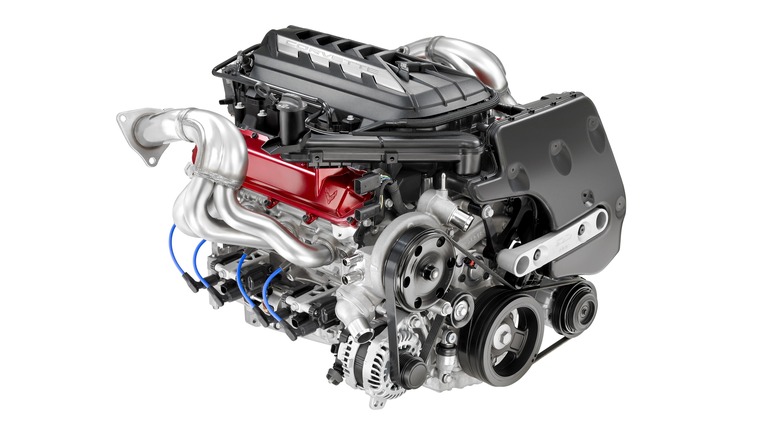
At their core, these are fundamentally the same engine, as they're both pushrod small block V8s — a trend that dates back to 1955 and 265-CI V8, the first V8 ever fitted to the Corvette. Of course, today's small block is far removed from that original design, having gone through countless iterations across dozens of individual configurations and six major generations. GM's small-block V8 had already changed significantly by the LT1's generation, representing a powerful, refined take on the base principles. The LT2 simply took what made the LT1 potent and made it better, all while adding some features of its own.
Both of the engines have the same displacement, bore, and stroke, but changes to the LT2 help shed excess weight and improve power. The most obvious and intuitive change is the exhaust; the mid-mounted engine position makes for a shorter distance between the engine and the car's rear end. The exhaust geometry has also been redesigned for better flow. Moreover, the intake system was revised as well, with the LT2 sporting a new plenum and new runners for improved performance as well, rounding out the package.
Other small but significant changes quickly add up, too; take the smaller, lightweight flywheel, for example, which improves performance by lowering the rotational mass (and thus parasitic power demand) compared to a heavier unit. The most substantial change, however, is the addition of a dry-sump oil system. Rather than an oil pan on the bottom of the block, the LT2 moves the oil to the left side, saving precious weight and allowing the engine to sit lower to the ground. The good news is that despite these changes, modern Corvettes are still quite reliable vehicles.
How the LT2's changes affect overall performance
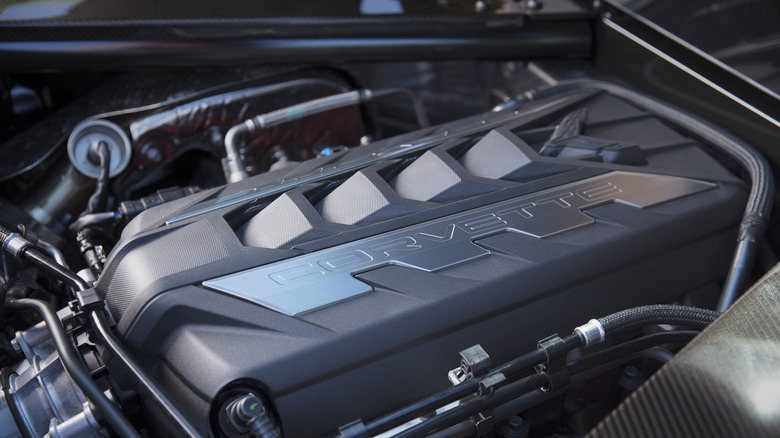
First and foremost, let's take a look at the hard facts: the LT2 boasts 495 hp and 470 lb-ft of torque compared to the LT1's 455 and 460. That's already a jump of about 8% in power figures from all the upgrades, coupled with the more refined chassis of the C8. And it's that chassis that the engine's truly designed to exploit; the exhaust system is built with the rear-mid engine configuration in mind, while the weight-saving changes and lowered center of gravity substantially affect the handling.
The fundamental reason why you want a car to be as light and as low to the ground as possible is to minimize body roll. The LT2, therefore, is designed chiefly as a track-focused powerplant, featuring a lightweight, rev-happy design to accentuate the mid-engine layout. Without the LT2's design architecture, the car would simply underperform, extra power or not.
It's not all good news, of course; drastic changes often come with their own teething issues, and the C8 represents a significant departure from the C7 in a number of ways, engine included. But if you're after raw performance figures and on-track performance, it's hard to beat the C8 with any other base-model 'Vette, and that's largely due to that LT2 engine. No wonder it's often considered the best budget supercar.