

The Kawasaki Ninja 500 Offers Something Most 'Beginner' Bikes Don't
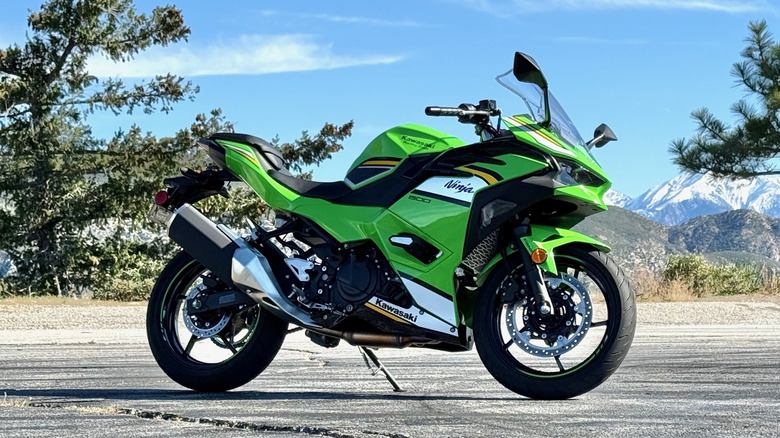
It isn't their least expensive motorcycle, but it's the least-expensive model that uses the Ninja name. But even beyond a low cost of entry, the Kawasaki Ninja 500 has broad appeal. For riders who have just passed their licensing test, it's an approachable and affordable bike that can be a companion for more than just the start of their journey. For more experienced riders, the Ninja 500 offers nimble, adequately powered transportation with enough modern features to feel like much more than just a beginner bike.
Kawasaki's Ninja bikes are broken up into three categories: Sport, Supersport, and Hypersport. The Ninja 500 is the entry-level model for the least performance-oriented subsection of Ninja bikes, the Sport category. Naturally, at that level, it's not a track-munching speed machine, but it's not held back by underwhelming power levels either. It has just enough in the form of features to feel well equipped, without pricing itself out of competition for your hard-earned beginner-bike dollars.
Healthy enough for climbing mountains
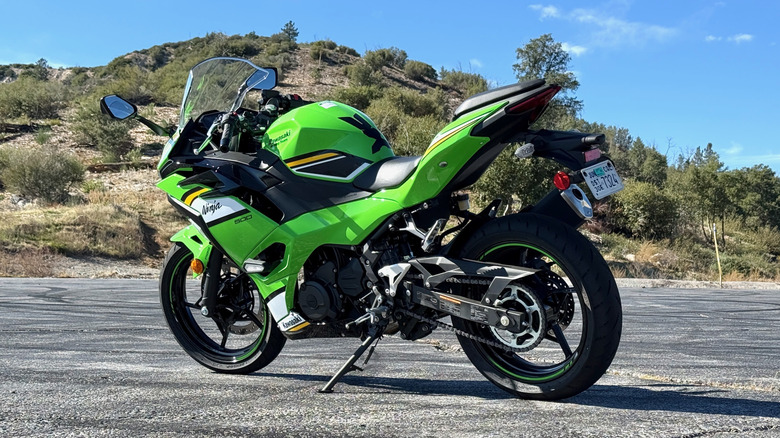
The Ninja 500 is powered by a 451cc parallel-twin engine that puts out 51 horsepower and 31.7 lb-ft of torque. The 451cc engine is a great source of power for riders who want to increase their skills without the cost associated with screaming four-cylinder engines. It provides smooth power and torque low in the rev range and it climbs through the RPMs at a decent speed, but no matter how quickly you twist the throttle, the Ninja 500 won't jerk you back suddenly — at least not without some seriously abusive treatment of the clutch.
 Travis Langness/SlashGear
The Ninja 500 is the sort of bike you could learn on without getting scared away on your first ride. On the other hand, getting it up to triple digits is not very difficult either, provided you've got a good amount of runway (which only happened theoretically, on a closed course, of course). Idling and at low speeds, there's a bit of the stereotypical parallel-twin thumping soundtrack, but the engine and exhaust have satisfying notes as speeds climb. The six-speed manual transmission comes with an assist and slipper clutch, and while there's no quick shifter, there's easily-motivated gear movement from the clutch lever.
Comfort that goes the distance
Commuting anywhere nearby is an easy task on the Ninja 500. Just swing a leg over, take a quick ride to the local shops, grab lunch, and head home. Long distance trips needn't be intimidating, either. The suspension is on the firm side, but still comfortable enough for 100-mile rides without much in the way of seat discomfort. Only the rear suspension has adjustable preload, but there's 4.7 inches of suspension travel up front and 5.1 inches in the rear, both of which are enough to soak up most bumps and road imperfections.
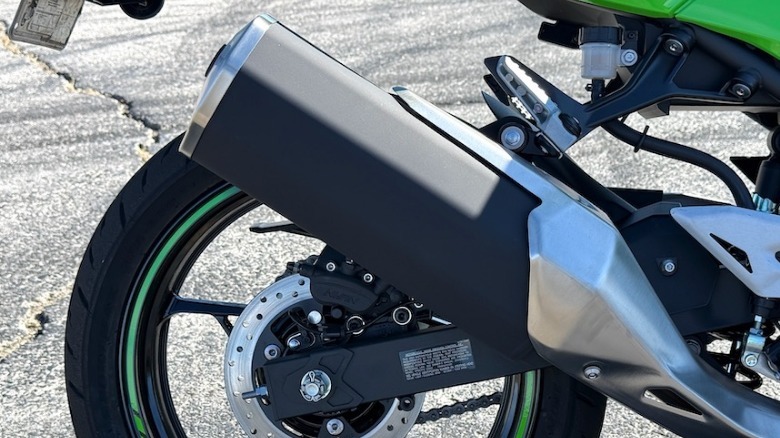
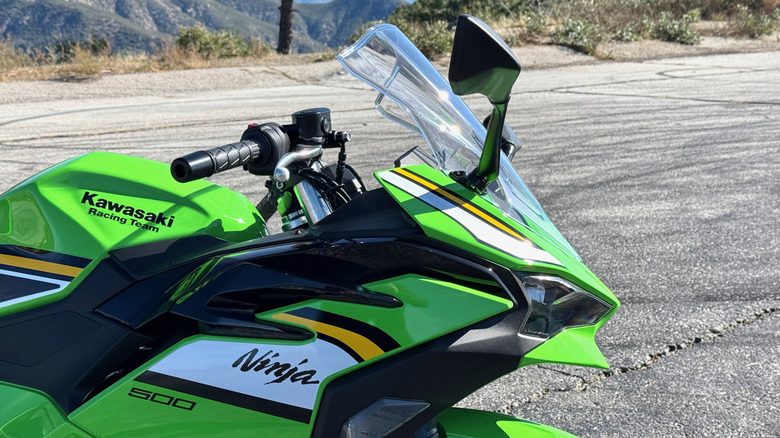
The Ninja 500's large (and optional) windscreen does quite a bit to add to the overall comfort too. It provides a nice barrier from wind for most of my chest and with the slightest bit of ducking, I can get the wind to come over the top of my helmet instead of flowing into it. The riding position is a bit more upright than what you'd get on one of Kawasaki's ZX bikes (like the blistering ZX-6R), but that means less weight on the wrists over time. The only gripe I had with the riding position was the large heat shield protecting the exhaust – it got in the way of my right foot a few times and made me push my foot position a bit further forward than I would've liked.
Light and easy to move around
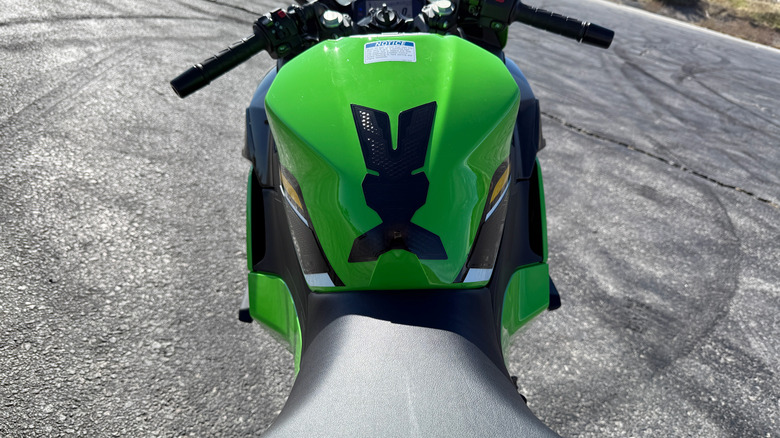
According to Kawasaki, the Ninja 500 weighs in at around 380 lbs with all its fluids. That's plenty light enough for the amount of power the 500 has, and it's relatively narrow too at just 28.7 inches wide. Even without folding the mirrors in, it's easy to navigate in tight spaces. In California, filtering between lanes is a big advantage for riders, but not all bikes can go between cars as easily.
Large cruisers, especially those with side cases or big front fairings, are tough to squeeze through traffic with. The Ninja 500 doesn't have any such issues; it felt right at home moving forward between lanes. With a seat height that is just 30.9 inches and a narrow seat, that means even shorter riders should have no trouble putting both feet flat at a stop. The tank also feels especially narrow, meaning you don't have to splay your legs out as you ride, adding to the comfort of the bike.
The sporty part of the Sport segment
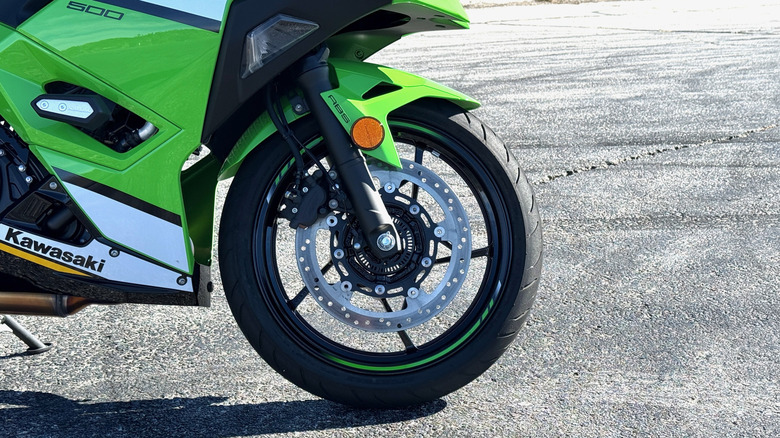
Put a bit of pressure on either side of the handlebars at higher speeds, look through the corner, and the Ninja naturally tracks its way towards the corner exit. The low overall weight means it's easy to guide through corners, and it's quick to change direction when you stitch together a few back-to-back lefts and rights. In that sense, the Ninja 500 is a great momentum bike: there's no need to hammer the brake before most corners, nor rip open the throttle to approach the next corner in a hurry. Just carry some speed and enjoy the flow.
 Travis Langness/SlashGear
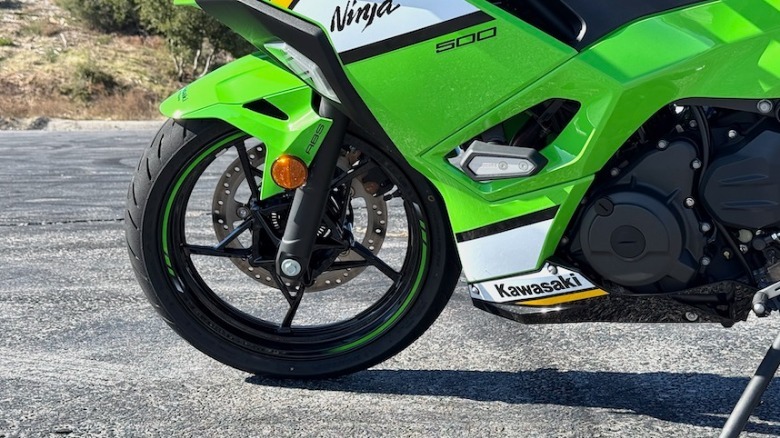
If you do want to ride at a bit more hustled pace, the brakes have no problem providing impressive stopping power. The front brake setup on most entry-level or sub-high-performance bikes like the Ninja 500 often relies on a single brake caliper, and that's the case here. It obviously saves manufacturers on the cost of equipping a second caliper and rotor up front, but it often comes at the cost of braking performance and front brake feel.
The Ninja 500 felt light enough, that this wasn't really an issue. The front brake was also responsive enough that I never felt the need to fully clamp down at speed for anything short of an emergency stop. Just a light touch of the brake lever and the 500 slowed down at a rapid rate, quick enough to instill confidence for a bit of enthusiastic riding.
Tech and practicality are both selling points
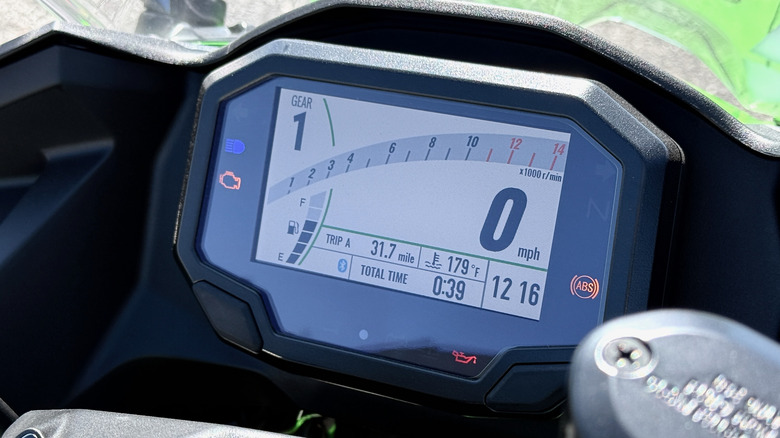
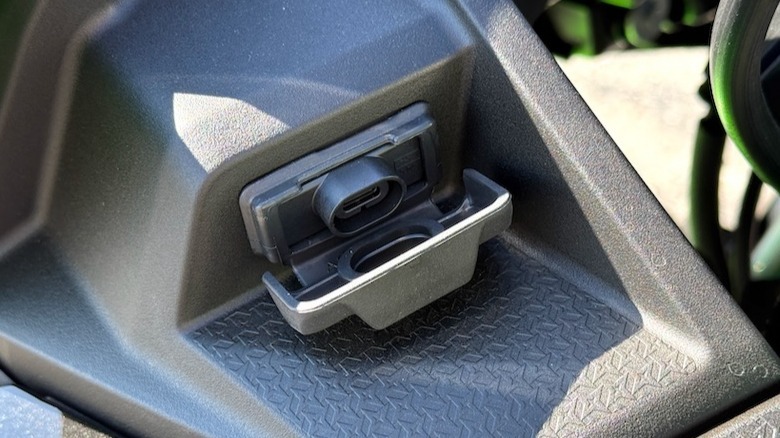
Shedding the perception of offering only entry-level equipment, the Ninja 500 on its top trims (more on that in a bit) has a lot of tech for its class. The TFT rider display is the first excellent tech feature worth noting: It's large enough, with big fonts and strong contrast between the various colors and shades on the display. Next, there's the fairing-mounted USB-C port for charging your devices (even some bikes at double the price hide their USB port under the seat).
 Travis Langness/SlashGear
Then, there's the keyless ignition, which makes it an easy task to hop on and get going without fumbling for your key with gloves on. The Ninja 500 lacks selectable rider modes or high-tech computer-controlled suspension, so there's no need to futz with handlebar-mounted controls — just the important stuff like throttle, brake, and clutch. A simple setup like this is better for distraction-free riding anyway. Underseat storage is pretty minimal, so you'll need extra baggage. I could roll up my jacket's wind-breaker layer and stuff it under the rear seat, but only barely. Attaching a soft rear-seat bag was the option I went with for most rides.
Pricing is impressive for what you get
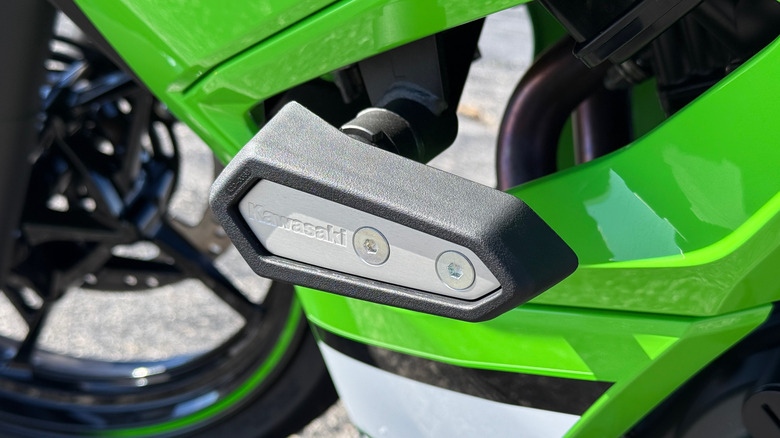
There are a couple of different trim levels to sort through if you decide that the Ninja 500 is right for you. Depending on whether or not you want ABS (anti-lock brakes), the standard 2025 Ninja 500 has an MSRP between $5,949 and $6,549 (including a $650 destination fee). The bike I rode was the top-trim SE KRT Edition with ABS. The SE KRT has a starting price of $7,049, which includes extra equipment on top of what the base bike offers, like a TFT display, an extra-large windshield, proximity key, frame sliders, LED turn signals, a tank pad, and USB-C outlet. The "KRT" part of that equation is Kawasaki Racing Team graphics on the fairings.
Having factory-installed frame sliders is a big win: there's no need to go drilling your fairings to install your own and if you have a slow-speed tip-over in a parking lot, you're likely to save fairings from some expensive damage. More than just affordable upfront and packed with features, the Ninja 500 is also pretty cheap to run. With a few enthusiastic mountain rides during my test, I still averaged around 60 mpg. A fuel capacity of 3.7 gallons means the Ninja 500 could easily go over 200 miles between fill-ups.
A quick clarification: The bike I rode for this test was the outgoing 2025 model, and prices have gone up for 2026 models by $100. Equipment stays mostly the same, though the color schemes have changed a bit.
Broad appeal means lots of rivals
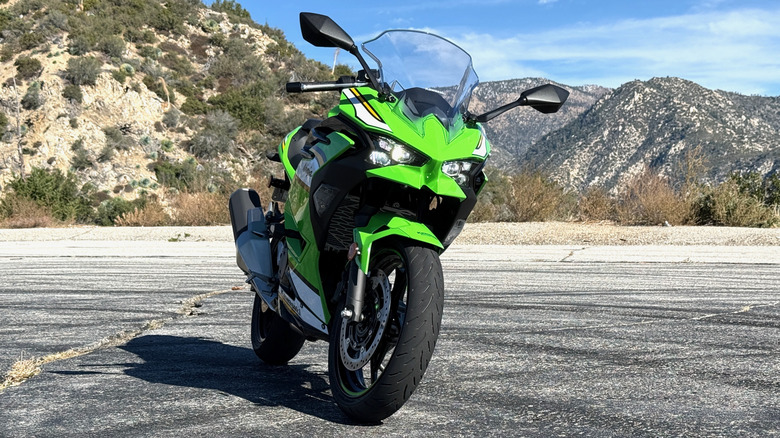
The strongest rival for the Ninja 500 is likely Honda's CBR500R. The Honda is powered by a 471cc parallel-twin engine which puts out 47 hp and 31 lb-ft. The CBR500R has an MSRP of $7,999 (including $600 destination fee for 2025 models) and it's a near-perfect match for the Kawasaki when it comes to features. The Honda is admittedly a bit heavier with a claimed curb weight of 421 lbs, but it has a 4.5-gallon fuel tank that could get you a bit further between fill-ups.
Finding other rivals for the Ninja 500 is a bit like shooting at a moving target. Several manufacturers make smaller 300cc bikes that serve as a strong beginner choice, but they often don't have the same amount of equipment or grunt. Yamaha's beginner sportbike is the R3, and with an MSRP of $6,149, it undercuts some of the trim levels of the Ninja 500, but the Yamaha has a significantly smaller 321cc engine. Suzuki still offers the GSX250R with an MSRP of $5,749, but it's not nearly as powerful or modern as the Ninja.
2025 Kawasaki Ninja 500 verdict
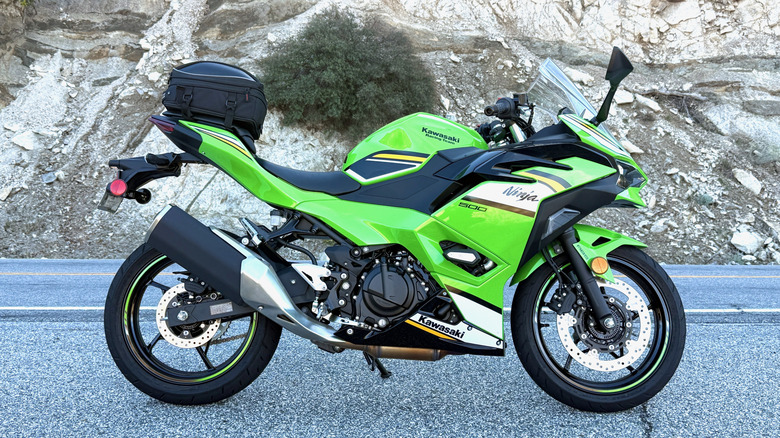
The beginner motorcycle market has shifted over the last few decades, if only by about 50cc's or so. I remember a time when every Motorcycle Safety Foundation course was taught on the backs of Honda Rebel 250s and Kawasaki Ninja 250s. But Kawasaki has skipped that class entirely, going straight for the 500cc motorcycle that will help new riders learn and give them enough power and capability to grow their skill set along the way. Normally, I'd bemoan changes like this, lean on nostalgia, and caution riders who want too much power too fast. With the Kawasaki Ninja 500, though, I don't think that's necessary.
Lots of new riders find themselves wanting more power after just a few months on a small motorcycle, but with the Ninja 500, it's easy to delay that thirst for a more powerful, more expensive bike. It won't be a bike you're ashamed to ride either. It looks like a proper Ninja sport bike. Even amongst riders with bigger, faster, more-expensive bikes, the Ninja 500 gets positive responses. Strangers approached me to ask about the looks, the powertrain, and the cost of the bike. It's attractive even amongst the toughest critics, and it's a bike I'd be proud to ride on a daily basis.