

How Does Android's New AirDrop-Style Feature Actually Work?
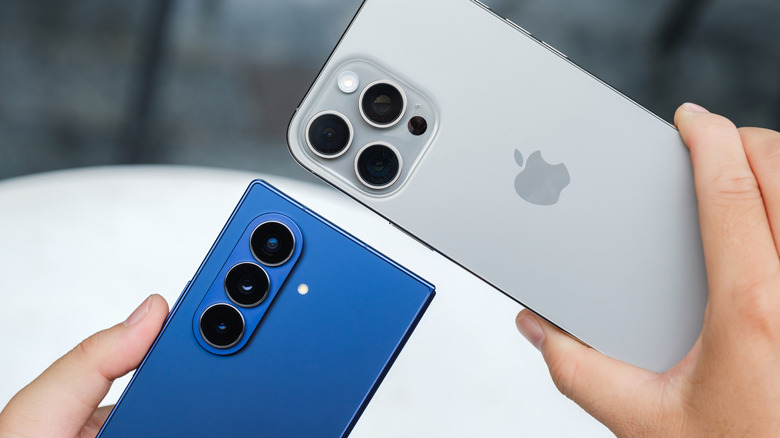
In late November 2025, Google announced it had made AirDrop compatible with Android, allowing iPhone and Mac users to share files wirelessly with Android phones. Apple was not involved in the development of this feature, which first rolled out on the Pixel 10 series of smartphones. In its announcement, Google claimed that it plans to expand the functionality to more devices.
The reactions were layered. First came the surprise — Apple is incredibly protective of its so-called walled garden ecosystem, since someone who buys an iPhone might end up buying a MacBook down the line to take advantage of AirDrop. In that context, adding AirDrop compatibility to Android is an extremely bold move. Even Google's accompanying security blog post opened with a not-so-subtle jab in Cupertino's direction, declaring, "Technology should bring people closer together, not create walls." But people were also thrilled. Both iOS and Android users know how annoying it is to share files with a friend who doesn't share your digital ecosystem, so it's a win-win for users.
But after processing the news, people wanted to know how Google had managed to crack the AirDrop protocol. Since its engineers had gone behind Apple's back, how could they be sure Android was implementing AirDrop safely? And are there any limitations, or are Android users really getting full-fat AirDrop? The simple answer is that new European antitrust regulations allowed Google to bypass AirDrop's device restrictions, which exclude non-Apple devices from the modified version of Wi-Fi that Apple uses.
European regulators opened the doors to AirDrop interoperability

It has always been in Apple's interest to obfuscate the fundamental technology behind AirDrop, which is simply a modified version of Wi-Fi Direct called AWDL (Apple Wireless Direct Link). In simple terms, it creates a temporary Wi-Fi network that connects both devices, then sends files over that connection. In other words, Apple created AirDrop by taking a universal standard and modifying it to only work on iOS and macOS. The next evolution of Wi-Fi actually came from that work, leading to the more modern Wi-Fi Aware.
European regulators were not a fan of Apple's approach, naming the firm among several digital "gatekeepers" listed in the Digital Markets Act. In March 2025, the European Commission denied an appeal from Apple, forcing the company in part to "allow third-party connected physical devices to establish and use [a peer-to-peer Wi-Fi] connection with an iPhone," per the ruling. This didn't mean Apple was forced to make AirDrop open-source, but it did mean the company had to allow non-Apple products to either work with AirDrop or alongside it.
Google, for its part, had adopted Wi-Fi Aware for file sharing beginning with Android 8.0 Oreo. Today, wireless file sharing on Android works through the unified Quick Share app, long hailed as one of Android's best features. Since Apple planted the seeds for that technology with AWDL, Google likely had a much easier time reverse-engineering it. And thanks to EU regulations, Apple may not be able to react too harshly without risking further penalties from European bureaucrats, who have not taken kindly to Apple's perceived foot-dragging with regard to compliance. That said, until AirDrop compatibility rolls out to phones other than the Pixel 10, third-party Android alternatives to AirDrop are worth checking out.
How Google implemented AirDrop
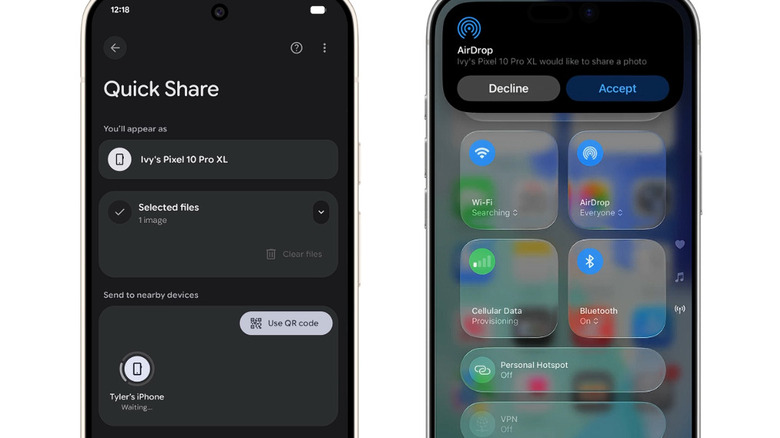
With the regulatory groundwork laid, the technical work Google did to reverse-engineer Apple's protocols for AirDrop and apply them to Android's Quick Share tool may well have been the easier endeavor. However, it was still a sensitive task, since opening up a Wi-Fi connection between two devices has the potential to create security vulnerabilities that could leave users open to exploits.
In order to avoid security pitfalls, Google's engineers used the Rust coding language, which has built-in security features such as memory and thread safety at compile time and several ownership rules. To heavily oversimplify, it checks for mistakes and vulnerabilities as a programmer works. The goal, according to Google, was to avoid "buffer overflows and other memory corruption bugs" that might allow a threat actor to execute malicious code. Google also claims it ensured Android and iOS security features would overlap one another to protect against malicious files and hacking. Penetration testing was then performed by an independent cybersecurity firm, NetSPI, after Google had concluded its internal testing.
The one thing Google couldn't get around, however, was AirDrop's sharing filters. In order for an Android phone to share with an iPhone, the iOS user must change their AirDrop settings to allow receiving files from anyone. Of course, this means the iPhone could receive files from anyone nearby. Even though AirDrop switches back to a more private setting after 10 minutes, iOS users may wish to avoid using AirDrop with an Android device in a crowded area. Google says it "welcome[s] the opportunity to work with Apple to enable 'Contacts Only' mode in the future," although it remains to be seen whether Apple will play ball.