

OnePlus 15R Review: Good Enough Is No Longer An Option
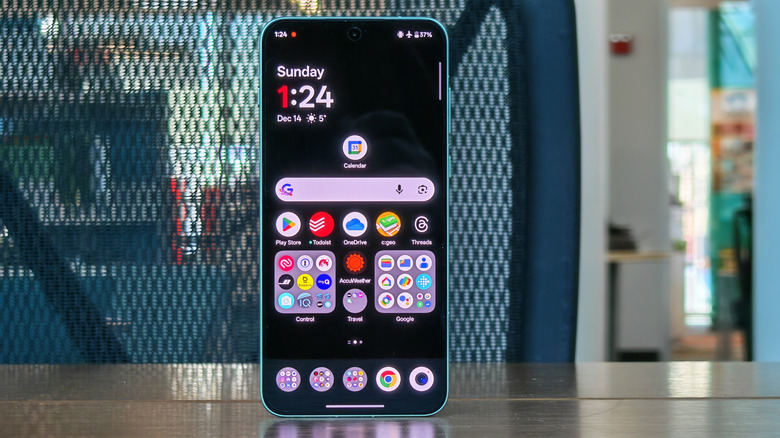
When you're looking for a brand-new flagship, and you're on a budget, the R-series of OnePlus phones is usually a good place to start. The series typically takes the flagship phone and swaps in some less expensive components in order to bring a better value to the customer. OnePlus did the same thing here.
The problem is that the corners the company cut are really important corners. Plus, OnePlus kicked up the starting price for this phone by a lot (compared to the equivalent device last year), so that also rankles. Put those two factors together and it makes you wonder what OnePlus is thinking.
On paper this is a pretty good phone. It has a beautiful display, a huge battery, fast charging, and a good amount of storage. But if you're a shutter bug, this is a phone that will drive you nutty. There is a lot to like about this phone, but there are a couple of really big points to dislike. I've been using a OnePlus 15R review sample provided by OnePlus for about two weeks, and this is my full review.
Mellow Yellow
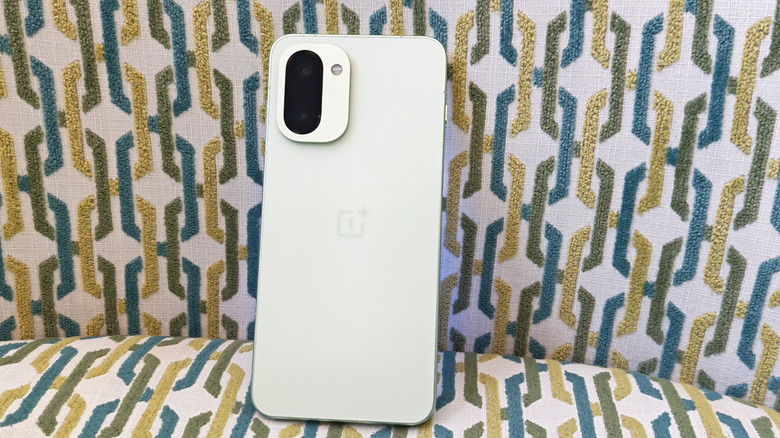
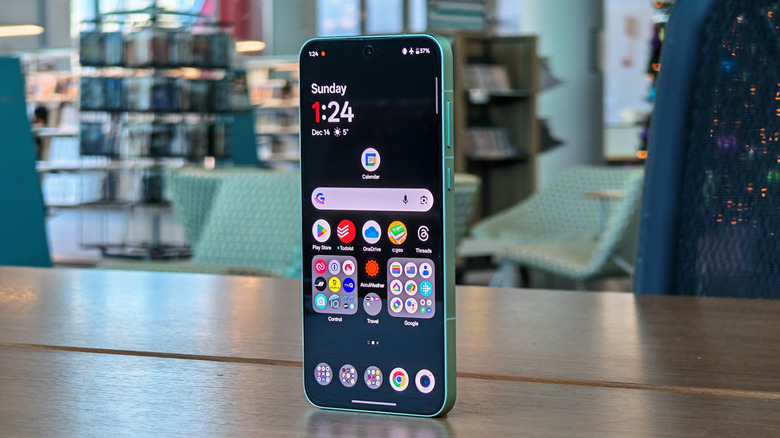
My review sample is what OnePlus describes as "Mint Breeze" and to my eye is has a yellowish/greenish tint to it. I'm not madly in love with it, but as Gen Z likes to say, "We're talking." The other available option is Charcoal Black, so if you gave me a choice between them, I'd go with this one. The internal hardware on this phone is impressive including a Qualcomm Snapdragon 8 Gen 5, which is a small step down from the Snapdragon 8 Elite Gen 5 the company launched at Snapdragon Summit this past fall. There's also 12 GB of RAM and 256 GB or 512 GB of storage.
The display is a 6.83-inch LTPS AMOLED panel that can refresh at up to 165 Hz, but only in supported games. Otherwise, it's capped at 120 Hz. The display is gorgeous and a joy to watch videos on. The phone is 8.3mm thick and weighs around 215 grams. Simply put, it's a very nice package that makes it seem like this phone is a flagship in its own right.
The newest addition to the hardware is in the Plus Key. Just like on the iPhone 17 Pro, the Plus key is a button that can perform an action. Also, just like the iPhone 17 Pro, the button has basically the same interface for selecting that function. It's comical how OnePlus aped the same UI for this feature while absolutely ignoring the rest of the phone's software, also, just like Apple.
Software is pure OnePlus
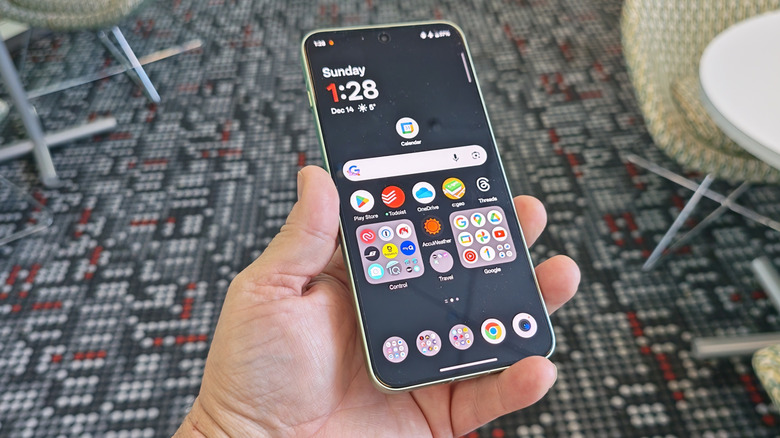
Speaking of the software, OnePlus is back with its same close-to-stock Android interface. If you read our review of the OnePlus 15, this is largely the same experience. The app launcher is clean and creating folders is pretty easy. I was disappointed that the phone didn't copy over my folders from the OnePlus 15, but Android doesn't always get that right.
OnePlus was the company that pioneered Open Canvas, the 90/10 multitasking interface that Google built into Android 16. That's great, but the fact that most Android phones can do it now makes the UI less special. That being said, it's a win for the entire Android community, so we'll take it.
One fun feature that you don't normally see in U.S. phones is an IR blaster that you can use as a remote control. More manufacturers should do this, period. It's handy if you find yourself in bed and you can't find the remote, or you remember it's on your partner's nightstand and they're fast asleep. I know this will never happen, but it would surely be nice.
Battery and Performance
The OnePlus 15R comes with the largest battery you can find in a phone in the U.S. At 7,400 mAh it's pretty massive, but what's funny is that it's beaten out by its older sibling, the OnePlus 15 (with a battery that's 100 mAh smaller) in both battery tests that I ran. In a 4K playback test, the OnePlus 15R lasted 28.5 hours while the OnePlus 15 clocked almost 31 hours. In the PC Mark Rundown test, the 15 lasts almost two hours longer than the 15R.
While there is probably a combination of factors that play into it, it's likely the Snapdragon 8 Elite Gen 5 that's in the OnePlus 15 is more efficient, allowing the phone to stretch out that much longer. It's still funny. All the same, the OnePlus 15R, like its sibling is an easy two-day phone. The only time I came close to killing it in a single day was on a plane trip to New York, running the hotspot the entire way, followed by back-to-back meetings and city navigation.
The OnePlus 15 is only capable of 55W wired charging, as opposed to the 80W of the OnePlus 15. There is no wireless charging, but like on the OnePlus 13R, the official case for the phone has a MagSafe ring inside it so you can still use accessories like a wallet or a mount. Seriously, OnePlus, just put in the coil.
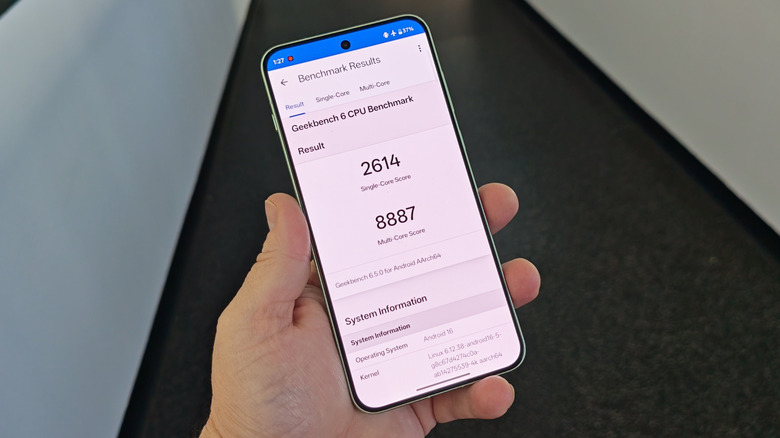
As for raw speed, the phone clocks 2,614/8,887 single/multi-core scores on Geekbench. Using the phone is just as fluid as you would expect from a OnePlus (or really any other) phone.
Midrange cameras

The one area where this phone is really disappointing is in the cameras. It's particularly so considering how good the cameras on the OnePlus 15 are. The 15R has a 50-megapixel main camera and an 8-megapixel ultrawide camera. Overall, you can capture some good photos with this phone, especially when the lighting is friendly.
The ultrawide cameras skew toward the warmer end of the spectrum, while the main camera is cooler, but also more realistic compared to what scenes actually looked like. It has been a while since I've seen a set of cameras with different color tuning, but here we are. Below the ultrawide camera is on the left and the main camera is on the right.
 Adam Doud/SlashGear
Photos with the ultrawide camera are really only just ok, and only hold up on a phone-sized screen. Throw them up onto a 32-inch monitor and things get a little rough. The main camera is better here, capturing more light and detail, which is great. Meanwhile macro photos can be a little hit or miss with the focus missing one subject, but absolutely nailing another. The image below this paragraph is one of my favorite macro photos I've taken in a long time (it looks even better when it's not quality-smashed slightly for display on the internet).
 Adam Doud/SlashGear
Video capture is not great, with stabilization being all over the place — even in good lighting. Nighttime videography isn't a lot worse, but that's only because daytime videography sets a pretty low bar.
Night photos can turn out well

Speaking of nighttime, even the main camera struggles here. Moving subjects are blurry and out of focus, which actually makes them almost accidentally artistic. The main camera will be your best friend here. It's capable of capturing some decent shots, but only if they stay small and compressed. There is some amount of grain in the black at night, and a bit of banding around light sources, but it's not terrible.
 Adam Doud/SlashGear
It's almost comical how much better the main camera is at night. That's not to say it's amazing — it's still pretty hit or miss, but your luck will be a lot better than it will be with the ultrawide. It's just so all over the place, but if you are shooting a perfectly still landscape, then you might be able to pull something off, but the odds will be against you.
I think it's fair to say that, overall, the cameras are not particularly good, which is a shame, because the rest of the phone is very not bad.
Pricing, availability, and final verdict
OnePlus, being the company it is, has some interesting pricing coming out of the gate. This phone checks in at $699.99 which puts it $100 short of iPhone 17 territory. The 512 GB variant will check in at $799.99. You can buy it on OnePlus's website with preordered opening today. You can also pick up the phone from Amazon and Best Buy early next year. If you order the 512 GB variant from OnePlus.com, you can get a set of OnePlus Buds 4 and a phone case for free.
Overall, this is a phone that exists in a weird space. Most of its specifications are quite good, but the cameras are quite...not. Considering how important cameras are to people, that's not a great place to cut corners, but OnePlus did. That's a shame, because aside from the cameras, this is a really good phone. It would be easier to recommend at $599 or $649, but at $699 it's not a bad call, but it feels like there are other options, like the Pixel 9a, or even the Pixel 10, which also starts at $100 more. I'm just not sure saving that $100 is worth the tradeoffs.