

Top 5 Largest Construction Machines On Earth
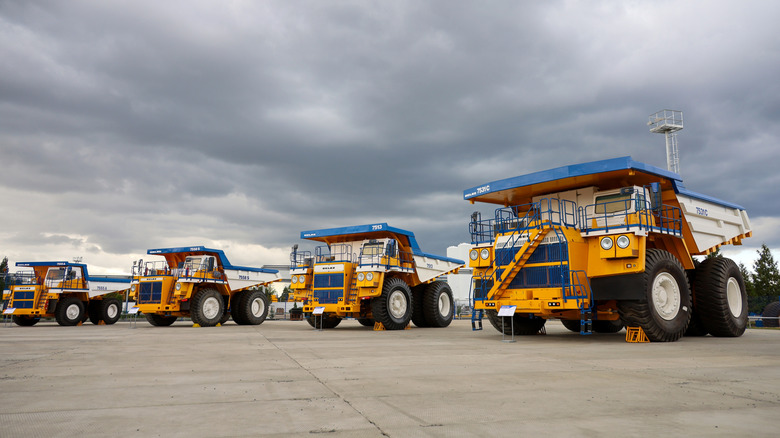
The sheer size of some of the world's tallest buildings is just extraordinary. The current tallest, Guinness World Records reports, is the Burj Khalifa in Dubai, which stands at 2,716 feet, 6 inches high. It's an astonishing feat of human engineering, as are some of the machines we've developed to aid in the construction of some of these behemoths.
The biggest cranes, dump trucks, excavators and bridge-builders aren't going to be appropriate for every size and shape of these jobs, of course, but they have potential on an enormous scale too. Sometimes, some of the world's biggest cars are slightly overkill, but these machines aren't just about spectacle. They make the biggest jobs possible.
We've already run down some of the planet's largest excavators, and now it's time for some other giants of the construction industry. From vast, towering cranes to wide and immensely powerful excavators, there are some gigantic vehicles to help workers with construction projects. They vary an awful lot in size, height, weight, and capacity depending on the type of vehicle and its role, so it's not as easy as ranking the five overall biggest.
Instead, these are some of the biggest and most formidable vehicles in their respective categories. We'll also explore their backgrounds and some further details on the work these giants were built for. Some continue to be in operation today, some found an alternative purpose, and others have long since been retired, taken apart or placed in storage. Regardless of their ultimate fates, though, they're all formidable.
BelAZ 75710 dump truck
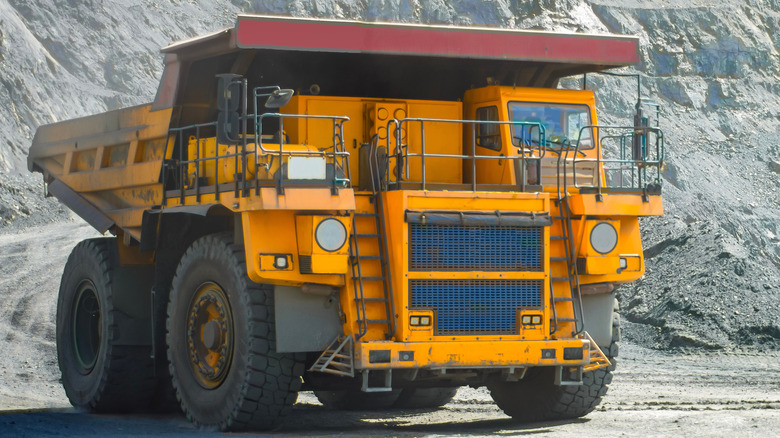
Some vehicles have critical roles in construction more broadly, but may not be directly involved in raising buildings themselves. The mighty dump truck, for instance. These powerful vehicles have a lot of utility across the construction industry. Beginning with the foundations, a dump truck can have an important role in managing the excavation, and carrying unearthed materials to where they need to be. There are limited options to replace them in such a role, because of the scale of material that a dump truck is capable of transporting at once. The BelAZ 75710 demonstrates this very effectively.
This powerhouse was built by Belarus's Belaz. It was first deployed in October 2014, and quickly found a role perfect for its talents: Carrying up to 450 tons of rock around a coal mine in Siberia. Everything about the truck was supersized in order to allow it to perform such feats, not least of which its monstrous tires. It has eight of them, which combine to allow the 75710 to support a total of 816 tons. Capable of traveling at up to 40 mph and with almost 14,000 lb-ft of torque, it's a huge vehicle indeed. It also has a diesel-hybrid powertrain.
Its enormous size and capacity is a great boon in its line of work. MTU's Key Account Manager for mining vehicles, Rainer Pelcz, explains why: "Spoil, i.e. rock that contains no raw material, has to be carried away. If fewer vehicles can do that work, the mine saves on staff and fuel." There are other dump trucks on a similarly titanic scale, such as the 400 ton-hauling, 4000 horsepower Caterpillar 797F, but it can't top the sheer size of this Belarus-built behemoth. It makes even the biggest Ford trucks look small and sensible.
Kalmar LMV's forklift truck
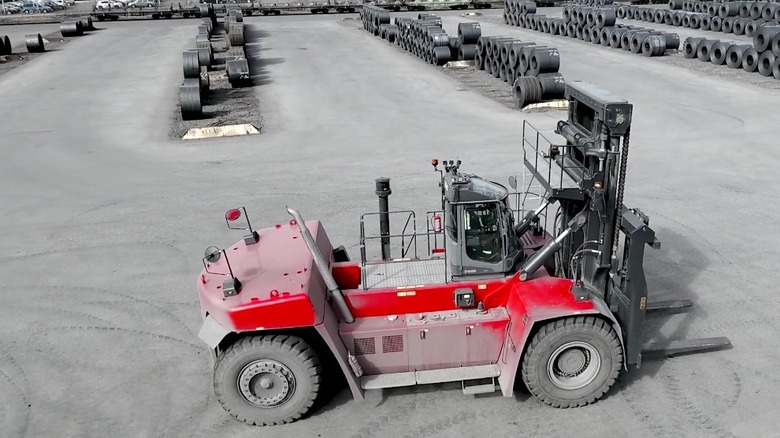
Depending on the job at hand, the Kalmar LMV forklift is also going to prove essential in its own way and a titan in its respective class. A forklift truck is a mainstay of construction sites around the world, uniquely equipped to raise, carry, and deposit materials according to the needs of the site. There are a wide range of accessories that can be used as appropriate, such as brick baskets. Just as with dump trucks, the size of a given forklift is increased as the scope of its intended purpose is. The biggest forklift of all, according to Guinness World Records, was manufactured by Sweden's Kalmar LMV in 1991.
This forklift is 54 feet, 5.5 inches long, weighs slightly over a quarter of a million pounds, and is capable of stretching up to 12 feet 5.6 inches when burdened with as much as 198,000 pounds' worth of cargo. LMV has been making forklift trucks for decades, beginning with a model designed to work in a Småland mill in 1949. It entered forklift production three years later, and in 1974, was purchased by Kalmar Verkstad AB.
The company became known as Kalmar LMV, and though it has been through name changes and product catalog updates since (terminal tractors and reachstackers are also among its innovations), continued to develop huge models such as the Kalmar Super Heavy DCG620 pictured here. In the 1980s, the Kalmar LMV 80-200 was the biggest forklift on the planet, but Kalmar itself reports that the Super Heavy Forklift Truck DCG600-850 is now one of the major contenders for that title, a beast powered by a Volvo D11 engine.
Kroll's K-10000 tower crane
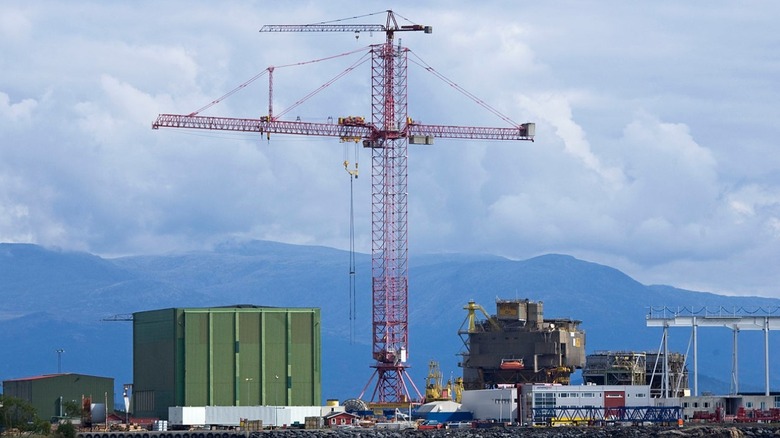
Typically, we call on cranes when it's time to hoist heavy construction materials like steel girders into the air. Depending on the scale of the job, cranes become increasingly larger themselves, and few more so than the K-10000, developed by Danish company Kroll. Guinness World Records declares it to be the largest tower crane on Earth, 393 feet tall and, according to the outlet, "capable of lifting 120 tonnes (264,500 lb) at 82 m (269 ft) radius (i.e. the distance from the central supporting column)."
Kroll boasts that its heavy-lifting powerhouse reduces the need for multiple smaller-scale cranes in a single work site. This can be important from a safety perspective, because multiple operative cranes increases the risk of potential accidents. The K-10000 has a huge range of operation along with its strength, which quite literally enables it to do the job of more than one smaller crane. Its versatility doesn't end there, either, as it is also available in a variant that has a base on rails, useful for those work areas large enough to practically accommodate that, as well as its immobile counterpart. Some marvelous engineering goes into the counterweights that help 400+ ton cranes work without tipping over.
The K-10000 has a history of performing very large-profile jobs to reflect its own size. The very first of these cranes was bought by General Public Utilities in New Jersey in 1978, intended to aid the construction of the ultimately-canceled Forked River nuclear plant. Several of those in service operate in huge shipyards. In fact, in February 2025, Favelle Favco reported on social media that a base-mounted K-10000 had been delivered to South Korea's Samsung Heavy Industries Shipyard, where it will presumably have a long and hard-working life ahead of it.
The Herrenknecht Mixshield S-880 tunnel-boring machine
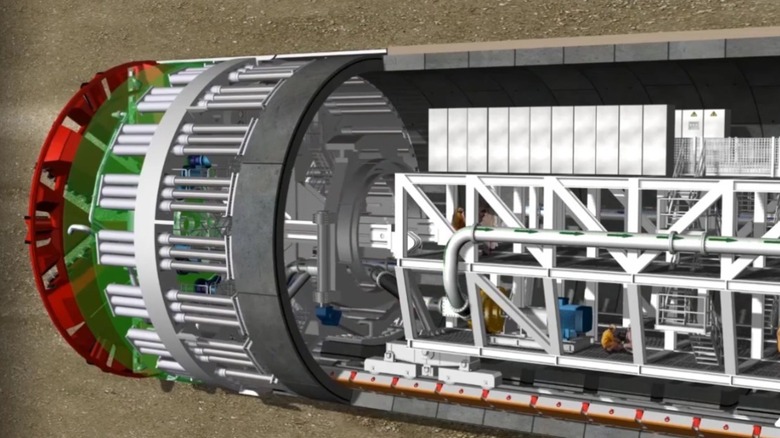
Without machines, it would be all but impossible to build bigger tunnels, but fortunately, there's another engineering titan for that. Tunnel-boring machines are, effectively, like giant mechanical moles, scoring their way through the earth often using rotating heads that slice their way through rock and any other underground challenges they meet. Of course, the bigger the machine used, the more quickly and efficiently it will be able to carve out the desired size for the tunnel, which means that some of these devices are suitably immense too.
Guinness World Records declares the Herrenknecht Mixshield S-880 (pictured is a model of the Mixshield family) to be the world's biggest tunnel boring machine. It weighs 5,346 tons and is 393 feet 8 inches long in total. A total of 15 motors, each capable of up to 200 kW, are used to power the the main drive of the machine, the cutting wheel. This model, the outlet goes on, was used to create Hong Kong's Chek Lap Kok to Tuen Mun tunnel, and doing so meant contending with the difficult terrain. Herrenknecht explains how the machine did just that: "19 triple-hydraulic cylinder presses ... move the Mixshield forward.
The cylinders brace themselves against the last previously installed lining ring and push the Mixshield ahead." An erector then takes each section, crafted from concrete, placing the basis for the tunnel's body as the machine moves through the earth. The advantage of such a huge device is that it can cut carbon use during projects by requiring only one machine. In the United Kingdom, the proposed Lower Thames Crossing in London will have both tunnels excavated by a single machine, thereby making the already-complex project cheaper and more manageable from a logistical point of view.
China's Iron Monster bridge building machine
If you're not in the trade, you may well never have seen a bridge in construction. We often take these safe passages across water for granted, as though they've always been there and always will. The fact is, though, bridge-building projects are becoming more and more advanced and ambitious as technology improves, and China is innovating in an enormous way in this regard.
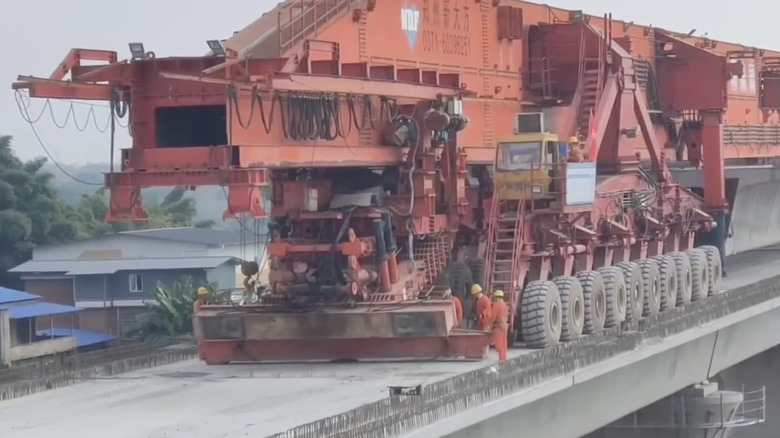
The world's longest bridge, the 102-mile long Danyang-Kunshan Grand Bridge is in China, which tells us all we need to know about the nation's capacity in the area. Of course, in order to develop engineering marvels such as this, some heavy duty equipment is needed. One of the largest bridge-building machines in the world is China's "Iron Monster," Beijing Wow Joint Machinery Company's SLJ900/32.
This remarkable machine lays a bridge section by section, passing backwards and forwards to lay one and then retrieve the next segment. It has a series of supports that extend from beneath the front of its body, allowing it to rest on the pre-laid vertical supports of the bridge. It has a grand total of 64 wheels, too, enhancing its maneuverability.
Of course, a speed of 3 mph isn't anything to shout about, but it allows for bridge construction at an impressive pace. As such, this approximately 29.5 feet tall and 302 feet long machine is hardly subtle, but much like the K-10000 tower crane, can make huge workspaces much less cluttered with machines, as it can effectively perform the work of several. The Segmental Bridge Launching Machine, as it's also known, can't directly build bridge components, but is perfect for taking girders (which are already built) and laying them like a railway track.