

What Are The Torque Tubes On Corvettes For?

From a scientific perspective, getting a car moving from Point A to Point B is all about physics and energy transfer. How do you turn the up and down reciprocating motion of an engine's pistons into the wheels turning? There are a lot of steps involved — converting that all into rotational energy, then transferring it to the axle, then finally to the wheels. Each step in this process produces a certain amount of flex as well. Imagine, for instance, you grabbed a pretzel and twisted it. The whole thing would start to fold in on itself; the same thing happens with a front-engine, rear-drive car's driveshaft.
Up until the current generation, all Chevrolet Corvettes were front-engine, rear-drive. This means that, like any other FR configuration car, to get the power to go from the engine to the wheels, you need a shaft connecting the two: the driveshaft. Ultimately, a driveshaft is nothing more than a long connecting rod; if you look under a truck, for instance, you'll see it spinning as the truck moves (incidentally, there is a reason behind why most trucks are RWD). It bridges the gap between the transmission and the rear differential, and in all so-equipped cars, exerts an amount of flex on the frame.
The Corvette partially counteracts this flex by installing what's known as a torque tube — basically, it's a tube that shrouds the driveshaft. The tube itself doesn't move, giving the car a measurable amount of rotational rigidity. Corvettes are both powerful and relatively light, hence their requirement for such a device. But how specifically does a hollow tube affect all these forces? Let's take a deep dive into the physics behind torque tubes.
The purpose of a torque tube
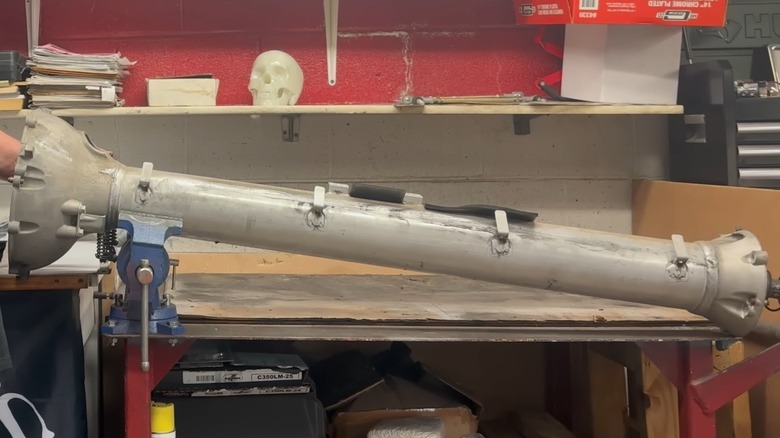
Going back to the pretzel analogy, imagine that the driveshaft is the middle part and the car's frame is the outer rim. Despite the fact that the driveshaft isn't fixed to the frame, the engine still exerts tremendous torque on it at full throttle; in extreme cases like drag racing, this'll pick up one side of the car as everything flexes. This is why stiffer is better when it comes to racecars; the less flex being exerted on the frame, the more stable the car is under heavy loads and G forces.
A driveshaft, meanwhile, is not a fixed point attached to the frame; it merely connects the axle to the transmission. Moreover, it has to move up and down with the movement of the differential (yes, car axles are rather complicated), hence why you can't really fit a torque tube on a car with solid axles. But so-equipped Corvettes have independent rear suspension; the way that works is you have a pair of half shafts connecting the wheels to the differential that each move independently, rather than one big long tube.
Because each of the half shafts can move up and down on its own, the differential itself acts as the pivoting point, which means the diff doesn't have to move nearly as much. Now the driveshaft can also remain relatively fixed, and thus you can fit a housing around it that acts as a supplement to the car's overall rigidity. Basically, by eliminating the vertical movement of the driveshaft, you can create a new brace against the frame wanting to pretzel, at the cost of some extra weight.
What the effects on the Corvette's driving experience are
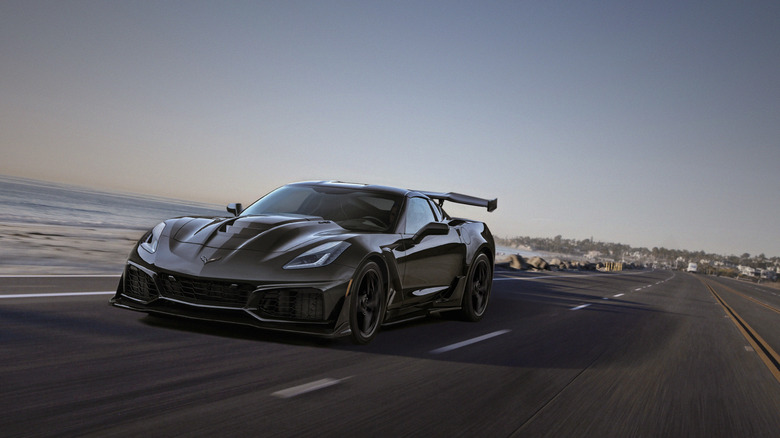
Now that we know how a torque tube works in principle, how does it affect a Corvette's ability to drive? Because it acts as an additional point of resistance against flex, that means that the other points don't need to weigh as much to take up the slack, so despite the tube itself weighing around 50 pounds, it doesn't actually contribute much to the overall weight of the car, in theory. Moreover, the driveshaft itself also has a certain amount of power loss associated with it, with that power loss increasing with the vertical angle between the front and rear axles. In other words, a more centered, fixed driveshaft is more efficient than one that moves up and down a lot.
All of this culminates in a car that's relatively stiff for its overall weight, mostly affecting the Corvette's on-track driving experience. With minimal flex comes minimal vertical wheel movement, and a car able to keep all four wheels planted at all times means it retains maximum grip through hard cornering and acceleration. Of course, the more torque you put on the system, the more strained it'll get. Part of what makes the LS so special is its power potential, after all; however, beyond a certain point, you'll also need a driveshaft and torque tube with enough beef to match. Every model has specific power ratings in its description, so be sure to choose one that's rated for more power than your application.