

The 2026 Toyota RAV4 Is Missing One Big Engine Option
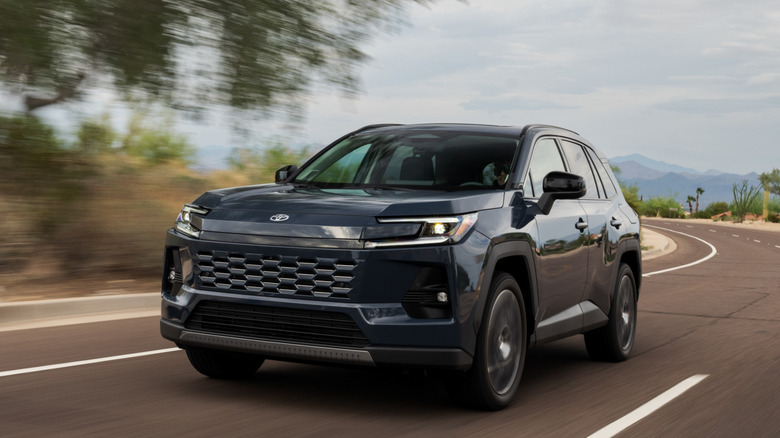
The Toyota RAV4 has been a staple of Toyota's lineup for over three decades now, being the most popular non-EV vehicle in its class and the fourth most popular overall in the U.S (as well as the most popular car in the world). They're known and loved for being reliable and accessible for anyone seeking a functional compact crossover. Moreover, the RAV4 comes in several variations, including a plug-in hybrid as well as a standard internal combustion engine — or at least, it used to. Starting in 2026, you can no longer purchase a RAV4 powered exclusively by gasoline; they are all either standard hybrid or PHEVs.
Until 2025, the base model RAV4 came standard with a 2.5-liter four-cylinder combustion engine powering the front wheels (with optional all-wheel drive). It sent 203 hp through an eight-speed automatic transmission and was an efficient, though pedestrian, powertrain that offered 27 city and 35 highway mpg. However, 2026 introduces a new generation for Toyota's crossover, and that means new powertrains. Now in its sixth generation, the 2026 RAV4 is designed around hybrid power from the get-go, boasting more power, better fuel economy, and an expected price bump.
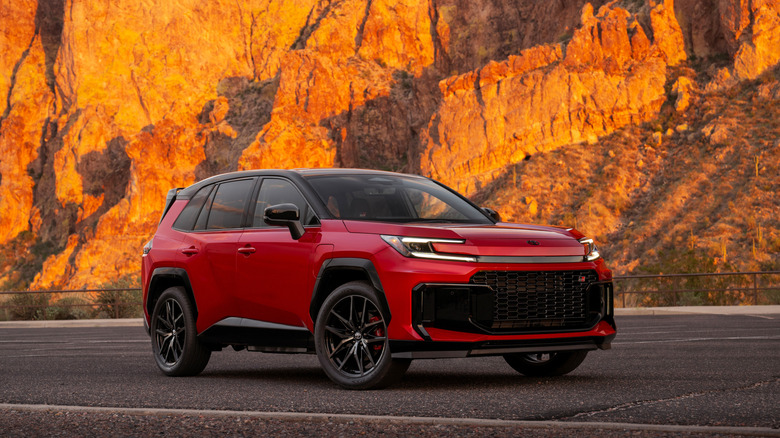
Of course, being a new generation, the 2026 RAV4 comes with features and design elements that haven't been seen on the RAV4, including the first-ever RAV4 GR Sport. However, even that edition will use the standard PHEV powertrain — although it does deliver an impressive 324 hp, admittedly. Let's open up the hood and take a closer look at these changes and what they mean for future owners.
What engines can you get in the 2026 RAV4?
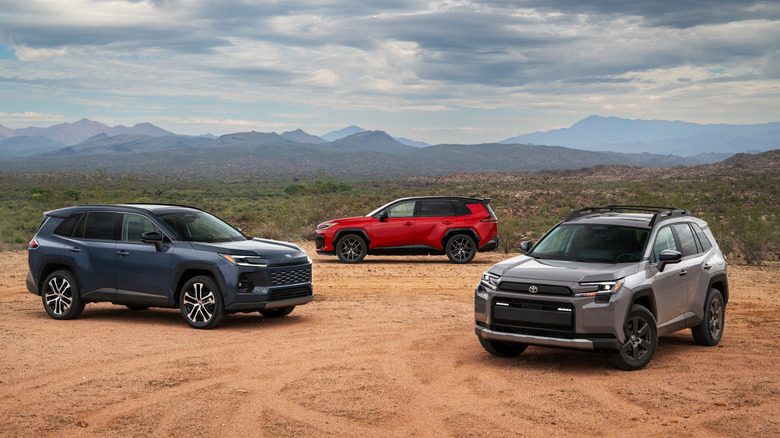
At launch, the 2026 RAV4 offers two main engine options available: a standard hybrid and a PHEV. Let's start with the former, representing the new base-model engine configuration. Toyota offered the hybrid powertrain as the midfield option for 2025, boasting 219 combined system horsepower; the new 2026 model brings a few extra horses to the table, upping that number to 236 on AWD and 226 on FWD models. Toyota states that the engine makes 163 lb-ft of torque, with the motor producing 153 lb-ft alongside it. Fuel economy also climbs over the 2025 model year, at 44 mpg combined rating for the FWD model. Overall, this engine will likely feel similar to the previous generation while saving a few bucks at the gas station.
The real star of the show for performance-oriented drivers will be the PHEV, though. The PHEV now makes 324 hp, 22 more than its 2025 counterpart. Fuel economy is also impressive at 41 mpg combined. Unlike the base hybrid powertrain, the PHEV comes standard with electronic on-demand AWD and will feature on the higher-end packages like the upcoming GR Sport (though it is optional across mid-range trims, as usual). The electric-only range for the PHEV is 52 miles as well, making it perfect for daily commutes. These updated powertrains come alongside a host of new features, such as new bodywork, a 12.3-inch digital instrument display, and more. However, while the RAV4 may look different, the engines are mostly incremental improvements, making for a relatively straightforward transition.
Why did Toyota drop the gasoline-only engine?
The main issue (if one could call it that) with the standard gasoline engine is that it didn't sell as well as its hybrid counterparts. According to Toyota's press release, more than half of the RAV4s sold in 2024 were hybrid and PHEV units. Thus, it makes sense that Toyota has gone for a fully-electrified RAV4 for 2026. Bear in mind that Toyota is a company known for its adoption of alternative fuels and efficiency standards; for instance, the Toyota Mirai was the first true mass-produced hydrogen fuel cell car and remains one of the few hydrogen-powered vehicles available in the U.S.
Obviously, it's a good thing to see that customers are prioritizing fuel efficiency amid environmental concerns. However, dropping the combustion engine also means a necessary increase to the RAV4's MSRP and a more complex system for the base model. It's possible that these changes might not be worth it to buyers who are looking for simplicity or do not have access to the infrastructure required for a PHEV. The latter is becoming less of an issue, though, as the charging ecosystem continues to grow.
Will this trend continue into the future with other Toyota models? Perhaps. Ot all depends on how well they sell in comparison to their gasoline-powered counterparts. Much like manual transmissions, we may see a quiet phasing-out of pure gasoline engines over time, with the RAV4 being one of the first models to do so. Of course, it may be for a host of other reasons, such as meeting stricter company-wide emissions regulations, though those reasons remain in the realm of speculation for now.