

Why Did Harley-Davidson Fail In India?
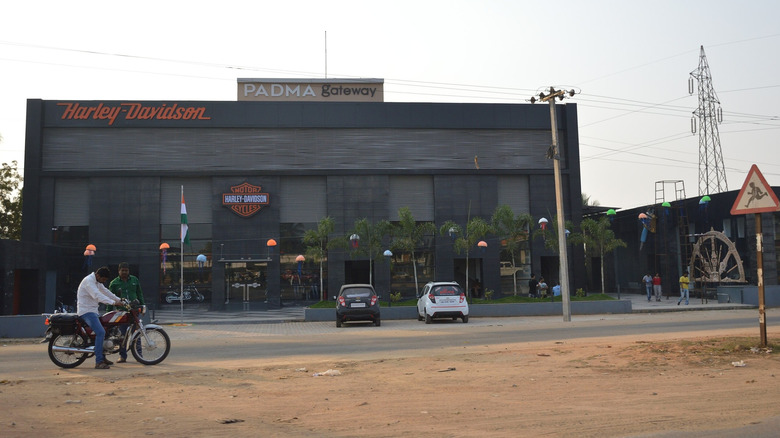
It might be hard to imagine Harley-Davidson ever failing, but when a company has been in business for over 120 years, it's most assuredly going to go through some ups and downs. It's simply the way of business, especially for one with such a vast global appeal as H-D. Such was the case in India, where the company found out the hard way that not everywhere is a good place to operate a big ol' Hog.
H-D opened its first dealership in Hyderabad in July 2010, and a 70,000-square-foot building at Bawal in Haryana – referred to as a "complete knock-down" assembly plant — that merely assembled kits received from plants in Wisconsin, Pennsylvania, and Missouri. This reduced import duties and lowered the bike's overall cost, while expanding their market presence. At the time, it was the company's second attempt at an operation outside the U.S., the first being located in Brazil. And why not? For a country with a population well over one billion, two-wheeled vehicles were by far the most popular mode of transportation, creating a perfect target-rich environment.
Harley-Davidson left India in September 2020, having sold just 27,000 units over a decade of operations. By comparison, Royal Enfield (Harley's main competition in the region) sold twice that amount — every month. During the fiscal year of 2019, H-D sold approximately 2,676 motorcycles, and only 100 between April and June of 2020. Several factors contributed to the legendary bike maker's overall Indian demise, but they all focused on one simple, ironic fact: the bikes were too much of a hog for India.
Too big, too expensive, too thirsty
During the fiscal year (2019) before Harley pulled the plug, over 17 million two-wheelers were sold in India, 90% of which were powered by engines under 150 cc. Sales of bikes with engines above 500cc only sold 25,000 units a year. But the smallest bike Harley offered in India came with a 750 cc engine.
What's more, the venerable bike maker Royal Enfield, which had a longstanding history in India dating back to 1949, was a significant problem for the iconic American company. Royal Enfield was accustomed to producing motorcycles that were far more affordable, got better gas mileage, and were much lighter, easier, and cheaper to maintain. All of which was borne out by the fact that it continuously outsold Harley (by exponentially large margins) each and every month. Royal Enfield wasn't the only bike maker Harley had to worry about, though. Triumph, Jawa, and Norton were all producing bikes that directly competed with Harley. Plus, Jawa and Norton had partnered with other Indian companies (Mahindra & Mahindra and TVS Motor Company) to build bikes in the country, making them much more affordable and practical.
Speaking of, remember that "complete knock-down" assembly plant Harley built? That became an issue because it wasn't a complete manufacturing facility capable of producing the much-needed replacement parts in India. By all accounts, getting those took months, as they had to be imported. And because the motorcycles weren't built in India, Harley had to deal with a tax burden twice that of other manufacturers in the country.
COVID was the final straw for Harley-Davidson
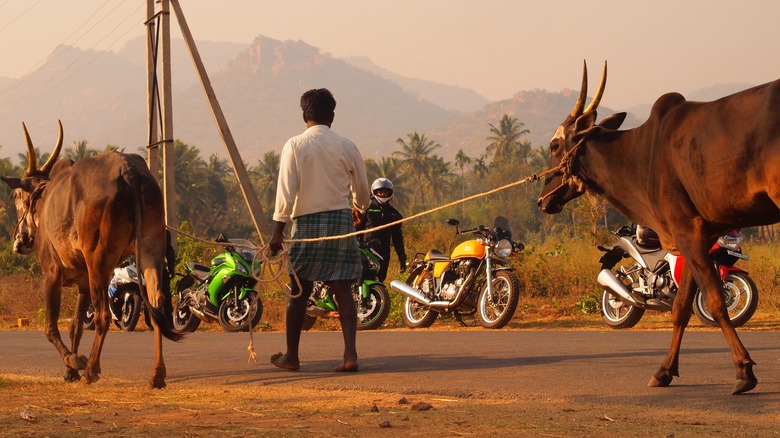
India is the seventh largest country in the world (covering 1,147,956 square miles), and is second only to the United States with the largest road network on the planet. Although the government has made great strides in expanding it since 2014, 40 percent are still made of dirt and gravel — conditions that are not ideal for a beefy touring bike.
Harley was in the throes of a financial decline when COVID hit. In 2019, it shipped only 213,939 motorcycles to dealerships — which may sound like a lot, but was the lowest total in nine years — and corresponded with its worst net income ($423 million) in those same nine years. That was followed up by a terrible beginning to 2020 as the pandemic swept across the globe, marking its first loss in 37 straight quarters. That coincided with a six-year sales low due to production cutbacks and dealership closures that had already taken effect. At the time, it was generally believed that the fallout from the pandemic would stall demand for two-wheelers in India by as much as three years. COVID was the final straw that broke Harley's back, and it shuttered its Bawal plant as part of a global restructuring plan known as "Rewire."
While Harley was in the country, it managed to open only 35 dealerships, with each selling fewer than 70 bikes a year. Ultimately, Harley simply wasn't a good fit for Indians, who were never really in the market for big, expensive, luxury motorcycles meant for cruising uncongested paved roads.