

Do Toyota Land Cruisers Come With Secondary Fuel Tanks? Here's What We Know
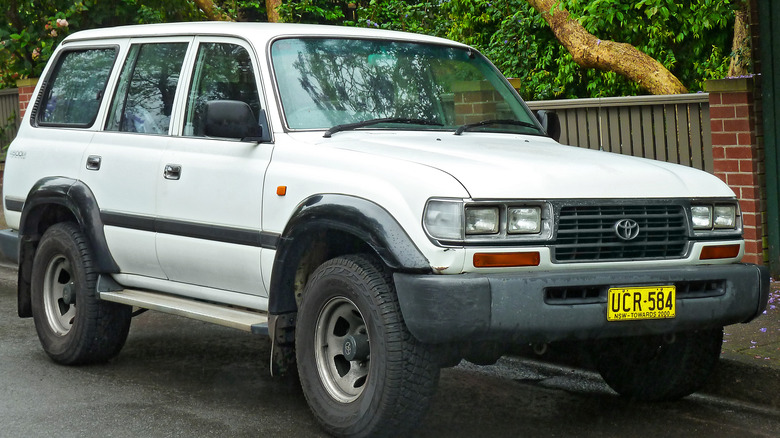
Toyota Land Cruisers are known for many things. They're legendarily reliable, excellent off-roaders, and some of the only true body-on-frame SUVs with a solid rear axle. And, for some reason, new Land Cruisers come with all the provisions for a rear seat except the actual seat. These trucks are fairly unique both inside and out, with some having not just one, but two independent fuel tanks.
But what's the point of having two fuel tanks in the first place, and how does the system work? It's actually not the only truck, much less passenger vehicle in general, boasting such a feature; many cars offer similar setups, each with different purposes. Toyota's is a main and sub fuel tank, linked together in such a way that the sub fuel tank acts as a reserve for the main tank. The driver presses a switch, which then draws fuel from the sub tank and feeds it into the main one, a particularly useful feature for long expeditions with few fuel stations.
While there are many Land Cruiser generations, only a few sport this feature: Namely, some military 70 series, various 80 series, and a few 100 and 105 series with utility-oriented diesel configurations. For those who don't speak Land Cruiser, those are the boxier models popular from the 1980s to the early 2000s, specifically ones used for municipal duties and troop transport. Some companies also offer long-range retrofit kits for more modern Land Cruisers, such as the 200 series.
Why have two fuel tanks?
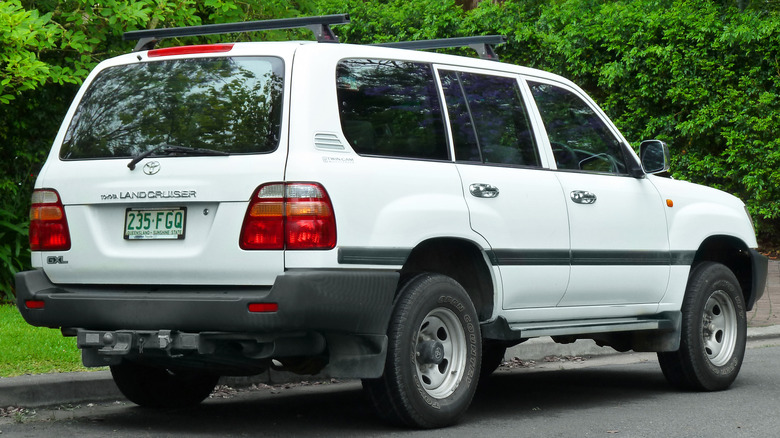
As mentioned before, the second fuel tank acts as a range extender, but that fails to answer the question of why not just have a larger fuel tank to begin with. Toyota offers no direct quote regarding its reasoning behind this decision, so much of this is inference and factors based on other cars using similar setups, but the general gist of it is that it acts as a reserve tank that's particularly handy to have in remote areas. Picture you're driving through the middle of the Australian Outback, and you're riding in a utility variant of a Land Cruiser. Rather than having a bunch of Jerry cans or a fuel bowser, you instead have a built-in reserve.
As for why it doesn't have a second full-sized fuel tank, that's the inference part, but it likely goes along with the Land Cruiser's layout. All Land Cruisers are traditional body-on-frame designs, meaning they're trucks that feature a frame on which the actual body sits. In order to maintain its durability, that subframe needs a certain amount of structural reinforcement, namely crossmembers. Land Cruisers of this era feature several such reinforcing joints, which bisect the frame at key points to help stiffen it.
Fitting a larger fuel tank on such a frame would likely either necessitate going vertically and interfering with the vehicle's bodywork or dropping down and risking scraping on rough terrain. Alternatively, you could just have two smaller fuel tanks positioned in two different areas, which allows the frame to remain strong and unmodified, adding to the Land Cruiser's legendary reputation for reliability, also perpetuated by its bulletproof engines.
How the system works

Because the point of the extra tank is to be a reserve, the fuel system isn't coupled together by default — generally, if you're driving a Land Cruiser that's so-equipped, you're pulling from the main tank alone. The secondary tank needs to be manually activated by the driver, which is done via a switch on the dashboard. Some models feature a separate fuel gauge located in the overhead console, though it's not a guarantee.
In order to fill the tank, there's a small plunger beside the regular gas filler that acts kind of like a choke on a carburetor. When you go to fill up the car, you pull the plunger out to swap which fuel system you're filling. It's functionally more convenient than something like a Ford F-150's dual gas tank setup with two independent fillers, a rather unique quirk which sadly faded into obscurity, along with the dual fuel tank passenger truck in general.
Toyota's take on this system is functionally similar to any other truck's; it just has those unique quirks with regard to fueling it up. It's actually more similar to something like the backup fuel reservoir on classic Volkswagens because it uses a single fuel filler and serves as a backup to the main tank, rather than a tank to be used interchangeably. Regardless, it's another bizarrely compelling feature on some vintage Land Cruisers, one that's not often talked about, but useful in niche situations nonetheless.