

Everything To Know About The Boeing 707 Jetliner
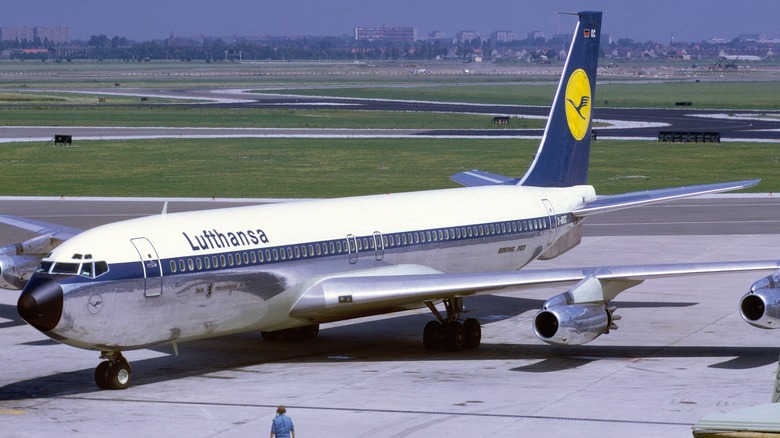
In the 1940s, if you were in a hurry and needed to travel across the continental United States, the fastest option was to hop inside one of the many propeller-driven planes of that era. The Douglas DC3 — perhaps the most popular commercial airplane of the time — let passengers travel from New York to Los Angeles in roughly 18 hours, with only three stops on the way. While these travel times look comically long by today's standards, it was a great improvement compared to the average transcontinental flight in the '30s when it took more than 25 hours to get from the East Coast to the West by air.
After World War 2 ended, there was a massive boom in the number of people taking flights, prompting aircraft companies to work on faster, more efficient aircraft. A major step in this direction came after the arrival of the de Havilland Comet. While the Comet is widely regarded as the world's first jet airliner, its legacy is also marred by a series of unfortunate incidents — including several crashes.
Despite teething troubles, the airline industry quickly realized the many advantages of jet engine-powered aircraft and continued working on more capable jet-powered planes. American aviation company — Boeing — which was primarily known for its military planes during the pre and post-war era, was also considering entering the booming commercial aviation market.
The company's efforts finally led to the creation of the Boeing 707 in 1957. The Boeing 707 is a significant aircraft in several aspects. Most modern-day jet-powered passenger planes owe their existence to the 707. The spirit of the design pioneered by the Boeing 707 is still in use today, more than 60 years since it first burst onto the scene. Its contribution to commercial aviation is remarkable, and the aircraft is widely credited for ushering in the jet age.
Birth of a legend: How Boeing 707 came to be
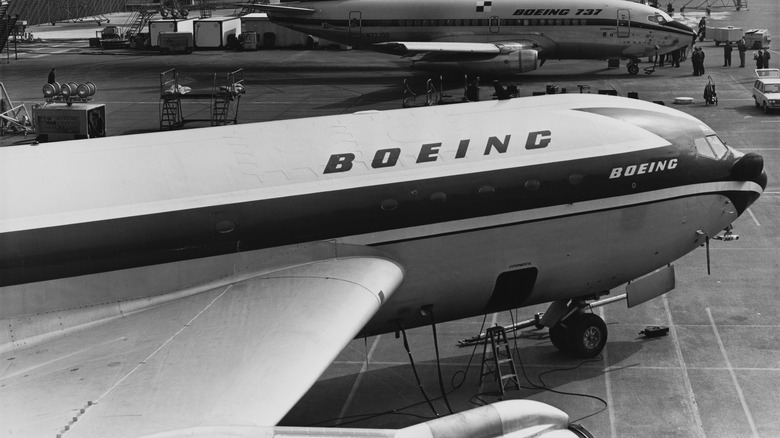
The post-war era was a challenging time for American military aircraft makers. While the end of the war resulted in orders drying up for military-focused aircraft, there was also a surge in the number of civilians taking to the skies. Boeing, realizing that it had fallen behind players like Douglas and Lockheed, started working on a new mixed-use jet aircraft in 1952.
It took Boeing over two years to develop the first prototype of what would go on to become the Boeing 707. The company called this plane the Boeing 367-80 (also called "Dash 80"), and the first working prototype of the plane rolled out of Boeing's production facility on May 14, 1954. Two months later, on July 15, 1954, the Boeing 367-80 took to the skies in its first-ever test flight.
What is notable here is the fact that Boeing had designed the Dash 80 as a multi-role aircraft that could be used for both military and civilian purposes. This was an understandable move because Boeing wasn't sure whether the civilian model of the plane would be successful. Nevertheless, three years after the prototype Dash 80 took to the skies, Boeing was ready with the first production variant of the Boeing 707. It took off for the first time on December 20, 1957, and Pan Am operated the first commercial flight on October 26, 1958, when its Boeing 707 named "Clipper America" took off from New York's Idlewild Airport, and landed at Paris Le Bourget Airport 8 hours and 41 minutes later.
To differentiate Boeing's jet engine-toting aircraft from its existing product line that included propeller-driven planes from the 300 series, Boeing decided that its passenger-focused jet planes would bear the 700-series numbers. Boeing has continued this tradition, and even today, its passenger jet planes still bear the 7xx- tag.
Which U.S. airlines operated the Boeing 707?
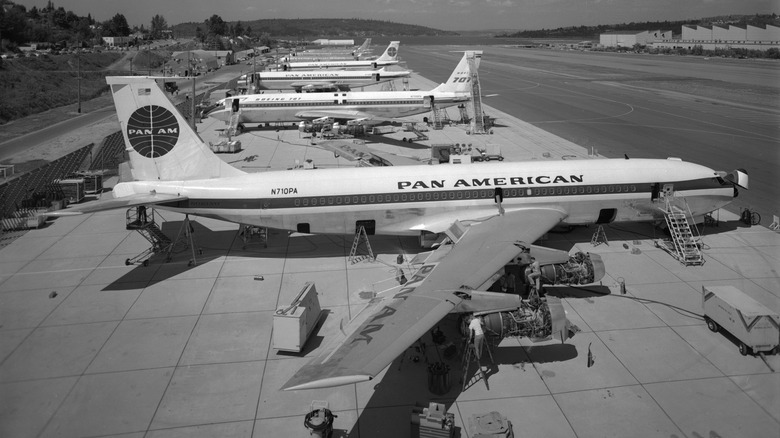
Even though the first test flight of the Boeing 707 didn't happen until 1957, Boeing had already received orders for the in-development aircraft in 1955. These first orders came from Pan Am, a leading carrier at the time. Pan Am committed to purchasing 20 Boeing 707s, a promise it fulfilled by becoming the Boeing 707's launch customer.
Two months after the first commercial flight of the Boeing 707 with Pan Am on October 26, 1958, National Airlines became the first U.S. carrier to operate domestic flights using the Boeing 707 when the first of this service flew its route between Florida and New York on December 10, 1958. Barely a month later, on January 25, 1959, TransWorld Airlines, another major U.S. carrier at the time, deployed the first of its Boeing 707s on the San Francisco to New York route. The same year Continental Airlines also added the Boeing 707 to its fleet.
The Boeing 707's success in the U.S. led to Boeing receiving large orders for the aircraft from overseas. The first non-U.S. carrier to operate the aircraft was the Australian carrier Qantas. American airline companies operated the original Boeing 707 and its updated variants well into the 80s. Globally, however, several international airlines operated the Boeing 707 aircraft until as recently as 2013.
What are the different passenger variants of the Boeing 707?
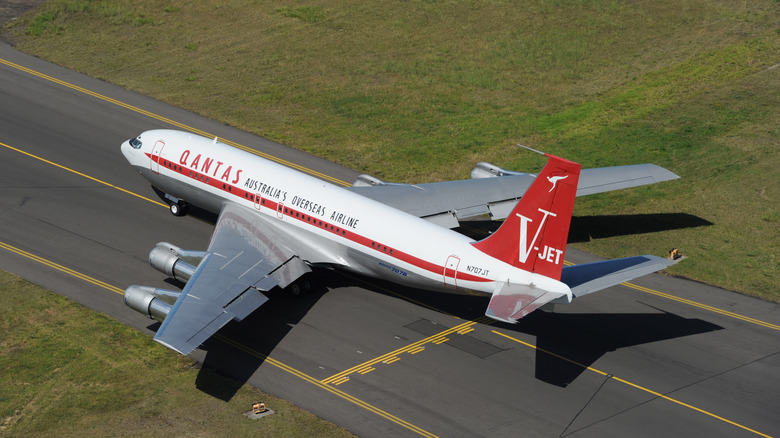
The first Boeing 707 variants that went into commercial service bore the model number 707-120. Boeing also made an upgraded variant of the 707-120 and called it the Boeing 707-120B. These planes featured quieter, more powerful engines, and had slight modifications made to the wings and the tailplane.
Other less-known variants of the 707-120 series include the Boeing 707-138 and the 707-138B, the latter being the same variant of the plane specifically built for Qantas. The Boeing 707-138 was smaller in size than the standard models and featured a fuselage that was 10 feet shorter. This modification made the aircraft lighter and more fuel-efficient. Alongside the 707-120, Boeing also developed a stretched version of the aircraft called the Boeing 707-320. This one featured a longer fuselage and longer wings, the latter enabling it to carry more fuel. The 707-320 also featured upgraded, more powerful engines, and the longer fuselage allowed airline companies to offer better comfort to passengers.
The Boeing 707-320 series of planes would become the most widely produced variants of the Boeing 707. The company made 69 units of the 707-320 and 174 units of the Boeing 707-320B. The most widely produced variant, however, was the Boeing 707-320C, of which there were 337 individual aircraft. Boeing also made a 4-series variant of the plane, called the Boeing 707-420, which was identical to the 320 series but featured engines made by Rolls-Royce instead of Pratt & Whitney.
Military and special variants of the Boeing 707
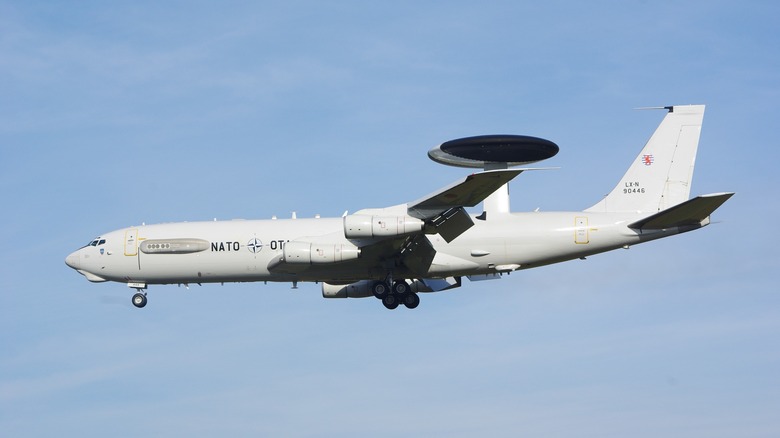
While the Boeing 707 was primarily used for passenger operations, the aircraft was also used by militaries of various countries. Notable examples of these include the Boeing E-3 Sentry, which was an airborne warning and control system (AWACS) aircraft. It was a commercial passenger jetliner modified to perform battleground surveillance. The most striking feature of the plane was its large rotating radar dome that let it track enemy aircraft that were more than 250 miles away. The Northrop Grumman E-8 Joint STARS was another such aircraft that was modified from a Boeing 707-300.
Perhaps the most recognizable Boeing 707s of its time were the two models designated as the VC-137B and the VC-137C. These planes operated as the official aircraft of the president of the United States under the Air Force One callsign. These modified Boeing 707s operated as the Air Force One between 1962 and 1990, after which they were replaced by Boeing 747s.
Boeing also made planes like the C-136 Stratolifter and the KC-135 Stratotanker, the latter specifically being used for airborne refueling purposes. Between 1971 and 1997, the Canadian military also used a Boeing 707 aircraft that was better known as the CC-137 Husky.
Are any Boeing 707's still in use today?
The Boeing 707 was arguably one of Boeing's most successful and important aircraft. The passenger variants of the plane entered service towards the end of the '50s and remained in service as recently as 2019. In the U.S., however, the last commercial flight using a Boeing 707 by a U.S. carrier was operated by Trans World Airlines on October 30, 1983.
The aircraft was in operation in several other countries long after that. 707s were in operation across the Middle East well into the late 90s. The last airline to operate a passenger-carrying Boeing 707 was Iran's Saha Air, which flew until 2013. Saha Air's cargo wing continued to operate the Boeing 707 until 2019 when the aircraft was lost in a crash.
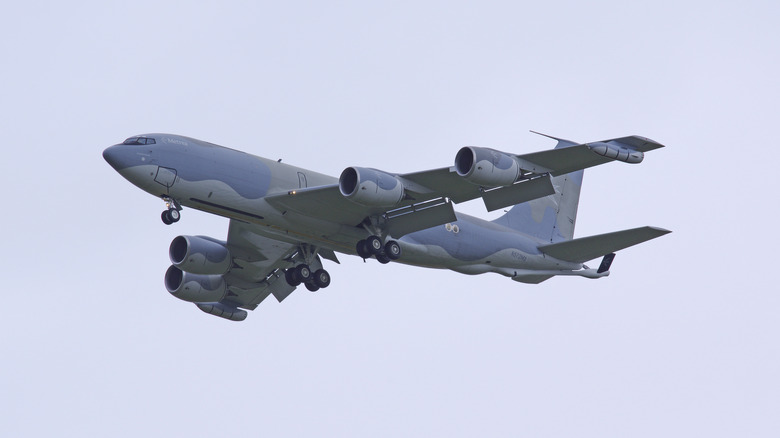
The only Boeing 707 variants still operational today are all military-focused aircraft. The most notable among these are the variants known as the KC-135 Stratotanker. These planes have been in service since the 60s and are expected to remain flying well into the 2030s, thanks to these receiving periodic upgrades.