

Mercedes-Benz Raises Eyebrows By Testing Mysterious EV Chassis
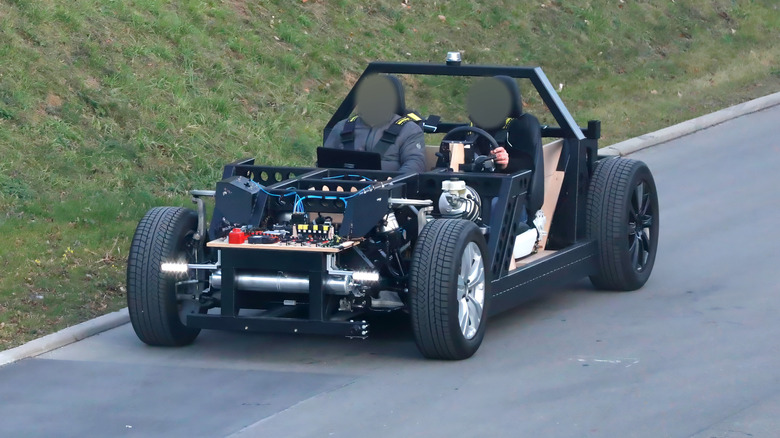
To take an idea and turn it into a car, automakers need to test a ton of things, and the chassis and the car's main propulsion system are arguably some of the more important bits. Early prototypes usually hide under borrowed bodywork or swirly wraps, and there are good reasons why auto brands camouflage unreleased cars. However, every now and then, a test vehicle shows up that gives away so little that there's simply no need for a camo. That's exactly the case with the rather Mad Max-looking rolling EV chassis a photographer recently caught at Mercedes-Benz's development department.
So, what can we see? Well, the whole thing is built around a black box-section frame punched full of holes, with good old plywood standing in for the floor, the footwells, and parts of the dashboard. Mercedes didn't make our list of favorite wood-paneled vehicles of all time, but if it keeps this up, we might have to update it. Meanwhile, two bucket seats with racing harnesses sit under a tall roll hoop topped with an amber warning beacon; the engineer riding shotgun has a laptop open, presumably logging data as the mule moves along.
Developing a new car from scratch can be a long and arduous process. For traditional automakers, research and development cycles from the first idea to a production car usually run around four years or longer. A McKinsey analysis pegs premium automakers, the club Mercedes-Benz belongs to, at 53 months. With EVs, however, that timeline can shrink dramatically.
A rolling skeleton with nothing to hide
Continuing with the chassis, we can see that, up front, there's no hood, no bumper, and no proper headlights, just two thin LED strips and a wooden board crammed with relays, fuses, and wiring. Behind the front axle sits what looks like a conventional brake booster and master cylinder, and the front suspension is mounted noticeably high. The steering column is also set far back in the frame, making it difficult to imagine this as anything besides a two-seater.
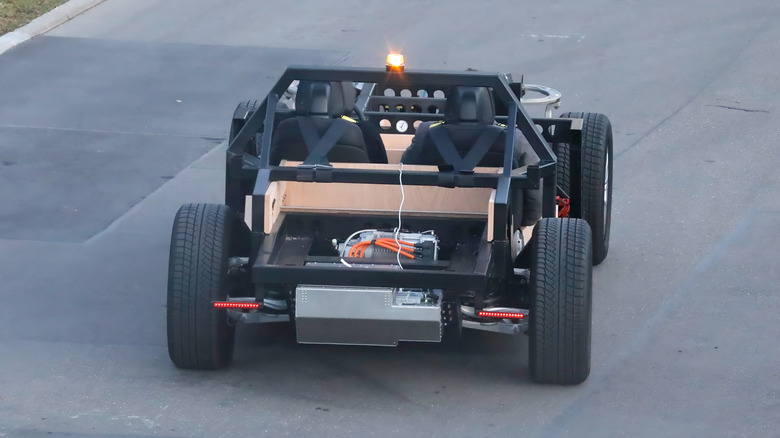
The rear is where things get interesting. An electric drive unit with bright orange high-voltage cables sits above the rear axle, while a boxy aluminum enclosure hangs low behind it. The battery itself is located in the trunk, which is an unusual layout for a modern EV, since most carry their battery as a flat pack in the floor between the axles.
There is little to go by that suggests this might eventually become a production model. The modest battery tucked behind the rear axle hints that this mule is more about chassis and drive unit testing than range, though that's our guess, not Mercedes'.
What could Mercedes be cooking up?
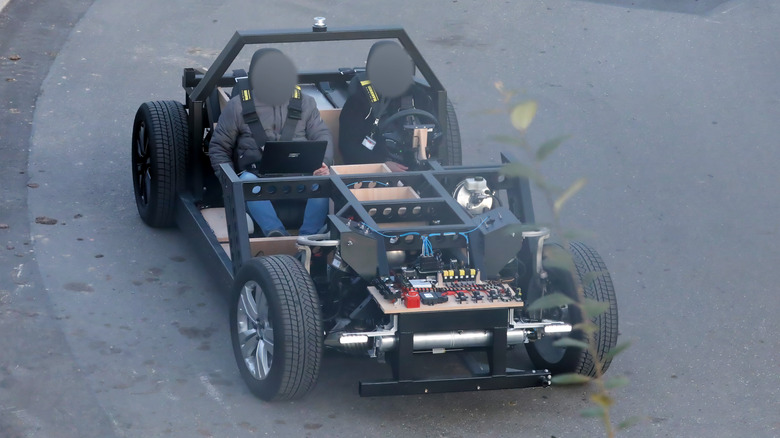
From what's visible, it's strictly a two-seater, though one with its front suspension mounted far too high to be a low-slung sports car. Still, that's worth weighing against what Mercedes has going on right now. In June 2026, for example, Mercedes' Berlin-Marienfelde plant began building axial flux motors in large numbers. Those motors made their debut in the electric Mercedes-AMG GT 4-Door Coupe, which also launched the new AMG.EA platform and makes up to 1,169 hp in its most powerful form. Mercedes also recently unveiled the AMG GT SUV, which borrows a fair bit from the sedan and packs it into an SUV.
Is this mule connected to any of that? It's honestly hard to say. The drive unit in these photos doesn't give away what kind of motor sits inside. Test mules like this one often exist to validate components such as suspension geometry, steering, brakes, or a new drive unit, long before anyone decides what the final car will look like. Mercedes has been busy on that front lately, too, with Mercedes' baby G-Wagon spied testing just last week.
That prototype looked like it might have had an exhaust pipe, though, so we wouldn't connect the two just yet. Mercedes hasn't said a word about this rolling skeleton, and it may never turn into a production car on its own. Still, if it's an early mule for a future model, prototypes with similar proportions and actual bodywork should show up sooner or later. When they do, we'll be happy to tell you more.