

Do Mulching Lawn Mower Blades Need To Be Sharpened?
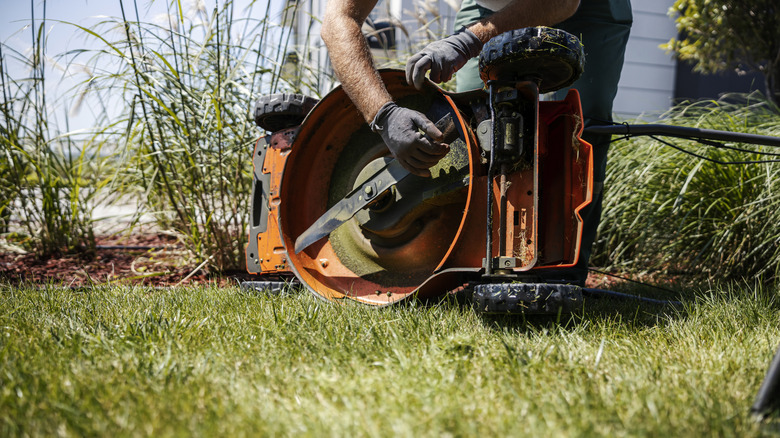
It's easy to overlook the fact that most lawn mowers need regular maintenance and care. They seem so low maintenance, but there's quite a bit you need to tend to between grass cuts. For instance, you should check the oil level, clean the filter (and swap it out when it gets too dirty), and inspect the spark plug. There is a host of other small maintenance tasks for lawn mowers also, including sharpening the blades when they're dull or changing them out when they're damaged. But how does that work with other types of blades that you can install on your mower? Should you be sharpening mulching blades, too, and how often?
The short answer is yes, most blades should be sharpened regularly. That goes for traditional straight blades, high and low lift blades, mulching blades, and gator-style blades. As a general rule, it should be done every 20 to 25 hours of use, or about twice per season.
Due to their unique designs, mulching blades have to be sharpened slightly differently than some of the other types. They usually have a curved shape and sometimes sharp ridges or teeth, which help you distinguish them from other blades. The biggest difference is that you want to preserve the factory angle of 30 to 45 degrees, as well as the natural curve. If you're sharpening a gator blade, you don't want to sharpen its teeth, as those are for airflow and directing clippings rather than cutting. Instead, your attention should be focused on the blade edge that is now dull.
How do you sharpen mulching blades?
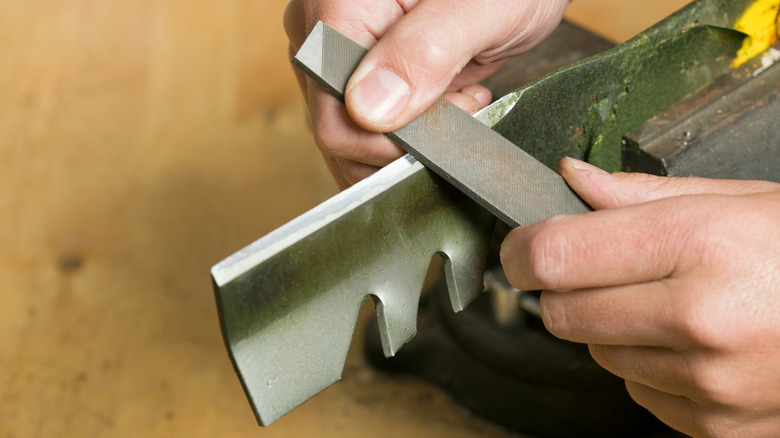
To sharpen a mulching blade, first turn over the lawn mower the correct way, with the filter and carburetor side up, and remove the blade. Be sure to follow safety guidelines, such as removing the spark plug to prevent accidental startups. Once the blade is off, secure it in a vise with the edge you want to sharpen facing up. Take your file or sharpening tool and apply pressure in one sweeping motion across the edge — moving in a single direction and away from the blade. Do this up to a dozen times until the edge is sharp. You can test it, carefully, with a thin piece of paper or a leaf. If the blade slices cleanly, then it is ready to go.
Before reinstalling the blade, make sure it is balanced and stable on the center stock. To test, hang it from a nail or screw on the wall, with the fixture passing through the center hole of the blade. (Alternatively, you can use a blade balancing tool.) Spin the blade to see how it moves. If one side appears to be heavier than the other and dips, you should continue filing the blade until it's balanced and sits evenly before reinstalling it inside the mowing deck. If you install an unbalanced blade, it will likely cause vibrations and other issues during operation.
Ultimately when sharpening a mulching blade, you're leaving its curve and unique shape alone. What you're focusing on is the cutting edge while taking care not to damage or score the rest of the blade.