

The Right Way To Tip A Lawn Mower Over Without Damaging It (And Why You May Need To)
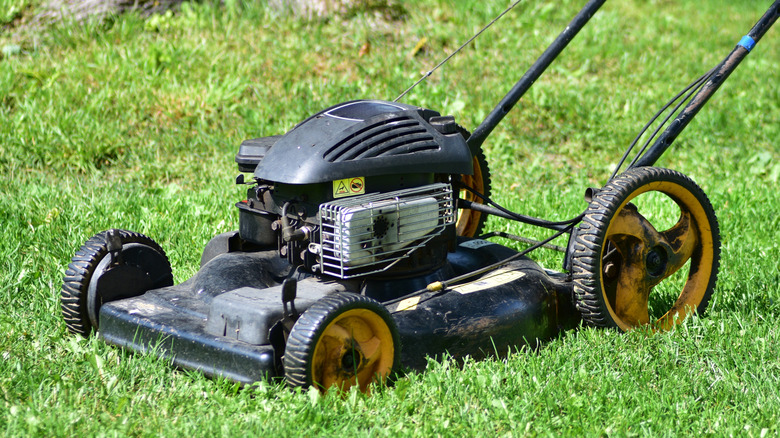
As the point of contact between the lawn mower and the lawn itself, the underside of a mower deck sees a lot of action. Access to it is necessary both for cleaning and repair of key mower parts. While giving it a tilt seems like an easy enough task, doing it wrong is among the most common mistakes everyone makes with their lawn mower. What many don't realize is that there's a correct way to do this, thought it does come with some additional steps beyond simply tipping it on its left or right side.
First, disconnect the spark plug wire to prevent any unintentional starting. Slowly yet firmly pull the starter cord until it reaches a tight point mid-pull. At this point leave it and don't pull any further. This closes the mower's valves and centers the piston, preventing fuel or oil from leaking into areas it shouldn't. Next, identify which side of the mower the carburetor and air filter are on. When you tilt the mower, these should be on the top while the muffler should be on the bottom. Only once you have done all that should you carefully tilt the mower on the correct side.
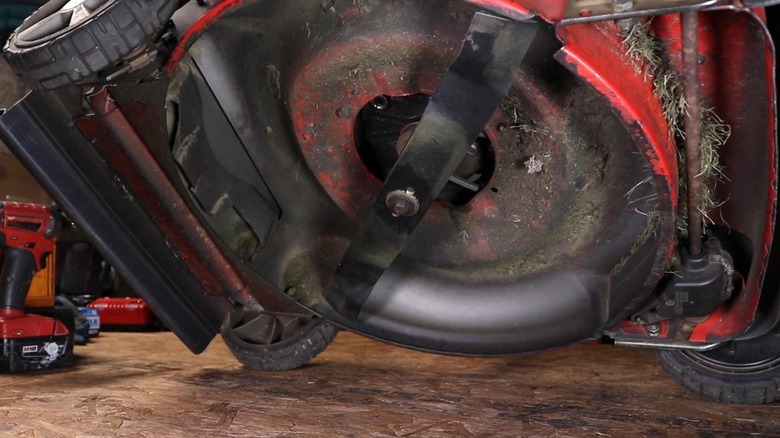
Now you have easy access to clean the underside of the deck after mowing, remove the blade so it can be replaced or sharpened safely, inspect the self-propel belt, or other key maintenance tasks. On top of that, you're not at risk of sending any fluids out of the machine or into any sensitive internal areas of the mower. If this tilting process is a bit too involved, though, there is a quicker and easier yet imperfect alternative.
An alternative to this mower tipping method
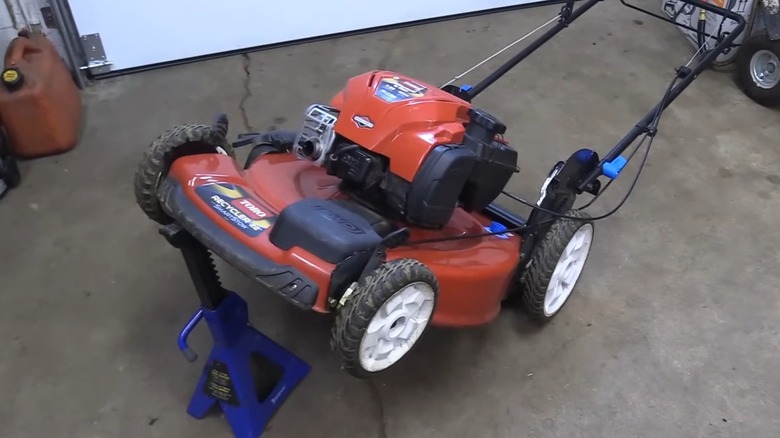
As safe and effective as the aforementioned mower tilting method is, the preparation involved might be overkill for a quick underside inspection. If you need to get underneath your mower, just get a quick look around or remove a piece of debris stuck underneath, you have an easy alternative option. You can just push down on the handlebars to lift up the front end so the mower rests on the back set of wheels and the deck is revealed. This method doesn't risk any leakage or internal damage, but it comes with some drawbacks.
For one, access is limited due to the presence of the handlebar. Sending the mower on its back wheels brings the handlebar to the ground. The deck won't be able to tilt any more than around 45 degrees. That limits your workspace, and there's the other limiting factor of the deck's weight distribution. You'll also have to hold it up while you try to work on the underside of the mower. Assuming you don't have a jack to help out, this is a major hindrance for thorough cleanings or extensive repair jobs. You can try to tilt the mower back on a ledge, or other place where there's clearance to push the handle further down and the mower can stand on its own, but not everyone will have that accomodation.
While it may not look like a big deal, tilting a lawn mower incorrectly can come with consequences. These are just some of the issues users can experience upon tipping their mower the wrong way.
The consequences of tilting a lawn mower incorrectly
Without taking the right safety measures to tilt your lawn mower, you risk harming its internal elements. When a mower is tipped on its side the wrong way, there's a strong possibility oil will seep into areas of the mower where it shouldn't be. Take the carburetor, for instance, where the only two things allowed in should be gas and air. Depending on how long the mower is tipped and how much oil enters that mixture, it can fail to start as normal or start with a big cloud of white smoke as the invading oil burns away.
If oil isn't the problem when tilting your mower, gas certainly could be. If the gas cap is bad or not on correctly, gas could leak out while the mower is slanted, wasting fuel and making a mess. If you use pricier premium gas in your lawn mower, that's even more money lost. Not to mention, mowers get incredibly hot when they run, so this is a fire hazard, too. Gas could also seep into the air filter, warranting cleaning if there's only a little or complete filter replacement if it's really covered. Before replacing the filter, the housing should be wiped clean to remove any residual fuel.