

What's The Difference Between WD-40 Specialist Dry Lube And Silicone Lubricant?
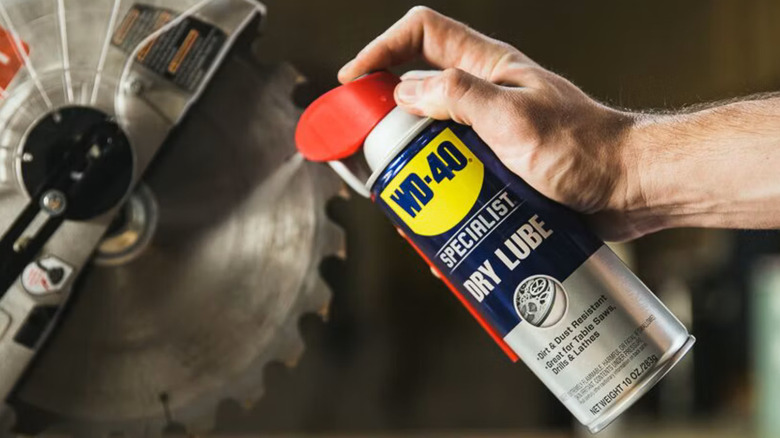
If you're a DIYer, you might regularly use WD-40 around the house and in the garage. It has a wide variety of applications and a number of solutions to choose from. But, unless you've looked into the brand's other products, you may not know how the Specialist Dry Lube and Silicone formulas differ and what they can do.
For example, WD-40 Specialist Dry Lube is designed to protect against corrosion and dries fast when applied. This formula is a dry-film lubricant that helps protect against everyday buildup of dust and dirt. It doesn't leave a tacky residue which means the items you use it on won't feel sticky afterward. This product is designed to protect items over the long term and can be used on several kinds of materials, including most rubber, plastic, and metal. WD-40 Specialist Dry Lube comes in the company's familiar branded can with the red straw system on top.
The Specialist Silicone product also comes in the signature red-top can, but this formula is silicone-based. It's engineered to safeguard your items from corrosion while being water-resistant as well. The resulting film is clear, not sticky, and helps decrease the amount of dirt that can adhere to your items. It's rated for use in extreme environments, from temperatures as low as minus 100 degrees Fahrenheit up to 500 degrees Fahrenheit. Like the dry lube, this formula can be used on many materials, including most plastic, metal, vinyl, and rubber.
Real-world applications and limitations
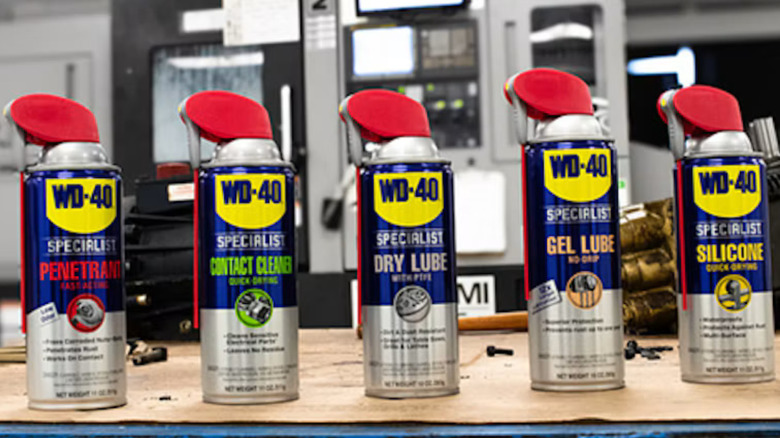
The Specialist Dry Lube formula can be applied to a variety of power tools and tool accessories, including saw blades and drill bits. It can also be used on hinges, rollers, slides, and more. The Specialist Silicone formula is suitable for valves, guide rails, cables, and pulleys, among other surfaces. Be sure you're applying these products as directed by the manufacturer and follow all safety guidelines.
WD-40 Dry Lube and Silicone are part of the Specialist line of products, which includes several other specialty formulas. Those products include Contact Cleaner, Gel Lube, Penetrant, Penetrant with EZ-Reach, and White Lithium Grease. Each one varies slightly from the others, and they are all designed to handle certain tasks as well as solve different problems. This is why it's important to use the right product for the job, as the original WD-40 does have its limitations.
Classic WD-40 is a basic lubricant, and while it can be used on a variety of surfaces, it lacks some of the features that the silicone and dry lube formulas have. For example, the classic can help stuck parts get moving again and defend against both corrosion and rust. However, it doesn't have the dirt-and-dust resistance of dry lube, and it also doesn't have the water resistance of silicone. When you look at the capabilities of each product, it becomes clear why the classic formula may not always be the right solution.