

Legendary Fighter Jet Landing Aboard The USS Enterprise Was A Miracle No One Thought Possible
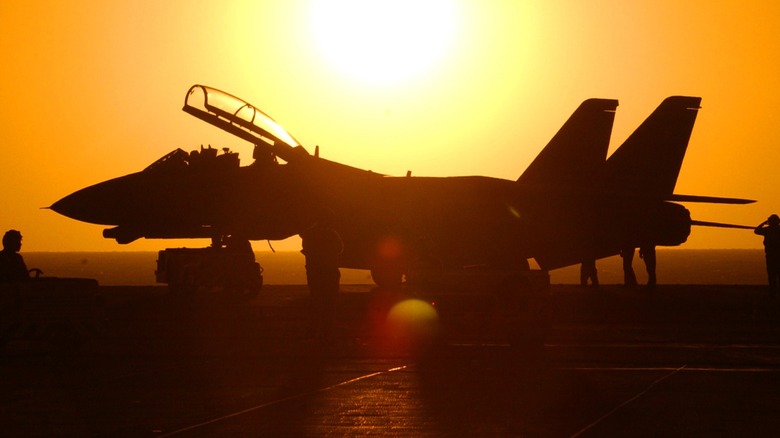
Landing on an aircraft carrier is an inherently difficult thing to do, which is why naval aviators spend countless hours training for said task. An aircraft carrier's flight deck features an incredibly short runway requiring the use of a tailhook and arresting cable, without which most planes would fall over the side without stopping. Add the fact that the carrier itself is moving under its own power, or sitting atop the ever-moving water, and the difficulty of landing on one becomes apparent.
Despite the challenges, thousands of naval aviators have successfully landed on aircraft carriers, and they share one thing in common: they could see the ship. That wasn't the case in one instance when Lt. Cdr. John Monroe "Hawk" Smith and his Radar Intercept Officer, Lt. Joe "Crash" Zahalka, brought their F-14 Tomcat in for a landing on the USS Enterprise (CVN-65). As explained in Donald E. Auten's 2008 book, the landing was seemingly impossible as it occurred during a thunderstorm where visibility was nonexistent.
It shouldn't have been possible to land on the carrier, but with the help of the Landing Signal Officer (LSO), Lt. Cdr. Grover "Skip" Giles, and the aircraft's radar, they pulled it off. The story has become legend, and while the F-14 isn't the hardest plane to land on an aircraft carrier, that didn't make the landing any less extraordinary. Both the pilot and radar operator worked alongside the LSO, finding a way to land without actually seeing the ship, the arresting cable, or much of anything outside the aircraft's cockpit.
Paddles Contact!
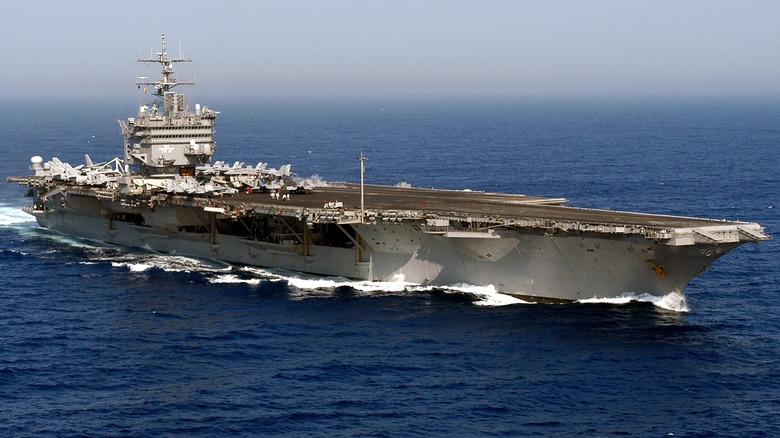
As Hawk and his F-14 Tomcat made their approach to land on the USS Enterprise, the LSO transmitted, "Paddles contact. Keep it coming, oh-five. You've got a good start!" "Paddles" is an informal nickname for the LSO. From there, Hawk flew towards the flight deck, knowing that the storm's ground swells made the vessel pitch and yaw, providing less than ideal circumstances for a safe landing. Regardless, he continued, taking the LSO's direction to move in one direction or another, with almost no delay between the LSO's guidance and his reaction.
Hawk calculated the size of his target wire, adjusting course to ensure he'd make contact. Meanwhile, Crash provided real-time radar details about their location and the ship. Using radio guidance and instruments to fly, Hawk focused on the task, and despite seeing no ship ahead of them, he knew it was there. Beyond the inability to see the flight deck, none of the usual markers like the ship's white wake, or even a break in the skyline and water, were apparent.
Despite these daunting challenges, Hawk managed to get his F-14 to approach the flight deck at the appropriate speed, slope, and on centerline. Though he couldn't see the ship or anything visually indicating it was there, Hawk and Crash immediately knew they'd made it when the F-14 touched down, successfully grabbed the arresting cable, and safely stopped the plane's momentum on the now-retired USS Enterprise.
Though the odds were stacked against a safe landing, Hawk and Crash's training, trust, and instincts allowed them to successfully land the plane.