

Which Toyota Tundra Is Better For Towing: Gas Or Hybrid?
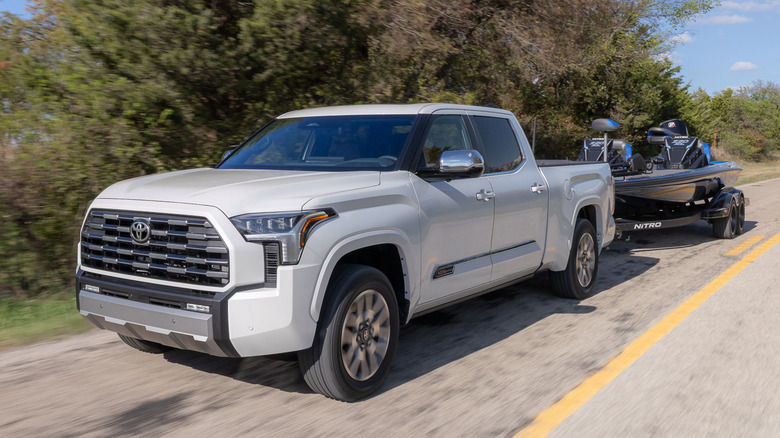
Ever since the original Toyota Tundra debuted back in the late 1990s, the truck has had a clear mission of pushing the automaker into the lucrative and highly competitive full-size pickup market dominated by America's Big Three. Needless to say, towing capacity is an important figure for full-size truck buyers, and the second- and third-generation Tundras in particular have really helped bring Toyota toward parity with the class leaders.
With the current third-generation Tundra, Toyota offers buyers the choice between two different engine options: a twin-turbocharged 3.4-liter i-Force V6 or a hybridized i-Force Max version of the same engine. With its higher price, the Tundra Hybrid delivers higher horsepower and torque figures than the non-hybrid, but does that mean it also provides better towing performance? The answer isn't as clear as you might think.
Towing capacity numbers for the Tundra vary depending on body style and drivetrain layout, but they show that the added power and torque of the hybrid don't actually translate to any noticeable advantage in towing ability. In fact, the most capable version of the Tundra uses the non-hybrid i-Force engine. However, that doesn't mean that owners will find the Tundra Hybrid lacking when towing — as long as they keep their expectations in check. Let's break down the numbers.
More torque doesn't equal better towing
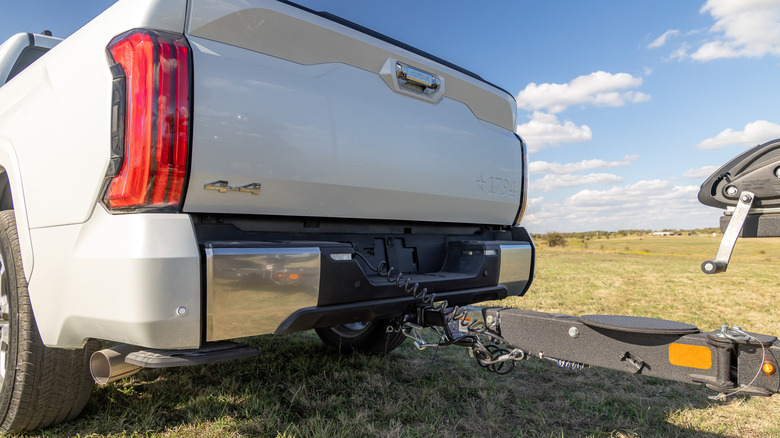
Toyota actually offers the Tundra with three different versions of the 3.4-liter i-Force V6, with the base SR trim having a detuned engine that comes with a fairly big hit in towing capacity. Those looking to do any sort of serious towing with their Tundra will want to step up to the SR5 trim or higher, where you unlock the more powerful i-Force V6, which is rated at 389 horsepower and 479 pound-feet of torque. Above that sits the top-of-the-line Tundra Hybrid, with its i-Force Max engine rated at 437 hp and an impressive 583 lb-ft of torque.
On paper, that big increase in low-end torque seems like it would result in a notable increase in towing capacity, but that's simply not the case, in part due to the additional weight of the hybrid system on the Tundra's frame. The Tundra with the highest towing capacity is the non-hybrid, two-wheel-drive, double-cab, long-bed SR5, which is rated to tow 12,000 pounds. For the Tundra Hybrid, the best performing variant is the two-wheel-drive, crew-cab, short-bed Limited trim, which is rated to tow up to 11,450 pounds.
Whether hybrid or not, the rest of the Tundra lineup has a maximum tow rating somewhere between 11,000 and 11,450 pounds. Overall, there isn't likely to be a big difference in real-world towing performance between them, and buyers will simply have to decide whether the hybrid is worth the extra money or not.
Tundra versus the competition
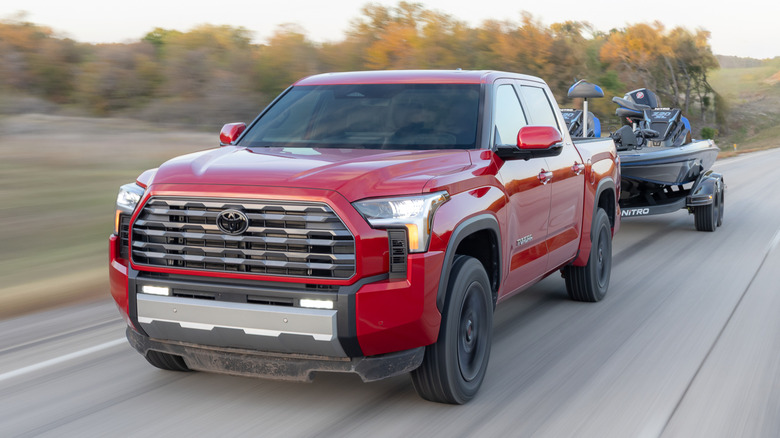
A max tow rating of 12,000 pounds is nothing to scoff at for a half-ton pickup truck, but for buyers who need the capability, there are other pickups that can tow more than the Tundra. For instance, the Ford F-150's towing capacity is near the top of the class with its impressive 13,500-pound max rating, while the new 2027 Chevrolet Silverado pushes that number even higher with a 13,700-pound rating. Is that alone enough to push truck buyers away from Toyota?
Ultimately, the biggest disadvantage for Toyota as a truck brand isn't any real lack of capability on the Tundra's part — it's the lack of a heavy-duty option in its lineup. For those who need big-time towing capability, the American automakers all offer the ability to step up to a heavy-duty F-250 Super Duty, Ram 2500, or Silverado 2500, where buyers can opt for either powerful V8 engines or a massively torquey turbo-diesel to handle the toughest pulls. With Toyota, the Tundra is the strongest truck you can get, and for demanding tow jobs, you'll either have to make do with its half-ton limitations or switch to a heavy-duty American pickup truck.