

5 Handy Features Of Husqvarna Leaf Blowers
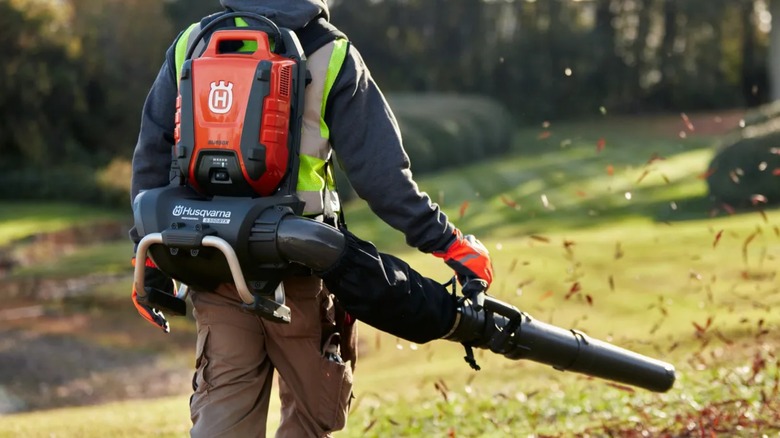
It's no secret that there are some things you should know before buying a leaf blower. Elements like power level, energy source, size and weight, price point, and the like are all crucial to be aware of. However, the real difference-maker is what you can get beyond standard leaf blower functionality. Supplemental features add practical uses for your leaf blower and help you tackle other jobs you didn't know your tool could handle. These extra options aren't essential, but they may prove useful in certain situations.
If you're in the market for a new leaf blower, you have plenty of names to choose from among different power equipment brands. Husqvarna stands out as one option, with the company having a long history of manufacturing outdoor tools of all kinds and producing some of the best electric leaf blowers you can find. As it turns out, a lot of its models have more to offer than just leaf clearing. Here are five Husqvarna blower features that could tip the scales.
Built-in debris scraper
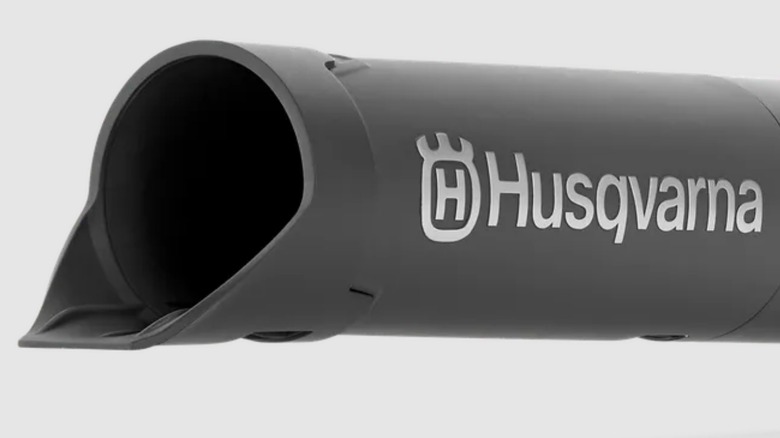
When using a blower on a driveway or walkway, leaves and other light debris will be lifted and moved with minimal struggle. However, along the way, you may encounter debris that has stuck itself to the ground and refuses to budge with any amount of air pressure. This is where a small yet helpful addition to some Husqvarna blowers comes in handy: the debris scraper. As seen on such blower models as the Husqvarna 230iB, this feature consists of a scraper attachment that locks onto the end of the blower nozzle. When you come across stubborn debris, you can work your way under it and pull it up, then blow it away along with everything else.
On the whole, this is a hugely helpful yet minor addition to Husqvarna blowers. It should be said, though, it's not a perfect inclusion. For one, the cone is plastic, so if you're constantly scraping at things on the ground, its sharp edge is likely to wear down over time. This is especially true if you try to use it on abrasive, uneven surfaces, like worn-out concrete walkways, for example. Not to mention, if you're dealing with something more than a patch of wet, driven-over grass or dirt clumps, it probably won't get the job done. At that point, you're likely better off taking a break and using a designated scraper. Still, for small, stuck-on debris, it should have no trouble proving why Husqvarna chose to include it in the first place.
Boost mode
For the most part, a simple handheld blower won't struggle much with dry ground debris like leaves and grass clippings. With that said, once you reach a wet patch or a particularly dense bunch of debris, your blower may prove less effective. Seemingly aware of this, Husqvarna has come up with a solution to remove these stubborn remains. Several Husqvarna blower models have a built-in Boost Mode, which supplies additional blowing power to deliver an increase in airflow as high as the tool can functionally handle. Ideally, this boost is enough to get problem spots removed or at least broken up.
One of the blowers that has this feature is the Husqvarna 530iB, with the product listing explaining how it works. Essentially, you activate Boost Mode by pressing the power trigger past its normal operating range; releasing it disengages boost and returns the blower to standard operation. Odds are you don't want to stay locked into this mode for too long. Since it's pushing your blower to its absolute limit, the same goes for the battery. Running anything at its peak for an extended period will result in decreased battery life, so keep in mind there is a trade-off between high-power blowing and runtime while Boost Mode is activated.
Automated battery switching
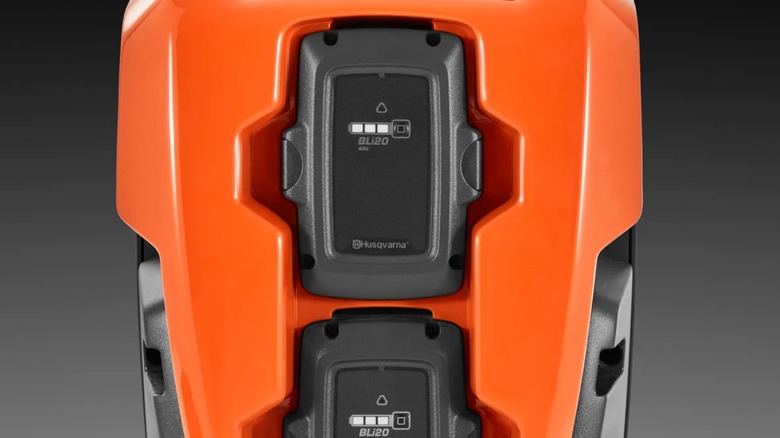
Like so many power tool brands out there, Husqvarna has very much embraced the battery-powered form of tool. Its leaf blowers are no exception, with plenty of models in its lineup functioning on rechargeable lithium-ion battery packs rather than gasoline while still claiming to deliver gas-powered-like results. Unfortunately, this does mean if you're using an undercharged battery or running your blower for a while to the point of draining it, you'll have to stop what you're doing and swap in a fresh battery. That is, unless you have one of the Husqvarna blower models specifically designed to handle this task for you, keeping your on-the-job momentum going.
As seen on models such as the Husqvarna 340iBT, there are two battery slots present on the backpack portion of the unit even though only a single 36-volt battery is required to run it. That's because this blower gives users the chance to plan ahead. You can attach a second battery pack and go about business as usual, effectively increasing the tool's runtime. This is thanks to Husqvarna's auto-switch technology, which detects when the initial battery has been depleted and taps into the backup without you having to stop and handle the change yourself. These are the kind of small yet game-changing additions to your tools that can make all the difference.
Cruise control
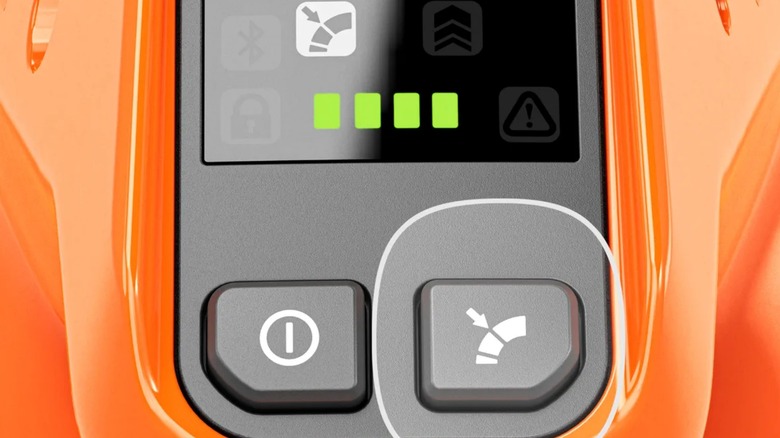
As noted previously, you're not locked into a single power mode when using certain Husqvarna blower models. Some are capable of leaping in airflow to meet the needs of your current cleanup job. Many of these models also have variable-speed controls, like the aforementioned 530iB, meaning that depending on the position of the trigger, the blower will increase and decrease in power. While this is a more common feature in the blower world, one that's seen far less often is the Cruise Control function, which aids in situations where specific blower speeds are needed, though maneuverability is the clear priority.
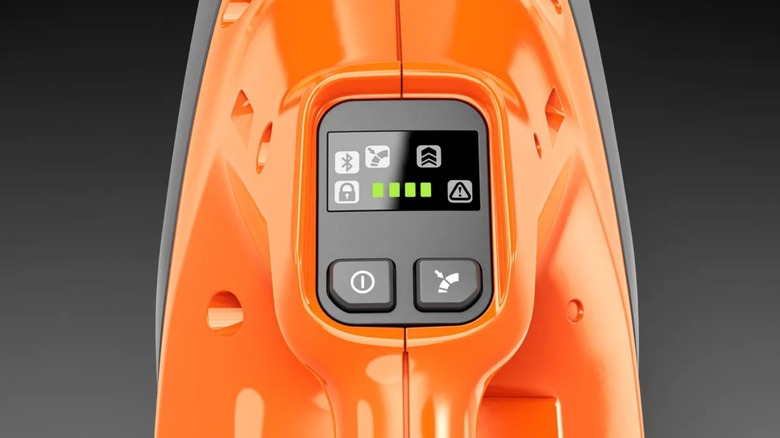
Much like the Boost Mode function, Cruise Control is simple to use and quite helpful on the job. Essentially, you set the trigger to your desired power level, and you press the Cruise Control button — the one that looks like a portion of a dial with an arrow pointing at it — near the keypad to lock it in. You can tap this button at any time to unlock it and go back to controlling your blower's airflow with the trigger as usual. It's similar to how cruise control works in modern vehicles. Just like going on a long drive and not wanting to work the gas pedal so much, this is perfect for scenarios of continuous blower use where maintaining constant trigger pressure becomes tiring.
LowVib technology
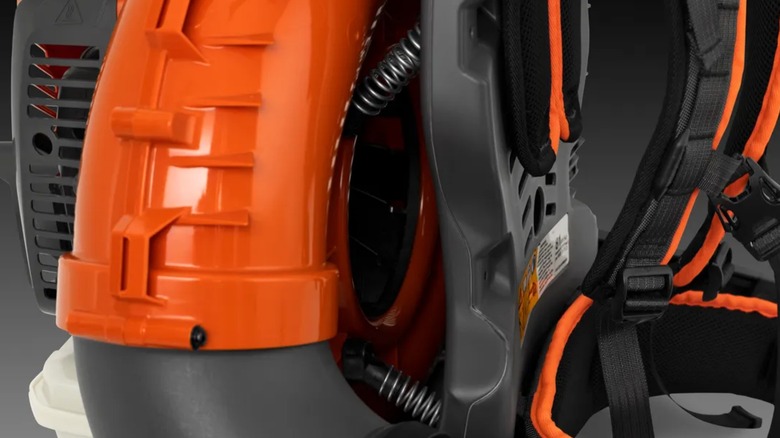
When dealing with a backpack blower specifically, it can get uncomfortable to use in a hurry. Not only can contending with the weight of such a unit become rather grueling, but while it's activated, it's going to move and vibrate quite a bit. This is especially true of gas-powered products, of which Husqvarna has numerous, where there's active combustion and fan rotation going on within. Therefore, companies are always trying to enhance user comfort on these blower units, with Husqvarna coming up with a solution of its own. Now, several of its gas models have what's known as LowVib technology.
LowVib technology is present on products such as the Husqvarna 590BFS. As the name suggests, the feature is intended to reduce on-the-job engine tremors as much as possible. The way it works is through the inclusion of vibration-dampening components that separate the engine from other parts, decreasing the amount of shaking transferred to the operator. This, combined with back padding, a cushioned harness, and the like, aims to improve user comfort during operation and support longer work sessions.