

'Full Self-Driving' Tesla Owners Can't Stop Falling Asleep At The Wheel
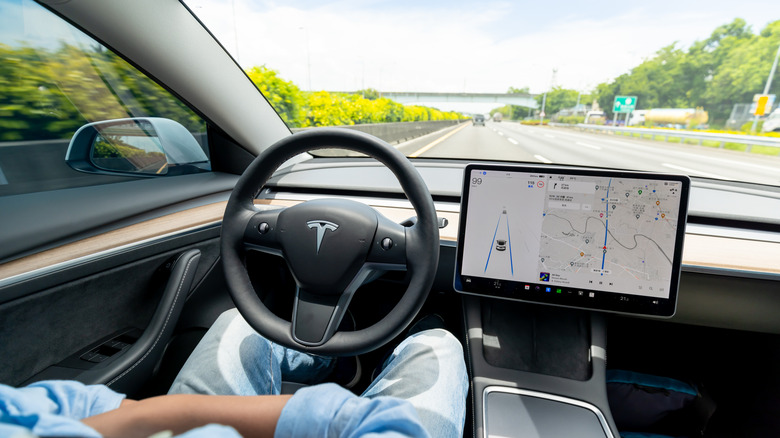
Tesla's Full Self-Driving (FSD) is a technological marvel that has, for the most part, left its growing pains behind. For instance, one Tesla driver made a full self-driving trip from Los Angeles to New York, which proves that the mode is finally capable enough to take the reins with minimal human input. Unfortunately, give humans anything, and they'll find a way to misuse it. As a driver of a self-driving car, you should always stay awake, but since the Tesla FSD is effective, some owners owners have become perfectly comfortable getting some shut-eye with the FSD on.
In November 2026, a Canadian Tesla Model Y driver was stopped by the Ontario Provincial Police in Ottawa and was charged $490 CAD for sleeping behind the wheel. This was more than just a quick nap; the officer reported that the driver had their eyes closed and their hands didn't even touch the steering wheel. This isn't an isolated case, mind you, as Canadian police spent the entire year catching various drivers counting sheep with the Tesla FSD enabled. It's not a problem limited to Canucks either. In the US, the Democratic lawmaker Raja Krishnamoorthi even urged the National Highway Traffic Safety Administration to bring the regulatory hammer down on Tesla. As proof, the Illinois representative highlighted a news report that compiled as many as 43 videos showing Tesla drivers sleeping with FSD on.
Aren't there safeguards in place to stop this from happening? Yes, but they're easy to circumvent. The cabin camera that watches the driver can be beaten with a pair of sunglasses (or by simply covering it with a piece of paper). The Tesla FSD system also requires you to add torque to the wheel, but just resting your hands on the rim is enough to prove that you're still engaged.
How dangerous can sleeping with FSD be?
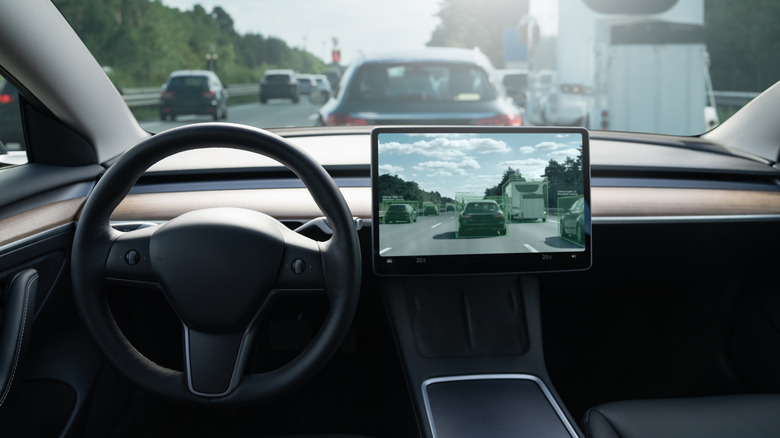
Tesla itself classifies FSD as an SAE Level 2 system, meaning that it takes care of braking, acceleration support, and steering. However, this classification also requires the driver to supervise the vehicle. The main reason is to maintain situational awareness to avoid edge cases that the system may struggle with. Think of an edge case as that crazy, erratic driver on the highway or random pedestrians. Regulations for FSD in most US states require active supervision, thus, dozing off could be categorized as reckless driving.
It goes beyond sheer legality. The idea that FSD software can't make mistakes is one of the most damaging myths about Tesla Self-Driving. There are simply too many accidents with fatal outcomes that prove this high-tech autonomous software is not foolproof. Tesla may do well when everything is hunky-dory, but on May 31, 2026, one running FSD slammed into an overturned truck, killing three occupants. A few months later, a Tesla on autopilot sped off a road and collided with a house. The driver survived, but the woman inside the house was killed.
These particular cases didn't even involve sleeping drivers, so the idea that someone would carelessly leave their fate (and the fates of other citizens) in the hands of software is a lot more concerning. What adds fuel to the fire is that Tesla itself may be unwillingly incentivizing such behavior, with Elon Musk himself claiming that the v14.3.3 update of the software makes FSD "nag" drivers less. Moreover, Tesla has yet to implement an effective solution. The system may detect a driver conking out, but instead of pulling the vehicle over, it only alerts the driver to stay focused — something that's obviously not good enough to protect people sharing the road with one of these EVs.