

Why We Have Undersea Tunnels But No Under-Ocean Tunnels
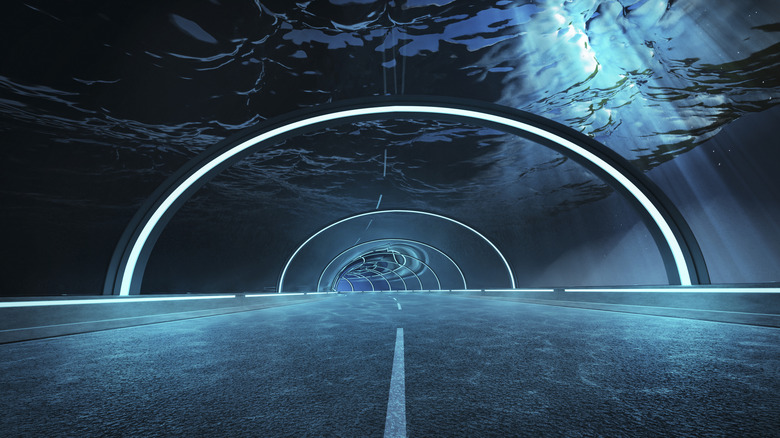
Norway is deep into constructing the world's longest undersea road tunnel, stretching approximately 16.5 miles and around 1,300 feet beneath sea level. The Rogfast project is using controlled explosions to carve a tunnel through underwater rock formations shaped by millions of years of tectonic and volcanic activity, while engineers design ventilation systems to supply fresh air and remove vehicle emissions. Even at its deepest point, Rogfast's depth is still relatively modest when compared to the average depth of the world's oceans.
The average oceanic depth is approximately 12,080 feet. No full-scale transport tunnel beneath the deep ocean floor has been developed to date, largely due to the immense engineering, logistical, and economic challenges involved. Water pressure is easily one of the biggest complexities. Pressure increases by one atmosphere (the air pressure at sea level) every 33 feet of seawater. Hypothetically, any engineering team attempting to bore a tunnel beneath the deep ocean floor would have to design it to withstand the immense pressure exerted by the overlying water. However, this is just one aspect, as geological instability, the risk of catastrophic leaks, along with enormous power requirements, construction time, and cost, would make building and operating an under-ocean tunnel extraordinarily difficult.
Why under-ocean tunnels are so difficult to build
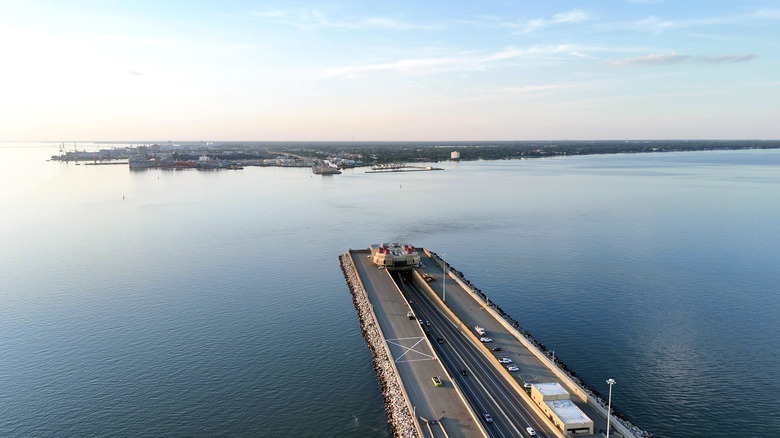
Unlike a construction site on land, much of the seabed is covered with layers of sediment, making it harder for engineers to investigate the ground conditions before excavation begins. Down there, engineers could encounter fractured rocks, faults, unstable formations, and pockets of groundwater during excavation. It's a particularly nasty combination when such unpredictable geological conditions are combined with high water pressure. Water can find its way into an excavation through cracks and fractures connected to water-bearing formations, potentially causing sudden water or mud inrushes. This happened during the construction of China's Xiang'an Subsea Tunnel in October 2006, when workers encountered a major water inrush while excavating through a heavily weathered rock formation known as the F1 trough.
And flooding isn't the only thing engineers would have to worry about. Digging through weak or heavily fractured rock could disturb the surrounding formations, potentially causing sections of the underwater tunnel to deform or even collapse. Things could get especially messy around fault zones, where the rock may already be weakened or badly fractured. Keeping the tunnel stable under such conditions would require additional reinforcement, adding another layer of complexity to an already difficult project.
Can current tunneling methods overcome deep-ocean conditions?
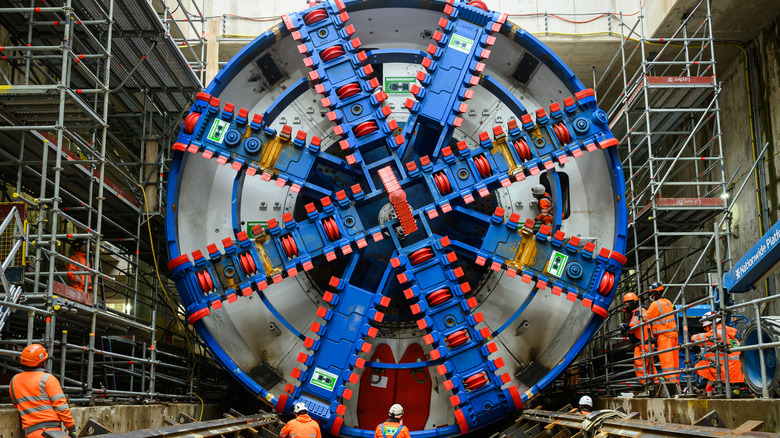
Tunnel boring machines (TBMs) offer an alternative to drill-and-blast excavation, the method used in Norway's Rogfast tunnel. Their giant rotating cutter heads grind through rock and soil, while the machine installs concrete lining segments behind it to support the tunnel. The Channel Tunnel between England and France is a prominent example, stretching 31.4 miles overall, with 23.6 miles running beneath the English Channel. Despite its scale, the tunnel reaches only around 246 feet below sea level at its deepest point.
The immersed-tube method takes a different approach. Instead of boring through the seabed, engineers construct large, watertight tunnel sections on land, tow them into position, and lower them into a prepared trench on the seabed. The sections are then connected and covered with protective material. The Hong Kong-Zhuhai-Macao Bridge uses this technique for its 4.2-mile underwater tunnel, which consists of 33 massive immersed elements. The tunnel's lowest point is approximately 151 feet below the sea surface.
A more experimental concept is the submerged floating tunnel, which would remain suspended underwater using buoyancy and anchoring systems rather than resting on the seabed. Norway has explored this approach for a proposed crossing of Sognefjord, where water depths reach approximately 4,101 feet. The proposed 2.3-mile crossing would use two parallel tunnel tubes suspended just 66 feet below the water's surface and supported by 16 pontoons. The concept tackles the challenge of crossing deep waters, but tunneling beneath the ocean floor remains a problem without a proven solution.