

How Do They Build Underwater Tunnels?
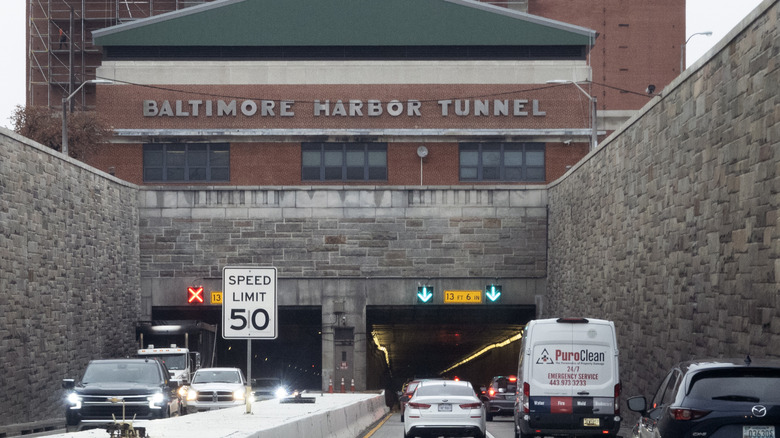
Tunnels are easy for groundhogs to dig; not so much for humans, even with our persistence. That is especially true when those tunnels are underwater, yet somehow, many of us have daily commutes that take us from one side of a harbor to the other. You might know of those giant tunnel boring machines or TBMs that have made the job of cutting earth easier and safer — Virginia's largest-ever infrastructure project underneath the Chesapeake River was recently helped along by a TBM named Mary — but the origin of underwater tunneling might be a bit more boring (pun intended) than you'd think.
The Thames Tunnel in London began construction in 1825, took 18 years to build, and was the third such attempt at such an under-river crossing. British-French engineer Marc Brunel patented a tunnel shield that he said was inspired by how a naval shipworm ate through wood: boards lined a cap between the dirt and miners who would open each one of them, dig out several inches behind, close the board, and repeat. Once a full section was cleared, workers would auger the shield forward while bricklayers furnished the actual tunnel. At about a quarter of a mile long, the job caused the occasional flood, claimed six workers' lives and the good health of many others. Unlike those earlier attempts, however, this project didn't get washed out. The tunnel opened to pedestrian traffic in 1843.
There were a few advancements that improved the tunnel shield during the 1800s: the conversion from a square shield to a circular one; the introduction of compressed air helped keep water away from the dig, and; the injection of a grout lining to reduce impacts from settlement. Wood and brick gave way to cement and steel. But it would take more than a century before tunnel cutters came into their own.
Running underwater? Build it above ground
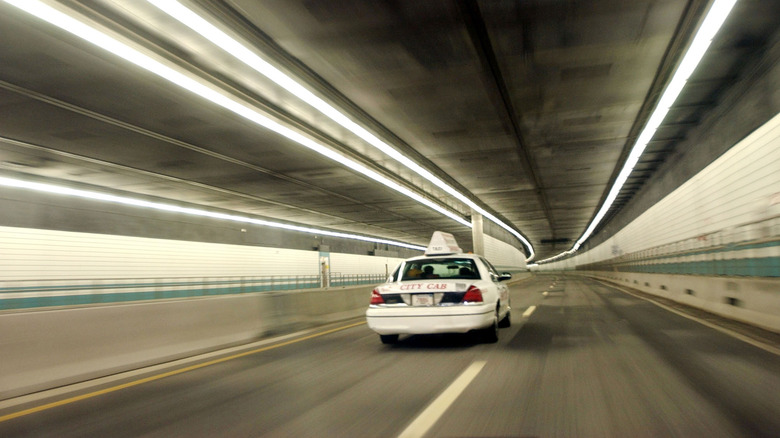
In the space between came another technique that was first recorded in the 1890s called immersed tube construction. For modern projects, sections of tunnel are fabricated above ground and then literally floated on-site by tug boats before a catamaran cradling barge aligns it into position. Ballast is loaded onto the tube portion to gently lower them onto a dredged and filled bed. The barge finally drags the tunnel section into its awaiting stub. The interlocking between the two sections is drained and fill material is then dumped to cover the connection. The first transportation tunnel to be built with this general method was the Michigan Central Railway Tunnel in 1906 which connected Detroit with its Canadian neighbor of Windsor, Ontario, just over a mile away.
Not every subaqueous crossing calls for boring machines or pre-cast tubes. For its Big Dig, the city of Boston partially drained the once-busy Fort Point shipping channel to construct an approach tube to a larger harbor crossing in the mid 1990s. A mix of somewhat novel techniques were used to keep the soil from collapsing in on the site while protecting the nearby Gilette razor manufacturing facility as well as existing subway tunnels. Engineers injected columns of grout to stabilize the ground before later refrigerating a grid of brine-filled pipes to freeze another section. This allowed MBTA Red Line trains to continue running just five feet below where a new underwater highway ramp was to be. Other tunnels in the Big Dig project, including that harbor crossing, also used immersed tube construction and other MBTA services including the commuter rail were not impacted during more than two decades of work.
At last, the tunnel boring machine
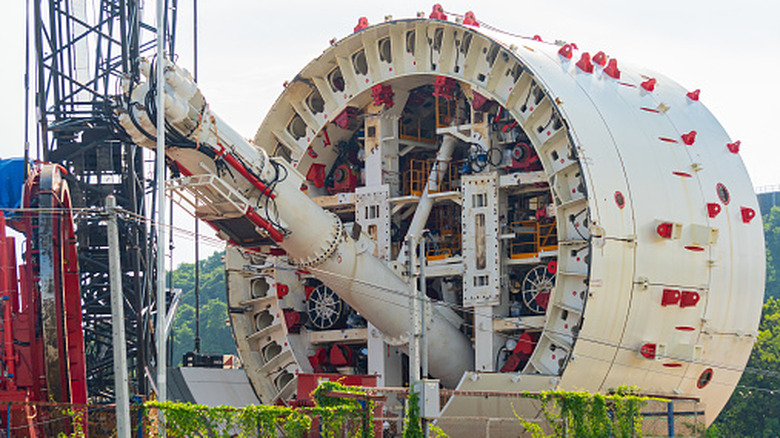
Attempts at cutting machines in the 19th century were unsuccessful. Belgian engineer Henri-Joseph Maus built a so-called "Mountain Slicer" in 1846 to tunnel through the Alps, but subsequent populist revolutions cut off his Sardinian royal line of credit. At the foot of the Hoosac Range of Massachusetts, the Wilson Patented Stone-Cutting Machine made it through about 10 feet of rock before giving up the goat in 1851.
Fast forward to 1952 when mining engineer James Robbins developed the first successful tunnel-boring machine that was put to use building Oahe Dam in South Dakota. Ahead of the machine's worker shield was a rotating head filled with incisors and cutting discs that worked at the site's soft shale rock. Designs have changed over time as further projects presented grander requirements, tighter constraints, and new embedded challenges. For example, in soft soil conditions, a slurry shield may be used where liquidized clay is pumped into the cutter head to maintain pressurized conditions favorable for excavating the soil. This mixed sludge is pumped back through the shield, and the clay is then separated for re-use.
TBMs are used for all sorts of tunnels, including those running underwater. 19 machines were used over the course of a dozen years to build Sydney Metro's network of transit tubes, a good portion of which run underneath harbors, rivers, and bays. Meanwhile, The Boring Company, an Elon Musk venture wants to use a TBM to create a 200-mph tunnel between San Antonio and Austin, Texas.