

Should You Put Your Left Or Right Foot Down When Stopping A Motorcycle?
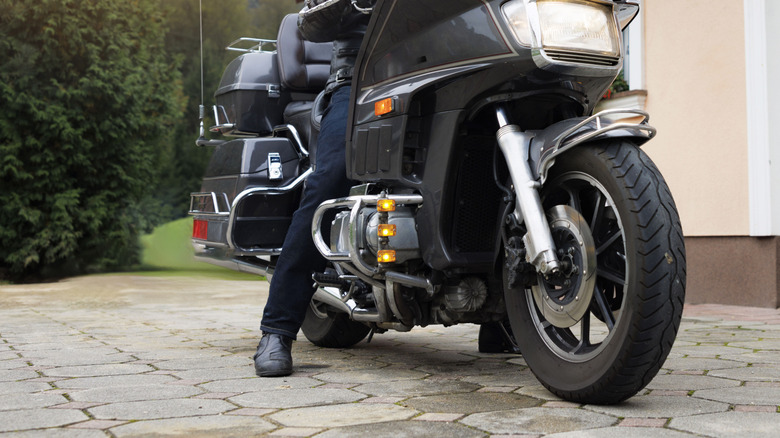
The thing about manual motorcycles is that they keep all four of your limbs busy at once. The legs play just as important a role as the hands, with the right foot controlling the rear brakes and the left the gears. But a motorcycle cannot balance itself, which is why when you stop moving, you're forced to give up one control for a moment. That choice can be confusing.
To clear things up, the National Highway Traffic Safety Administration (NHTSA) has standards in place that ensure specific functions for each foot. Federal Motor Vehicle Safety Standard No.123 requires the right foot to operate the rear brake, while the left foot gets the gears. This also means that the answer to which foot comes off first is the same on nearly every manual motorcycle in the U.S. Even that rule has a nuance, as there's a right time to use the rear brake on motorcycles.
A rider once asked the question in the Ask The MSF column of American Motorcyclist magazine in 2018. The Motorcycle Safety Association (MSF) responded that for brief stops, riders should usually stay in the first gear, and lower just the left foot to the ground. The right stays on the footrest. However, this isn't necessarily a strict rule. The foundation added that you still have a choice, and it comes down to the situation and your experience — the MSF says it isn't aware of any law on the subject.
Why the left foot hits the ground first
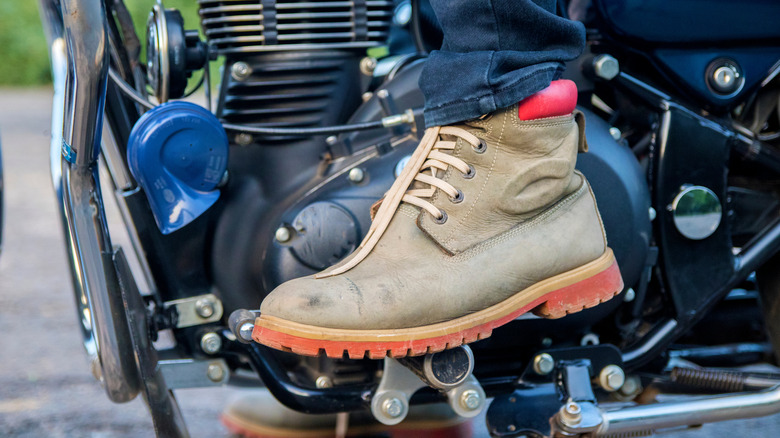
The MSF also has its own "Motorcycle Operator Manual", a booklet designed for bikers and state licensing programs. It notes that as the riders slow down, they should shift down through gears. But once stopped, it's best to stay in first so they can pull away quickly. At that point, the gear shift has served its purpose, so you can spare your left foot until it's time to go. That's not the case for the right foot, though. Since it has to keep braking until the final moment, it clearly can't be the one reaching for the ground. It's not just the MSF either, since Honda has similar advice for its riders in the owner's manual for its 2025 CRF125F trail bike.
There's an important reason why bikers are adviced to stay in first gear for brief stops. The chances of getting rear-ended at signals are low but never zero. To guard against that, you stay in first so that if a car comes up behind too fast, you can simply accelerate. All you have to do is let the clutch go, pull your foot up, and flee at the first hint of danger you spot in your mirrors. If you do get rear-ended, keeping your right foot pressed on the break means you are less likely to be thrown forward into traffic. Learning intricacies like these is exactly why a motorcycle safety course is a good idea.
When the left foot isn't the answer
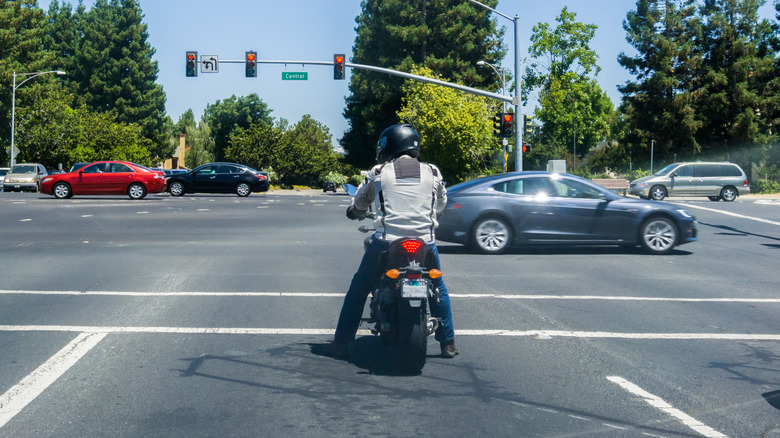
Having the right foot on the brake also comes in handy for hill-starts. That's because as soon as you let go of the brakes, your bike wants to roll back. Sure, your right hand has the front brake on tap, but it's busy with the throttle. Keeping the right foot on the brake — and left foot on the ground — ensures your bike stays put until you're ready to pull away.
That said, you don't always have to pick between your feet. For longer idling periods — like at an especially lengthy red light — riders can cut fatigue by putting both feet down. You shift to neutral, which shows up as an "N" on a motorcycle gear indicator, and let go of the clutch. The MSF says that in this position, you can hold the front brake instead. Moreover, in a traffic jam, you'd want to use both feet to crawl along as the traffic inches forward. And for heavier bikes with lots of luggage or a passenger at the back, planting both feet helps with balance.
In some cases, though, you'd be better off putting your right foot instead. A rut or a slope on your left means you'd have to put the right out rather than the left. Rider Magazine recommends doing this to keep the bike from tipping over, while using the front brake instead of the rear. So for most stops, the left foot goes down and the right covers the break, but the road and the length of the wait can change the answer.