

What Does 'N' Mean On A Motorcycle Gear Indicator & Why Does It Come After '1'?
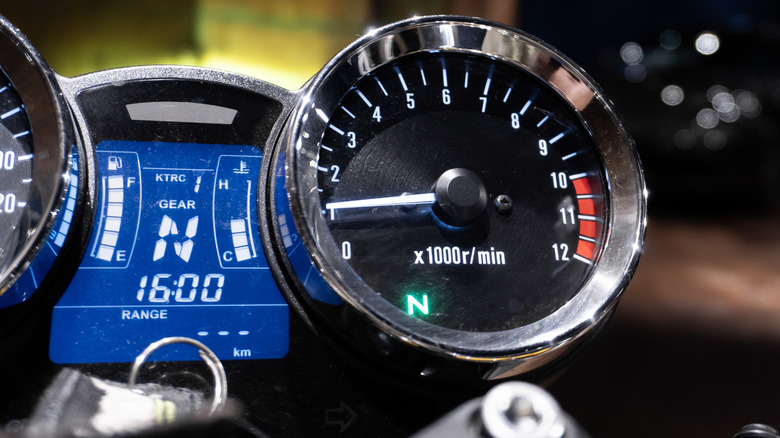
In cars, selecting gears is a fairly straightforward process, and there's no scope for confusion since those are all clearly mapped out. But a motorcycle transmission relies a lot more on feel. A lot of it comes down to the sequence of your foot clicks and the subtle tactile feedback that comes with it. That said, many modern motorcycles have indicators on the dash. When it displays N, it means no gear is engaged inside the box, and the engine spins happily on its own without sending any of that rotation to the rear wheel. That's exactly why riders pop into it at red lights, in the garage, or when they're rolling the machine around a parking spot by hand. They can disengage the clutch without any fear of the bike jumping forward.
But getting to neutral isn't as straightforward as you'd think. To engage it, you nudge the shift lever halfway up from first gear, which is where the position lives on most modern bikes. Of course, you can also get to neutral by gently nudging down from second. Some riders actually even find this easier than going up from first, especially once the bike is stopped. Once you properly get into neutral, the light for it flicks on.
Why does N come after '1'?
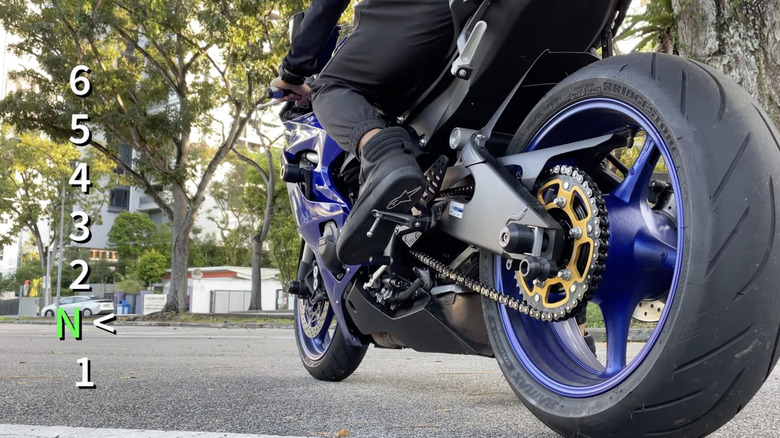
The standard shift pattern, on most motorcycle transmission types, goes 1-N-2-3-4-5 and so on. That may look odd at first, but it's actually a deliberate choice, designed for safety. You'd realize it if you were on the road and a situation demanded you stop immediately. In this case, you'd typically jam the gear lever downwards at the same time you slam the brakes. If neutral were the bottom option, that's where you'd end up, which would leave you coasting with zero engine braking. That can put you in a dangerous spot, and it's the same reason you should never coast in neutral while going downhill. If you're still tempted to use N going downhill to save fuel, just know that's one of the fuel myths you should stop entertaining.
How this setup came to be

Before the 70s, bike makers used to do their own thing when it came to gear layouts. The Bridgestone 175 DT, for instance, had an optional rotary shift pattern that actually looped through the gears, meaning you could tap down repeatedly to roll through first, second, third, fourth, and then pop back into neutral. Many British bikes mounted the shift lever on the right side, too, sometimes with the first up and the rest down.
It was all pretty confusing, so to eliminate the risk of riders mixing things up on the road, the US government stepped in. A 1974 federal law mandated a universal standard. Because the American market was so influential, it forced a global shift, which is why virtually all modern manual bikes today use the exact same left-foot-operated pattern.
Fun fact: there is an exception to the neutral rule, and that's MotoGP machines. On those, neutral actually lives below first gear instead of above it. Selecting it isn't straightforward either, since riders have to flick a little lever on the handlebars to unlock it. This is deliberate and acts as a tiny hurdle riders have to clear because accidentally kicking into neutral at 200 mph in the middle of a corner would end badly.