

What Does A Road Sign That Says 'Inherently Low Emissions Vehicles' Mean?
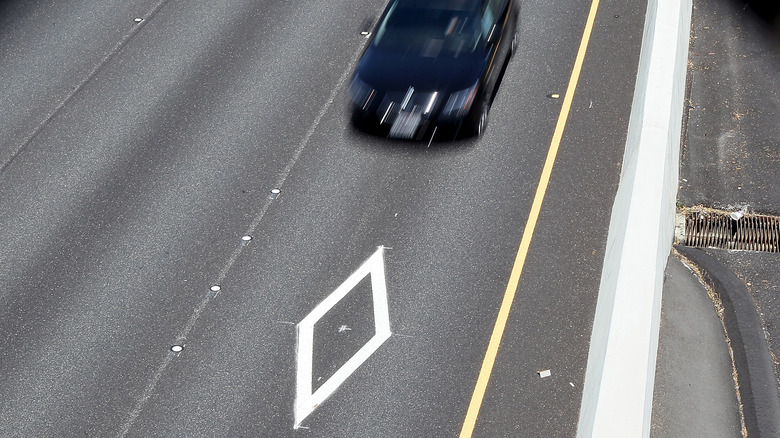
Have you ever been driving down the highway and spotted a black and white road sign talking about "Inherently Low Emissions Vehicles"? It's one of the most confusing signs ever, and with drivers flying by at highway speeds, there's not exactly time (not to mention adequate space) for the sign to explain what that means to people who aren't in the know. Is it an invitation for anyone driving an environmentally friendly car to enter the lane? That's what you'd assume when you see the "Low Emissions Vehicles" part, but Inherently Low Emissions Vehicles (ILEVs) are something much more specific than an EV alone.
Since the early 1990s, the sign has been used to mark a special exception to high-occupancy vehicle (HOV) lane restrictions. When posted, only certain vehicles with specific Environmental Protection Agency (EPA) certifications have permission to use the lane, even if they fall below the minimum passenger requirement. These vehicles were known as inherently low emission vehicles, or ILEVs. The designation pre-dated the transformation of Tesla that helped popularize electric vehicles, so it's not used nearly as often today as it was 20-30 years ago.
What was considered an ILEV?
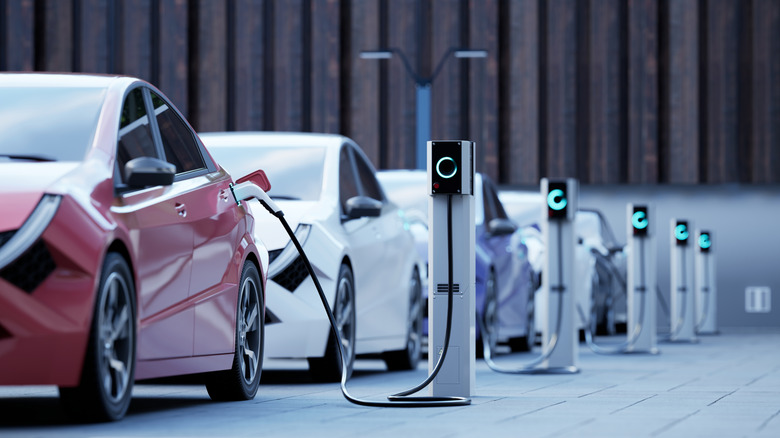
Unlike ordinary low-emission vehicles, ILEVs had to meet a specific set of federal standards for controlling emissions that was defined by the EPA. The agency's standards specifically targeted hydrocarbon emissions and other fuel vapors that might escape from a vehicle. Unlike exhaust emissions, which are a natural result of the combustion process, evaporative emissions occur when fuel releases hydrocarbons into the atmosphere. ILEVs are designed to keep these emissions exceptionally low without depending too much on mechanical emission-control components that could hypothetically malfunction.
When established in the '90s, ILEV categorization included certain light-duty vehicles, light-duty trucks, heavy-duty vehicles, and alternative-fuel vehicles. Federal regulations established the requirements and labeling provisions, and the EPA was also the one and only authority that could grant ILEV certification. That means manufacturers had to request approval before a vehicle could carry the designation. It's not something you can apply for as a driver, as it has to come with the car from the factory. All that said, it's been mostly rendered outdated by the EV boom, so you won't often see "ILEV" used anywhere but on the remaining HOV signs on highways in the U.S.