

What Does A Black Road Sign With A White Diamond On It Mean?
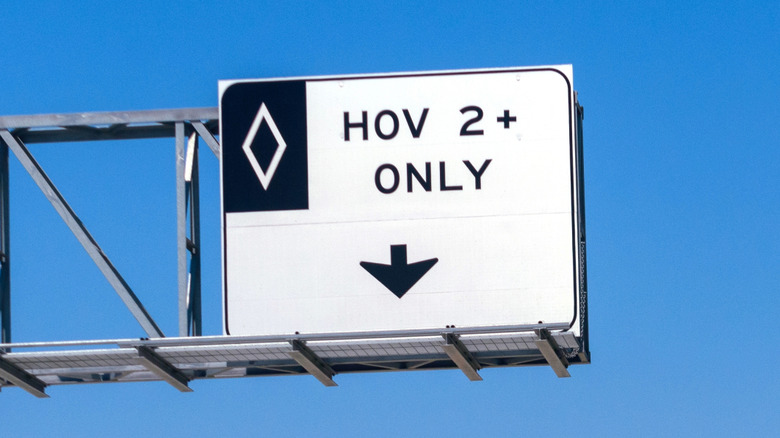
Regulatory signs are probably the most important road signs you see while driving. These signs indicate that you would be breaking the law if you don't follow them, leading to fines, penalties, or worse, depending on the situation. Many of these regulatory signs are quite clear, such as a speed limit sign, a stop sign, or a no parking sign. There's are some signs that are bit more mysterious though, like the one featuring a black rectangle with the outline of a white diamond inside of it, which indicates a High-Occupancy Vehicle (HOV) lane.
When you see this sign, it means that the lane is only to be used by vehicles with two or more passengers inside of them. They must be human passengers, too, so pets or human-shaped dummies don't count. Some people refer to these a carpool lanes. HOV lanes first started popping up in the 1970s, and their primary goal was to help reduce emissions by encouraging people to ride together, thus reducing the number of cars on the road. This would also help ease traffic.
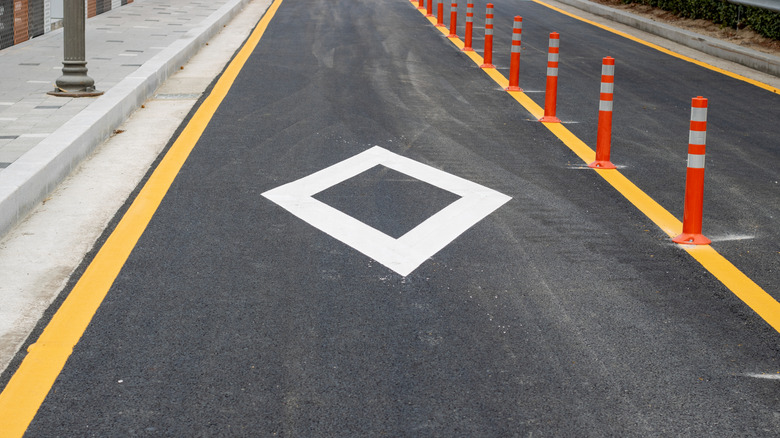
However, HOV signs aren't the most common road signs. After Florida eliminated them in 2025, only about 20 of the 50 states now have HOV lanes; they're most commonly (though not always) seen on major highways. Not only will you see the sign with the diamond on it, but sometimes, the road itself will have the diamond painted on it, just to make sure you know what lane you're driving in.
Other vehicles that can use HOV lanes
While the two or more passenger vehicle is the most common use of an HOV lane, there's actually other vehicle types welcome to use them as well. When it comes to multi-passenger vehicles, this also extends to buses and taxis with passengers (taxis with just the driver can't). Some HOV lane signs will even feature a picture of a bus or taxi on it. There are some multi-passenger exceptions though: Since this lane is meant strictly for passenger vehicles with two axles, a truck with more than two axles can't use an HOV lane, even if there are two or more people inside.
A significant multi-passenger exception goes the other way, too, and that's with motorcycles. By and large, motorcycles are free to use HOV lanes, even though just one person may be on them. This may run counterintuitive to the spirit of the lane, but it's all about increasing safety. It's much more difficult for a two-wheeled vehicle to safely operate in start-and-stop traffic, so they're allowed in the HOV lane that's more free-flowing for traffic. That said, motorcyclists must still abide by the local regulations for things like lane-splitting.
Until October 2025, drivers of EVs and hybrids were able to use HOV lanes even with only one person in the vehicle. Now, these drivers have to get a special exemption, which varies state-by-state when it comes to what kind of vehicles are eligible, and they'll usually be given a special decal or license plate indicating they may use an HOV lane. Lastly, any emergency vehicles can use them as well.
Some HOV lanes have special circumstances
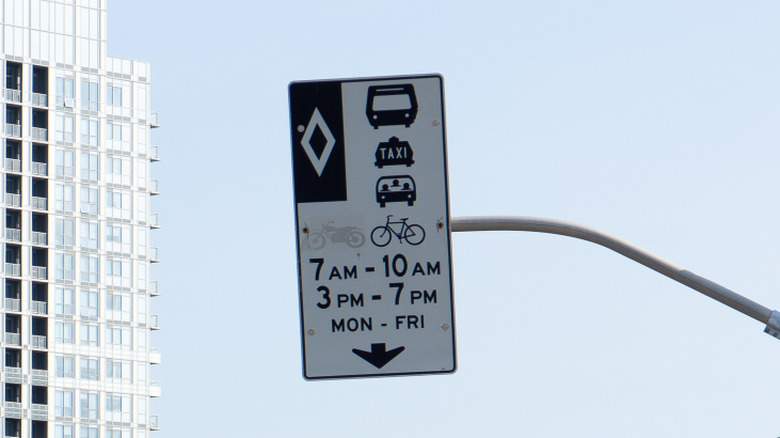
But not every HOV lane in the country operates the same way. Luckily, HOV lane signs will typically include other information on the sign to indicate important specifics, like what kind of vehicles can be used in those lanes. While most HOV lanes accommodate passenger vehicles with at least two people inside, there are some HOV lanes that require a third passenger before getting into them. Other times, you may see a sign that says a regular bicycle can use the lane as well.
Another important factor for some HOV lanes are what times that lane actually acts as an HOV lane. If you see an HOV lane sign with hours of the day and/or days of the week on it, that's when that lane operates as an HOV lane. Outside of those posted hours, it works as just a normal lane of traffic. You may also see this diamond-symboled sign at the end of an HOV lane, letting you know that it's transitioned from an HOV lane to a regular traffic lane.
The other crucial indicator is whether or not these HOV lanes are also toll roads, specifically, High-Occupancy Tolled lanes, or HOTs. These lanes require you to pay a toll to ride on them, which may be fixed or dynamically priced, and you must abide by the particular HOV rules of that road as well. These are different than express toll lanes, which single-driver vehicles are able to use. Rarely is the black rectangle with the white diamond on a sign alone, though, so most of the necessary information will also be visible on that sign.