

How Long It Took To Cross The Atlantic By Ocean Liner In The 1950s Vs. Today
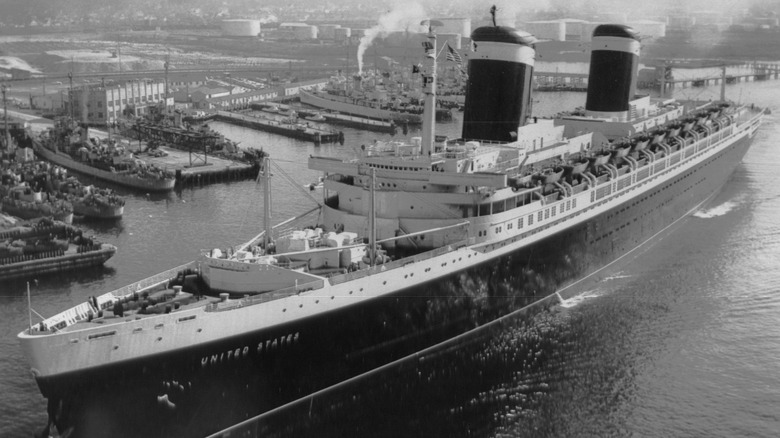
It's almost baffling that the fastest Atlantic crossing by an ocean liner was achieved nearly 75 years ago and hasn't been beaten since. The SS United States, set to be sunk off the coast of Florida soon, set the record by crossing from New York to England in just 3 days, 10 hours, and 40 minutes. It did so in July 1952, as part of its maiden voyage. During that era, the typical express liner voyage took around five days.
Today, ocean liners are largely a thing of the past. In fact, there's only one that still runs through roughly the same route — the Queen Mary 2, operated by Cunard Line. However, it usually takes seven days to complete it. Cunard's itinerary for a December 2027 westbound sailing says the ship starts in Southampton, takes six days at sea, and concludes in New York on Day 8.
It's a fair comparison, too. The Queen Mary 2 is the only liner still running a scheduled liner crossing like the express liners of the 1950s. Even so, it takes two days longer than the average trip of decades ago and nearly twice as long as the super-speedy SS United States.
And it's not just ocean liners that are taking longer, since regular cruise ships are slower, too. Royal Caribbean, a cruise company, says that its ships average 18 to 20 knots. At that speed, covering the same 2,949-nautical-mile route non-stop would take roughly six to seven days. However, the actual voyages are slower since these ships tend to spend time at port stops such as the Azores and Bermuda. As an example, Celebrity Cruises says its ships take 11 to 16 nights to cross the Atlantic.
Why does it take longer now, when ships are newer?
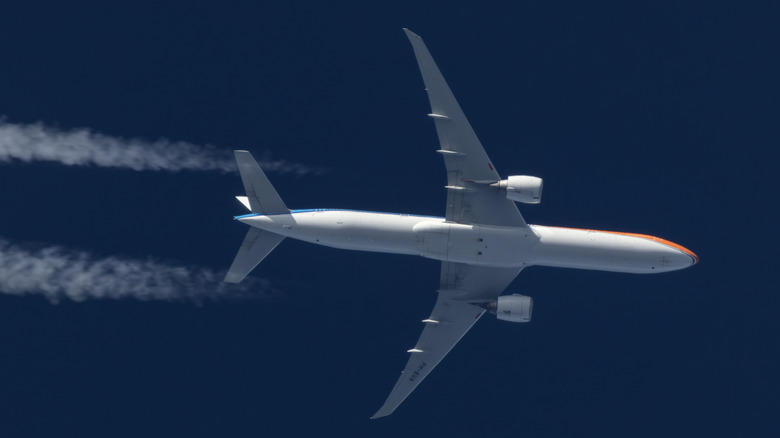
The main reason is that people don't book ocean liners or even cruise ships for the speed anymore. In fact, not long after that record was set, liners were already starting to lose travelers to jets. In 1957, more people crossed the Atlantic by air than by sea for the first time, enabled by propeller planes like the Lockheed Constellation. Then came the Boeing 707, a wholly different beast: It could cruise at nearly 600 mph and complete a transatlantic trip in just over six hours. So obviously, anyone who traveled by ship to cross the ocean in the shortest possible time simply gave up on them.
By 1968, Cunard, a major passenger line at the time, lost more than $40 million on its passenger ships over six years. It then repositioned itself to avoid competing with jets and decided it would focus on the leisure business instead. Naturally, speed stopped being a priority: People on vacation don't normally wish their trips to end in the shortest possible time.
Today, Queen Mary 2 crosses at about 21.5 knots, according to a 2012 Business Travel News report. This is slower than the original Queen Mary, which sailed from 1936 to 1967, at 28.5 knots. Besides the lack of need for speed, some of it has to do with cost. The thing with the Queen Mary 2 is that it runs on two kinds of engines: a pair of gas turbines and four diesel engines, and diesel engines are cheaper to run.
A faster liner is possible, but costly
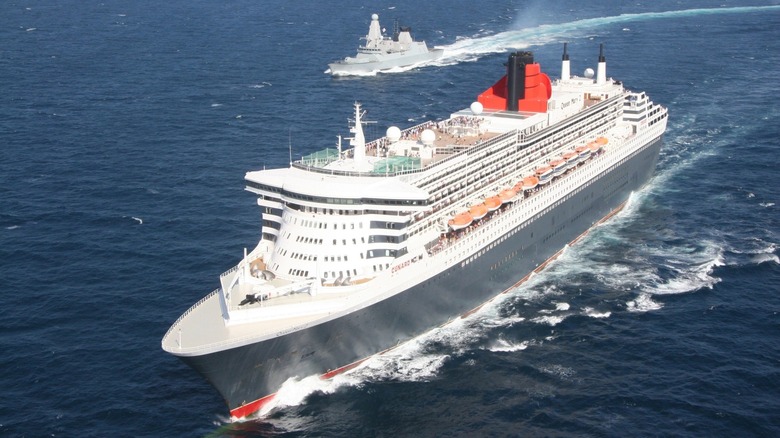
The thing with ships like the Queen Mary 2 is that they rarely go all out. The ship's own chief designer, according to an Ingenia report, says that it was contracted for a top speed of 29.35 knots, though it could go even faster in sea trials, hitting 29.65 knots. This specific speed, the report adds, was picked after studying the logs of Cunard's previous liner, then tested against five years of real Atlantic weather. It lets the ship make up any lost time if it ever gets delayed by weather.
Beyond operating costs, building faster ships is also pretty expensive. Speed and rough seas are a formula that doesn't mix together — you need a deeper hull and extra strength, especially to push through stormy weather, and that quickly raises costs. In fact, according to the Ingenia report, building a true ocean liner with its specific strength requirements incurs a 40% increase in the cost of construction versus a cruise ship of the same size.
Supersized ships also need much more power to move fast, which we observe with the Queen Mary 2. The Mary 2 measures about 150,000 gross tons and is the largest liner ever. It's nearly three times bigger than the SS United States, which measured 53,329 tons, and nearly twice as big as the largest liners from the 1950s. It also helps that the SS United States had roughly twice Queen Mary 2's propulsion power. In other words, more power for a significantly smaller overall package.