

This '90s Truck Needed More Power, So They Stuck A Diesel Engine In The Trailer
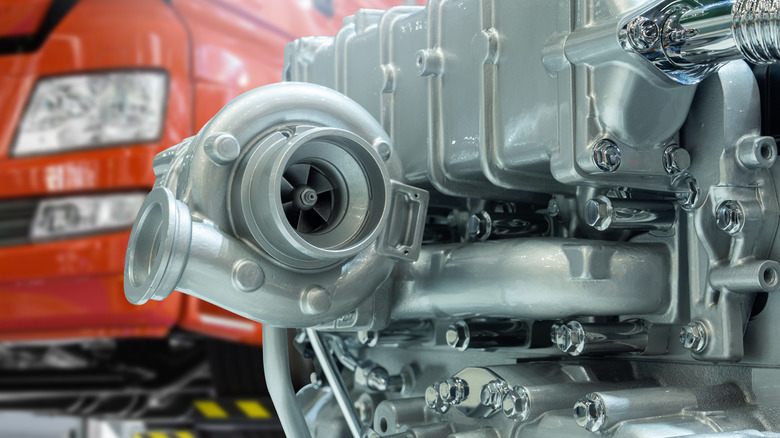
Diesel engines have a number of pros and cons, but they can be a powerful source of extra vehicular oomph, particularly for industrial applications. A diesel engine in a trailer may sound like a bizarre fit, but in New Zealand's Kaingaroa State Forest back in the '90s, it was the defining feature of the Pacific P510 logging truck.
Commissioned by the Magee family and driven almost exclusively by Lance Magee, it operated out of Murupara under its Marathon Truck and Trailer banner. Caterpillar, a storied truck engine manufacturer, supplied the diesel in the rig, a 3406B ATAAC engine. Its lead trailer, meanwhile, added another Caterpillar, specifically a 3406A. Together, the two engines produced a massive 900 horsepower, with the trailer's engine packing muscle farther back in the logging train.
Both engines were turbocharged, 14.6-liter inline-sixes, each connected to its own Allison automatic transmission. The additional engine sat between the lead trailer's axles, giving it its own, independent propulsion.
Built for the demands of Kaingaroa logging
The combo was built to haul logs from remote skids, the areas in a forest where timber is gathered and staged before transport. Getting a fully laden logging train away from skids was a tall order that required a tremendous amount of horsepower. While 900 HP may sound like a wild, unnecessary flex, the Pacific P510 operated as a double, a triple, and occasionally even a quad, meaning it was sometimes required to haul four lumber trailers simultaneously. A pair of diesel engines, which often provide more torque than their gas counterparts, were the only logical answer to get the sheer hauling power necessary.
Murupara had a history of operating trucks in the rugged Kaingaroa wilderness, a plantation forest planted mainly with radiata pine for commercial logging. Former driver Pat Cox recalled Canadian Pacific trucks assembled locally by Kaingaroa Logging Company, with trailers manufactured in its workshops. According to Cox, the front axles of these trucks were so heavy they couldn't be used on highways. Off-highway roads had to be carved out to give those heavy beasts access to the timber and the skids where it was staged. Specialized trucks pulling multiple trailers were a common feature in Kaingaroa, and this P510 pushed the idea to its logical extreme by slapping a second diesel where another truck would haul cargo.