

How Road Signs Helped The Romans Build An Empire
The western half of the Roman Empire fell in A.D. 476, but the eastern half remained intact well into the Middle Ages (1453, to be exact). In total, the Romans were in power for nearly 1,500 years, and during that time, they built a staggeringly vast network of roads. A study published in November 2025 estimated they built nearly 186,000 miles of highway. These hard-packed thoroughfares helped carts, wagons, carriages, and chariots move more easily across Rome's vastness. However, they were actually built for another purpose altogether.
At its height, Imperium Romanum impressively stretched for almost 2 million square miles. It achieved this monumental feat by getting its much-feared legions to far-flung locations quickly and efficiently to conquer those lands. Roads have been around for a long time, and the Romans weren't the first to build them, but they certainly perfected them. And what is inextricably linked with virtually all roads? Signs.
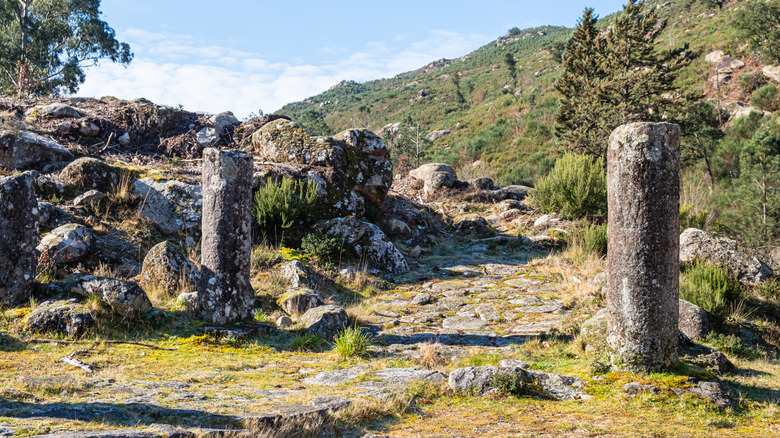
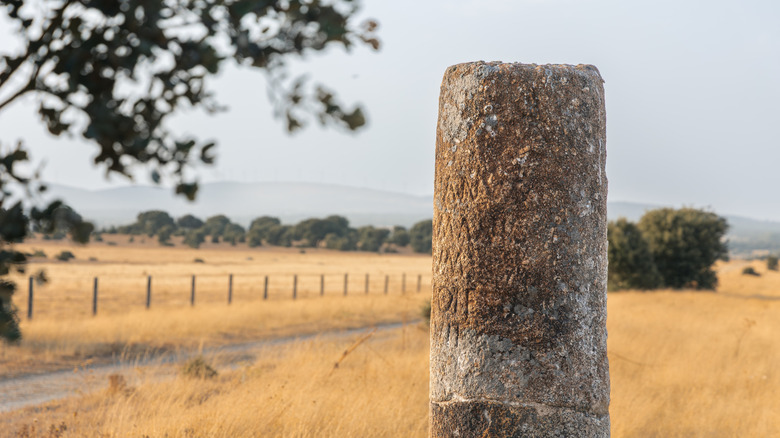
The first Roman road sign was called a milestone because it represented a single Roman mile, defined as 1,000 paces, with each pace equaling 5 feet. Quick math gives us 5,000 feet, which is very close to today's statute mile at 5,280 feet. The milestone originally appeared along Rome's first great road, the Appian Way, which began construction in 312 B.C. as the world's first superhighway, and initially stretched from Rome to Capua. Milestones marked the distance along the road, which helped travelers determine their position. The stones also provided additional information such as the date the road was built, when it was last repaired, and who funded the road's construction.
All roads lead to Rome
Roads and milestones were key to Rome's expansive power. When Rome captured a new location, it built additional roads linking provincial capitals, seaports, towns, and military compounds. Cutting swaths of new road not only reduced travel time but also increased marching speed and the army's ability to strategically attack. Legions were able to march up to 20 miles a day thanks to these engineering marvels.
As part of a much larger network, roads and milestones were integral to a well-organized infrastructure that allowed the empire to expand farther from the beating heart of Rome itself. Rome also built roadside hotels, way stations, and a network of horse-changing stations every 10 miles that let government officials swap a tired mount for a fresh one and continue their journey without delay. Imperial couriers tasked with running messages across the vastness of the empire could travel upwards of 60 miles a day, helped by the milestones flanking the roads.
Milestones were crafted from stone — usually marble or granite — to truly withstand the test of time. They acted much like our modern-day metal mile markers, which are helpful but don't include nearly as much information as the ancient Roman versions. Many milestones stand in their original spots; others have been moved to museums over time.