

This Handheld Trencher Is Like A Chainsaw Made For Digging
We may receive a commission on purchases made from links.
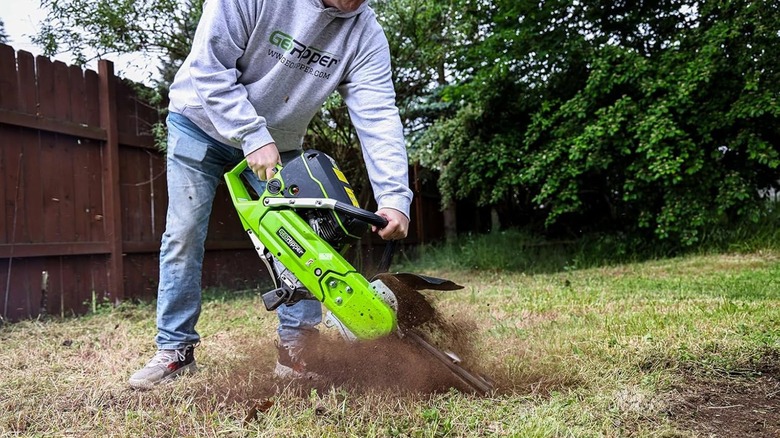
Have you ever tried digging a small trench in your garden or property using nothing but spades and shovels? It's as tough as chopping down a tree with a small handsaw. Fortunately, just like chainsaws make cutting wood easier, there's machinery that can offer a similar level of aid while digging. For vertical holes, you can get by with purchasing a Ryobi auger or something similar, but for trenches, you're much better off trying a handheld trencher that looks and operates like a chainsaw.
Designed for smaller DIY projects, landscaping trenchers are compact with the ability to dig as deep as 27 inches. Much like a larger trencher, a handheld one rips into the dirt with steel teeth on a wheel or a chain. The key difference is the size and easy maneuverability that far exceeds the mobility of more "serious" equipment. However, while it doesn't require training or an elaborate setup (which is undoubtedly its main selling point), a handheld trencher has a few drawbacks you should be aware of. Just like chainsaws are tools with a sizable track record for injuries, handheld trenchers can be equally hazardous.
For instance, if you hit a rock or any solid object with this tool, the kickback could lead to an injury if your hand slips off the handle. You could also get hurt by the flying debris. The other drawback is the price. Quality handheld trenchers are only marginally more affordable than larger equipment. A sit-on towable backhoe by Harbor Freight and its alternatives sit in the $3,000 range, while a handheld TerraTrencher (despite its size) costs around $2,750.
What are the alternatives to the handheld trencher?
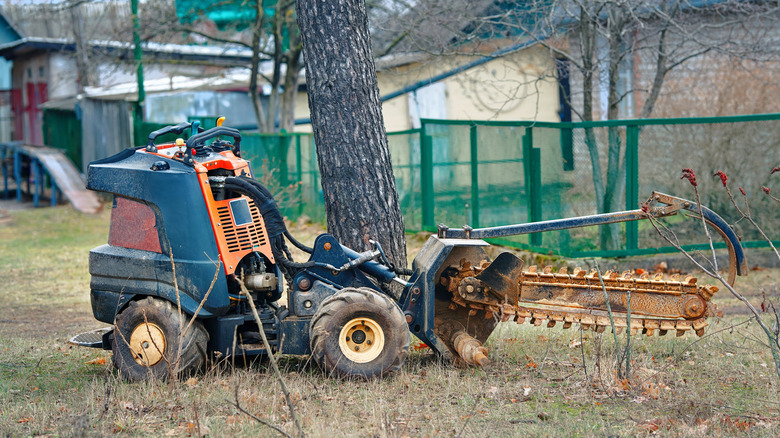
You don't have to go back to spades and shovels if the trenching chainsaw isn't the right fit for you. There are plenty of larger (yet still somewhat compact) machines you can purchase for smaller DIY projects. The aforementioned towable backhoe is a small version of an excavator that will do just fine for digging canals, and it's equally as useful for other tasks, such as clearing away stumps or removing larger debris.
Alternatively, you can get a walk-behind trencher. It's much easier on your back than a handheld trencher, but as with many models, you'll probably have to slowly walk backwards behind the machine as it digs (not everyone's cup of tea). It's also not considerably cheaper than a backhoe and will end up costing you at least $3,000 or more, which makes the chainsaw trencher the wallet-friendlier option.
Considering the higher admission costs of these machines, you could rent one to avoid the upfront costs. Whether this is right for the project you're doing depends on its length, as rentals for equipment like trenchers land in the $150 to $350 range. It goes without saying that this can add up quite fast, so if your trenching "operation" will take time, or you plan on starting new projects later, it may be more fiscally reasonable to bite the bullet and buy the $3,000 piece of machinery.