

Why Do Some Government Vehicles Have 'GSA' On Their License Plates?
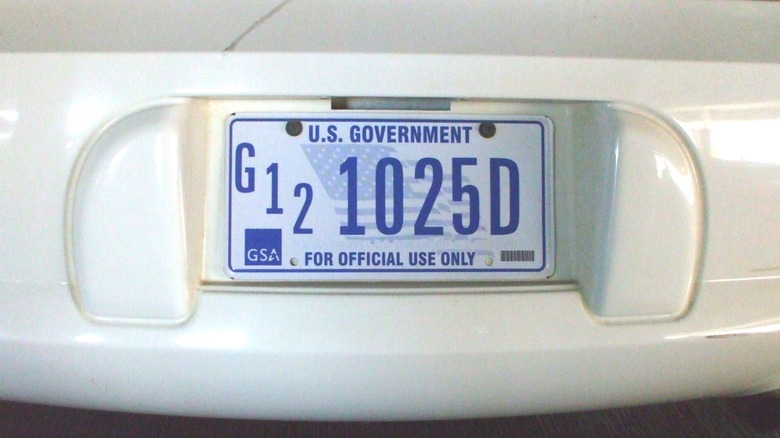
Laws, taxes, and the other purposes of government are not realized without the right tools and facilities to perform their enforcement. In the U.S., the role of procuring and allocating those resources belongs to the General Services Administration. Formed from a merger of several executive agencies in 1949, the GSA deals in IT products — including Elon Musk's Grok AI — real estate, workforce training, and, most pertinent to our concern today, vehicles. Approved agencies across federal, state, and local levels, their contractors, as well as select NGOs can buy, lease, and rent anything with wheels from the GSA. Members of the public can also purchase retired fleet vehicles such as weird Navy ships through auction.
All domestic vehicles owned by an agency of the federal government must be clearly marked as such, with the exception of vehicles where identification could interfere with the agency's mission. Regulations on how that is done have changed over the years, but license plates primarily satisfy this requirement today. All U.S. Government plates currently feature the text "U.S. Government" and "For Official Use Only."
Vehicles owned and used by the GSA itself have the administration's logomark on the license plate along with a plate number beginning with the prefix "GS." Plate numbers starting with "G" indicate vehicles leased or rented from GSA Fleet, the administration's dedicated vehicle management division. Those plates will also feature the GSA logo, but the vehicles themselves will be under the custody of a different party that may or may not be clearly watermarked in another fashion.
Things to know about U.S Government license plates

The GSA's Office of Government-wide Policy maintains how license plates are formatted — this includes the prefix assignments for various federal agencies — and distributed. Parties requesting plates for their vehicles must interface with their agency fleet manager as well as the OGP and UNICOR, the federally owned corporation overseeing prison labor that manufactures the plates. A plate is made to be used only with one vehicle. If a vehicle is no longer needed at its current station, the plate is sent back to UNICOR for destruction.
U.S. Government license plates feature a barcode at the bottom-right corner. When scanned, it discloses the associated Vehicle Identification Number (VIN) as well as information about the vehicle, plate, and insurance status as logged in the Federal Motor Vehicle Registration System (FMVRS). Vehicles leased from GSA Fleet with plates printed on or after October 1, 2024, do not expire and have no expiration dates. Dateless plates are being adopted by other agencies at their own discretion.
The GSA and UNICOR also produce license plates for federally owned off-road vehicles, which are vehicles that do not use public roads in the United States, such as those on foreign bases. They are not official plates, and such vehicles are not required to be registered with FMVRS. It's a stark difference from how off-highway vehicles in some states require two license plates to be mounted.