

Why Do Fighter Jets Taking Off From Aircraft Carriers Have Walls Behind Them?
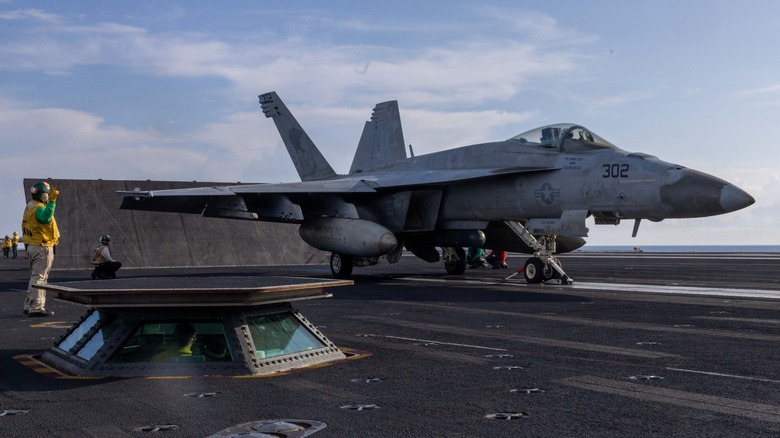
If you've ever been to an air show or seen fighter jets take off from a runway, you know that they follow pretty much the same process as any other fixed-wing aircraft. They taxi into position, fire up their engine(s), and fly up into the sky, but that's not how things work on an aircraft carrier. Because a carrier flight deck is significantly shorter than a standard runway, fighter jets are literally catapulted off the deck via steam or a newer technology, the Electromagnetic Aircraft Launch System (EMALS).
That makes sense, but carrier flight decks also have an additional piece of equipment you won't necessarily find on a terrestrial airstrip. Behind every fighter jet getting ready to take off, a large section of the floor rises to create a wall just behind the aircraft. This is called a Jet Blast Deflector (JBD), and it's not required for a plane to take off. It does what its name suggests: deflect the jet blast from an aircraft as it takes off.
Aircraft carrier flight decks are among the most dangerous places in the world to work, and the JBD is there to ensure the safety of flight deck personnel. It's not required to take off, but it absorbs much of the thermal energy the jet's engine(s) emit when they are launched, ensuring it doesn't wash over anyone. It might not seem entirely necessary on the surface, but if you look into the fact that a jet aircraft's exhaust can reach thousands of degrees Fahrenheit, things start to become clear rather quickly.
Jet Blast Deflectors save lives
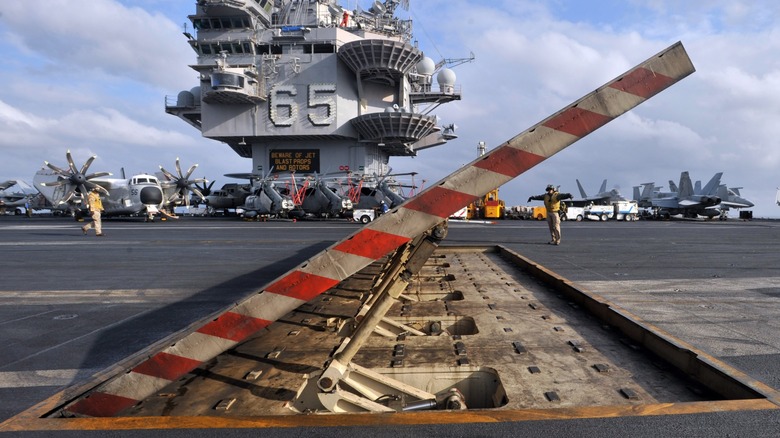
It's not hyperbolic to say that JBDs save lives because that's precisely what they were designed to do. The aircraft doesn't need a flat surface behind it to take off, so its only purpose is safety. A JBD is slightly angled so the exhaust is carried upward, ensuring the safety of nearby personnel, and there are plenty of folks working on the deck during flight operations. The United States Navy doesn't only execute standard takeoffs with its fighter jets, as the Navy's next-level fighter, the F/A-18 Super Hornet, often uses afterburners to achieve an additional 40% to 70% more thrust at takeoff.
With afterburners engaged, a fighter jet's gas temperature can reach hot enough to end a nearby sailor's life in seconds. The JBD keeps that from happening by containing the jet blast. It's standard operating procedure to lift them for takeoff and lower them when they're not needed. The JBD is operated by a sailor from a hatch behind the aircraft catapults. Planes roll right over on their way to the catapults, and once they pass overhead, the sailor raises the JBD.
While JBDs are standard on American aircraft carriers, they do appear in airports as blast fences and walls meant to ensure the safety and security of various areas. They're probably something you've seen countless times but haven't given much thought to, as they're not on the runway directly behind a passenger jet as it prepares to take off. That's where they differ from JBDs on carriers, but fundamentally, civilian options provide the same service: protecting people, equipment, and infrastructure from dangerously hot jet exhaust.