

3 Of The Most Reliable 12-Cylinder Engines Ever
Engine reliability isn't black and white. No engine is perfect, and almost every single one is likely to run into some kind of issue over its lifespan. What separates the good from the bad is how automakers tailor displacement, cylinder count, and operating tolerances to the way an engine is actually going to be used. The V12 sits at an odd intersection of that equation.
It's often viewed as the dinosaur of the engine world — too large, too thirsty, and, despite its cylinder count, not always the most powerful. It's also far from kind to the environment, which is a big part of why automakers have been phasing out V12s in favor of smaller, turbocharged, or hybridized setups that can still match or beat a V12's output. But "obsolete" and "unreliable" aren't the same thing. A lot of the V12s that made it to production were engineered with lots of mechanical restraint, resulting in an understressed design. This is why some of these units have gone on to rack up hundreds of thousands of miles without needing rebuilds. Here are three 12-cylinder engines that back up that reputation — proof that even in a category known for extravagance and impracticality, a handful of automakers got the engineering just right.
Toyota 1GZ-FE 5.0
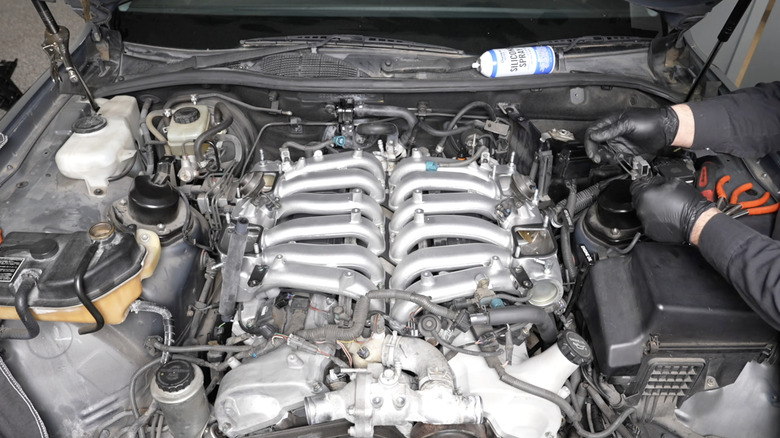
The G50-generation Toyota Century ran the 1GZ-FE from 1997 to 2017 — a 5.0-liter, 60-degree V12, and the only Japanese V12 Toyota has ever put into production. Rated output was 276 horsepower and 355 lb-ft of torque, a figure held down by Japan's "gentleman's agreement" cap restricting advertised power rather than listing what the engine could actually produce. Mechanically, the engine uses a bore and piston stroke at 81mm and 80.8mm.
Weight-saving and strength both factored into materials: aluminum construction for both the block and heads, a forged-steel crankshaft, six-bolt main bearings, iridium spark plugs, VVT-i, and slant-squish combustion chamber design. Toyota's development team drew comparisons to Ferrari, Jag, Mercedes, and to Bugatti's EB110, according to research Hagerty reviewed using 1997 Japanese Society of Automotive Engineers lecture notes.
Per Hagerty's review of Toyota's internal output charts, "their 12 out-grunts every other manufacturer from 500 to 3,500 rpm." Each cylinder bank has its own ECU. This is what allows the engine to keep running on six cylinders if one bank goes down entirely. Typical rebuild-free mileage for this engine is often above 200,000, and seeing a V12 for sale with almost 300,000 miles and running is not something you'll often spot.
Superior reliability and top-level build quality are both recurring adjectives tied to the Century, and its V12 is a big part of that. When ReDriven did a deep dive into the Century V12, their mechanic specifically noted for the engine that "other than age-related problems — things like brittle plastics and oil leaks and a few coolant leaks, there's really not much that goes wrong with these."
Mercedes-Benz M120
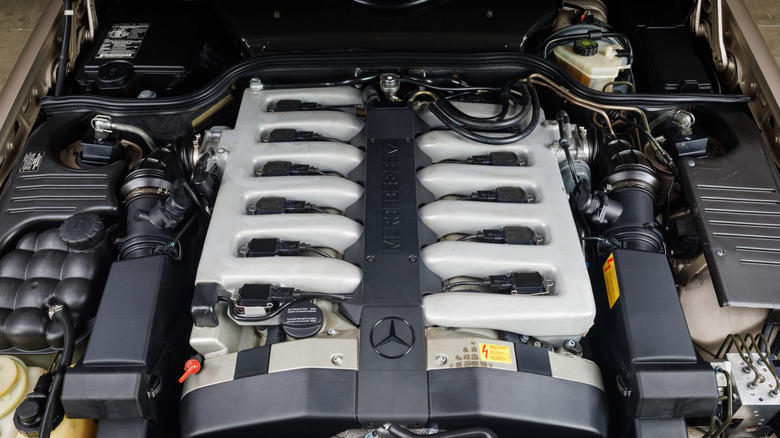
Mercedes-Benz's first production V12 arrived in 1991 in the W140-generation 600 SE/SEL, later carried into the S600. The crankshaft and connecting rods are forged steel, running on seven main bearings. Forged-steel crankshafts are the harder-wearing choice under repeated load: component testing found them lasting six times longer than ductile cast iron before fatigue failure, with a 32% fatigue-strength edge.
The block skips separate cylinder liners entirely. Instead, Mercedes mixed 17% silicon and 4% copper into the aluminum itself. That silicon is what does the work: once the block is machined, tiny hard particles of it are left exposed on the cylinder walls, and those particles become the actual surface the pistons ride against, cutting friction and improving heat transfer compared to a traditional iron-liner block.
Goodwood made a list of the best V12 engines ever made, and they noted that the M120 has "stellar performance, reliability and pedigree," especially since it is used in both Mercedes cars and the multi-million dollar Pagani Zonda. The R129 Mercedes is one of the best Mercedes models worth buying used, and also one of the most affordable ways to enjoy the M120 V12 in the 600SL/SL600 if you do not want the V8.
It's not the cheapest engine to run — rather expected for a V12 — but documented high-mileage examples of the M120 turning in several 200,000 miles aren't hard to find, with plenty of used examples still on the market decades later.
Ferrari F133
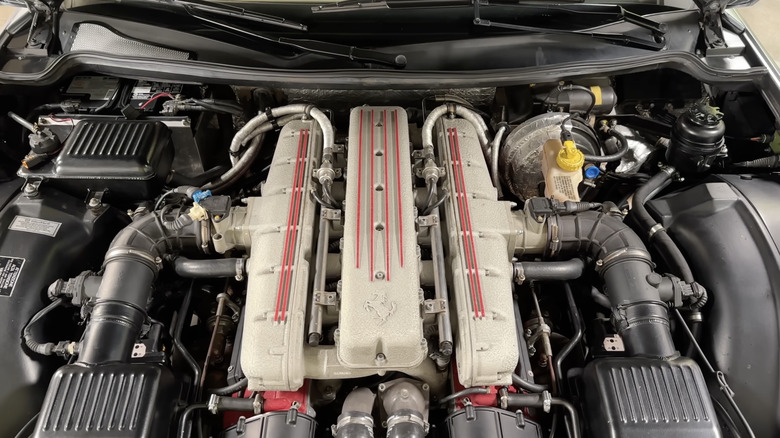
Reliability is relative, and especially so when it comes to exotics. Still, the Ferrari F133 V12 earns its spot by being dependable in Ferrari terms rather than as a Toyota-style tank. It debuted in the 550 Maranello, arguably the last truly great Ferrari. In that car, the naturally aspirated 5,474cc V12 made 485 horsepower at 7,000 rpm and 420 lb-ft at 5,000 rpm using four camshafts, 48 valves, dry-sump lubrication and, unlike the 456's V12, no hydraulic tappets.
In the 575M's 5,748cc form, output was 515 horsepower. The specialists who look after them rate the engine highly. Dean Pallett, assistant service manager at Graypaul Nottingham, told evo that "It's a good, strong, reliable car" and that "for a V12 Ferrari the running costs are actually quite reasonable," while Graypaul boss Mario Vignale said, "550s are far more resilient than most exotics."
Over 30,000 miles with evo founder Harry Metcalfe, his 550's single breakdown came down to a fuel cut-off solenoid rather than anything inside the V12. There are some catches: three-year cambelt intervals, camshaft seals prone to oil leaks, and an overheating risk that makes factors like healthy cooling fans a must.
Regardless, the F133 is regarded by many as one of the best V12s out there. When Doug DeMuro reviewed a 550, he called its F133 engine "absolutely exquisite," and RAC's review called the engine "unburstable," adding that "The 550 Maranello is an astonishingly reliable car." Lastly, big mileage isn't typical for a 550, but well-kept examples do rack up distance, so much so that seeing a 550 in the 60k-mile range is common.