

How Do Internet Cables Get Installed Under The Ocean?
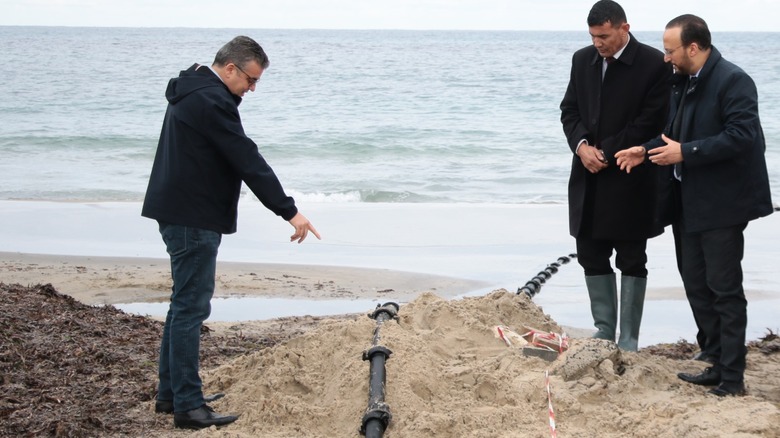
While many people might believe that the internet and other forms of modern digital communication are conducted primarily via satellite, that's not really the case. The internet is a vast, global network of interconnected computer networks spread around the world, and for most intercontinental connections, satellites aren't how they communicate. Instead, we've been laying submarine cables along the ocean floor for a long time. The practice dates back to 1858 with the installation of the first transatlantic telegraph cable.
Today, the cable in question isn't made of copper wire; it's fiber-optic, and it's installed in various marine environments, including the Red Sea. Since they don't sell fiber-optic cables with lengths in excess of several thousand miles, for most people, it's unclear how modern cables are installed beneath the waves. Submarine fiber cable is installed via a special type of cable ship with a massive amount of cabling. People from multiple disciplines, including oceanographers, geologists, and geophysicists, perform the initial survey, and once enough cable is placed onboard, the ship begins operating by moving as close to shore as possible.
The cable is laid nearest to the shore, where a plow simultaneously digs a trench and lays the cable. From there, the ship continues to pull the plow along its planned route, making its way across the ocean. Cables are laid over various submarine geological features, and every 25 miles, an amplifier is installed, helping to boost the signal as it passes across the vast ocean. It costs hundreds of millions of dollars to lay intercontinental fiber-optic cables, which are joined together via fusion splicing. This ensures that there is little to no signal loss when multiple cable segments are joined together.
There's more to submarine cables than installing them
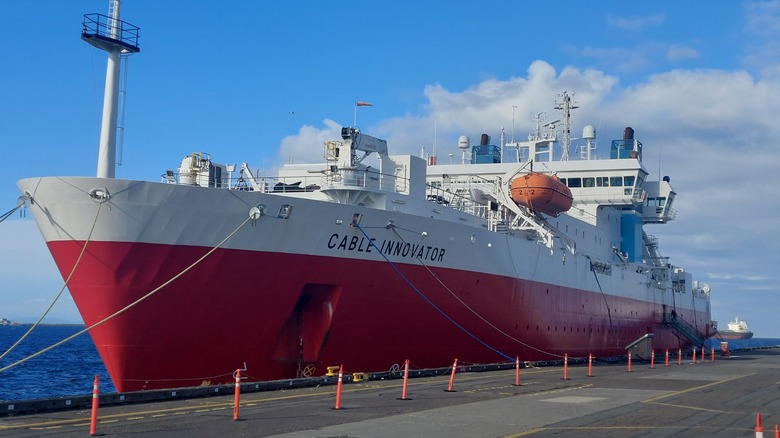
Fiber-optic cables were invented in the 1950s, and they've become vital to the modern world's communications. Still, submarine cables were installed long before fiber optics, and like anything that touches saltwater, they required maintenance. Fiber-optic submarine cables also need to be properly maintained, and it's generally accepted that they are replaced every 25 years. During that time, a cable can become damaged from ship anchors, natural disasters, fishing, and marine life — sharks have occasionally attacked them, hence the preference to bury the cables.
Once damage is detected, they're raised to the surface via a cable repair ship. It uses grappling hooks and other specialized machinery to capture the damaged cable and bring it to the surface for repairs. The individual fibers are repaired or replaced, typically by removing the damaged sections, which are replaced by new ones that are spliced into the original cable. Once the repair work is completed, the cable is returned to the bottom, where it's either laid upon the ocean floor or is reburied.
Before leaving the area, the cable repair ship tests the cable, and once it's working as designed, the ship moves on to wherever else it's needed. Because they need repairs and are replaced every so often, cable ships and cable repair ships operate all the time. There are plans to lay a 2,800-mile undersea data cable between Canada and Europe, and that's one of many projects involving submarine cable installation. Since the technology is so vital for modern communications, it's likely that humanity will continue laying undersea cables for the foreseeable future.