

2,800 Mile Undersea Data Cable Plan Leaves The US Out In The Cold
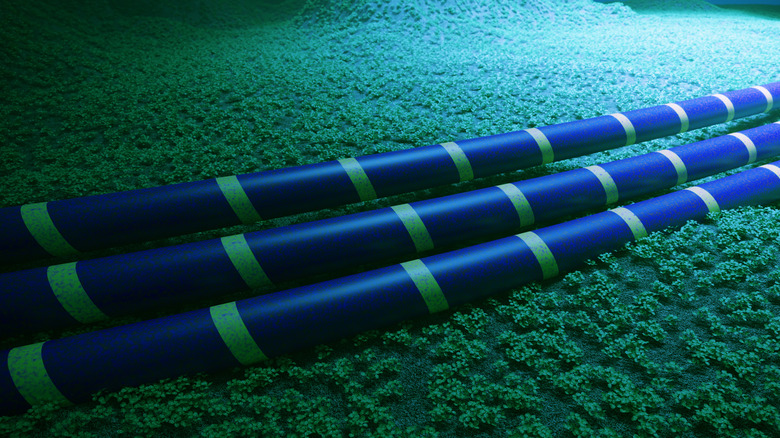
Though we can't see them, the importance of undersea cables is indisputable. These installations are required for fiber-optic data transfer, telecommunications, and more across vast distances, traveling across the ocean floor and avoiding contact with the surface. These massive cable systems are excellent for connecting nations separated by vast bodies of water, as evidenced by the remarkable 2,800-mile cable project that has been proposed to connect Canada to Europe across the Atlantic Ocean — a roughly $620 million endeavor that would leave the United States completely out of the equation.
Dubbed Project Leif Erikson, this project would begin at the southern end of Norway and extend to Happy Valley-Goose Bay in the Canadian province of Newfoundland and Labrador. Now landbound, the cable connection would continue underground through Quebec and eventually reach Montreal. Private company Bulk Infrastructure would oversee the project, with its planning dating back to 2021 when initial measurement estimates were taken. Bulk seeks funding from a Canadian majority partner to fully realize the project's scope, moving Canada toward a less U.S.-reliant state for data transfer capabilities.
Overall, this project isn't being proposed for no reason. Canada's leadership wants to move away from U.S.-connected fiber-optic cable routes, and this could be a major step in that direction if it becomes reality.
Canada's leadership seeks to strengthen its digital infrastructure

At the time of publication, the Canada-to-Norway Project Leif Erikson has yet to get off the ground. As mentioned, planning and funding are still being ironed out, and Canada and the European Union still need to officially sign off on construction approval. Notably, the project would run underground through 1,180 miles of land that Indigenous communities would need to approve the use of. Should it become a reality, though, it would be a major step forward for Canada's infrastructure. So far, only a few undersea cables run to Canada without crossing the U.S. border first, and none of these are actually owned by the country itself. Not to mention, cables, not satellites, keep the internet alive, so establishing secure, reliable Internet access is huge in the modern era.
All of this is to say that Canadian leadership seeks to move away from its cable connections to the U.S. Relations between Washington, D.C., and Ottawa have reportedly taken a hit in recent years, so Prime Minister Mark Carney wants to strengthen Canada's infrastructure and forge new, more fruitful alliances. Bulk Infrastructure co-founder Peder Nærbø referred to Project Leif Erikson as a "sovereign cable system" for Canada that would aid in the nation's ability to secure fast and effective data transmission for everything from artificial intelligence to telecom to hyperscale markets, all without having to rely on its neighbor to the south for aid.
It remains to be seen what will become of Project Leif Erikson, and what the construction process could look like. We'll just have to wait and see as all parties involved work to figure out next steps, if there are to be any at all.