

This Is The Last WWII Landing Ship Still Sailing Today
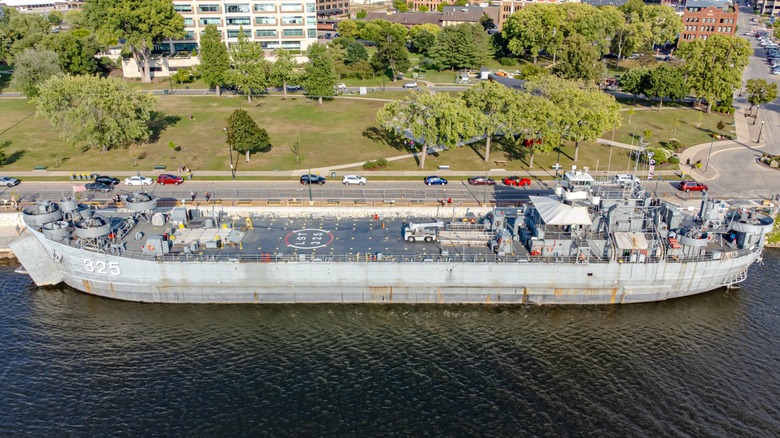
The U.S. Navy and America's other military branches used a variety of ships throughout World War II. Some of the most important were landing craft like the Higgins boats that brought the Allies onto the beaches of Normandy. That was only one type of landing ship, with another type used for landing tanks on enemy beaches. While almost all of the craft that carried the Allies during the war have long been decommissioned, scrapped, or sold, one remains afloat: the USS LST-325.
This "Landing Ship Tank," or, as the troops called it, "Large Slow Target," was commissioned on February 1, 1943. It remained in operation throughout the war, and played a significant role in the Normandy invasion during D-Day: It unloaded a total of 59 vehicles and over 400 personnel at Omaha Beach on June 7, 1944. With the war ending the next year, it was decommissioned on July 2, 1946. Its service ended with two battle stars, having made 43 trips across the English Channel during the conflict.
No longer needed by the Navy, the USS LST-325 — a name that referred to its hull number — was given to Greece, where it remained in operation for decades. Eventually, it found its way back into American hands. Since then, it has operated as a museum ship, with one unique capability that sets it apart from every other floating museum ship in the United States: its mobility. The USS LST-325 retains the ability to travel, so the folks who manage it take it from port to port, educating the public on its history and ensuring it continues to sail as long as possible.
The LST that keeps on sailing
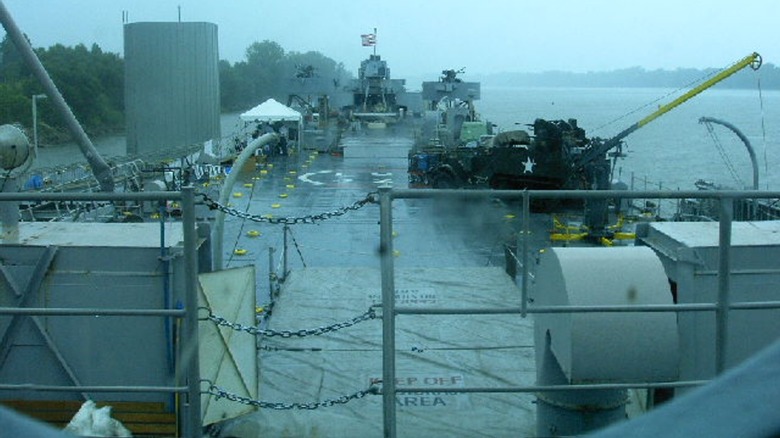
Typically, when a ship becomes a museum, it's permanently moored somewhere. In the U.S. alone, there are dozens of excellent museum ships, including those that let you tour eight retired battleships and five historic aircraft carriers that function as museum ships. The one thing they all have in common is that they don't move. That's not a problem for the USS LST-325, which has sailed quite a bit since it became a floating museum.
In one cruise, as the museum organizers call it, the LST-325 left its home dock in Evansville, Indiana, and sailed to three Tennessee river towns: Hendersonville, Ashland City, and Clarksville. During that cruise, which took nearly a month, more than 44,000 people visited the LST. Indeed, a primary reason that it remains mobile is to cater to as many people as possible.
As Ken Rupp, the ship's cruise director, said in an article written for the U.S. Army, "Evansville isn't a big enough draw to support this." Rupp said the boat remains in Evansville for 11 months a year, but it's taken "out on the road, one month out of the year, since 2000," which helps fund its continual operation.