

Who Makes Kubota Diesel Engines And Where Are They Manufactured?
If you live in the U.S. and have ever shopped around for things like compact tractors, lawn mowers, or construction equipment, there is a good chance you have come across a brand called Kubota. A Japanese company, Kubota has been doing business in the U.S. since 1972, and has grown to become a well-known player in the agricultural and construction equipment sector. It competes with other established players in the segment, including the likes of John Deere, New Holland, and Bobcat. Kubota's tractors are generally considered among the best in business.
That said, tractors and construction equipment aren't the only things Kubota is known for. The company is also a major manufacturer of engines (including gasoline, diesel, natural gas, and LPG) that power everything from agricultural machinery and industrial equipment to generators. In fact, Kubota's engine manufacturing business has a history stretching back over a century, and goes back in time further than its tractor business.
Today, we're focusing our attention on Kubota's diesel engines, which power several machinery used in agriculture and the industrial space. Popular brands that use Kubota engines in their products include Avant, Bobcat, Merlo, Timberwolf, Manitou, and Liebherr; you may have used a machine powered by a Kubota engine without realizing it. Now that we have established that Kubota itself makes Kubota diesel engines, let's try to understand where the company actually manufactures them.
Kubota's engine manufacturing is concentrated in Asia
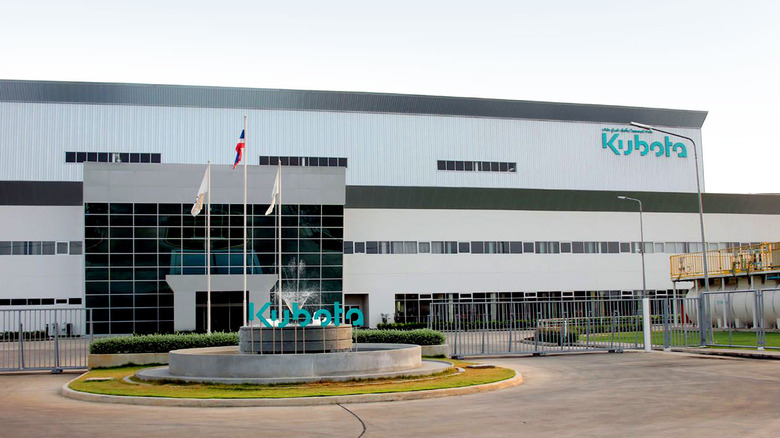
Kubota's engine manufacturing division is a multinational brand of its own, with operations spread across the world. Upon observing the company's operations closely, the one thing that becomes clear is that the company's offices in the West mostly deal with sales and operations. The vast majority of Kubota's manufacturing, as well as R&D operations, are primarily concentrated in Japan and Southeast Asia. Kubota's major engine manufacturing facilities include the Sakai, Sakai Rinkai, Tsukuba, and Okajima plants in Japan, the Wuxi plant in China, and several dedicated engine manufacturing facilities in Thailand and Indonesia.
Kubota's Sakai plant primarily focuses on the production of the company's engines, but also makes Kubota tractors and small-size construction machinery. The same can be said about the Tsukuba plant, which manufactures tractors as well as engines. The Sakai Rinkai plant does lots of things aside from engine manufacturing, including R&D on engines, and obtaining certification and responding to audits for emission regulations. Kubota's only engine manufacturing facility in China — at Wuxi — exclusively deals with the production of vertical-type diesel engines.
Kubota has three manufacturing sites spread across Thailand — one in Pathumthani, and two in Chachoengsao. The Pathumthani plant and one plant at Chachoengsao manufacture diesel engines, while the second facility at Chachoengsao makes parts that go into these engines. Kubota's Indonesia facility, located in Semarang, exclusively makes small-capacity diesel engines.
Outside of these engine manufacturing facilities dotted across Asia, Kubota also operates several sales and regional offices across Asia, with a presence in countries like India, Malaysia, the Philippines, Vietnam, and South Korea. In Europe, the company operates three offices, located in France, Germany, and the U.K. Kubota's U.S. operations (for the Kubota Engines subsidiary) are managed from the company's office in Lincolnshire, Illinois.