

Why Do Some Construction Zones Make Trucks Use The Left Lane?
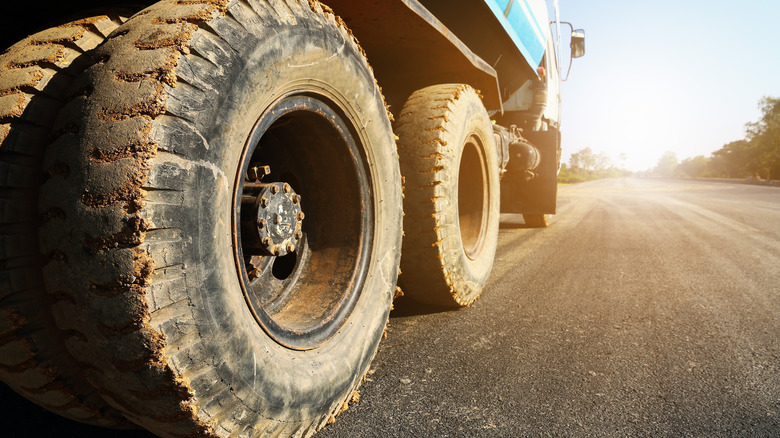
When driving through a construction zone or heavily modified roadway, you might notice something contradictory, at least compared to what you're used to. On highways and major roads, signs usually direct trucks to stay out of the left or cruising lanes, instead focusing attention far right. In turn, that preserves the left lanes for smaller commuter vehicles and faster traffic, which helps keep things flowing smoothly. But in some construction areas, signs intentionally command trucks and big vehicles to use the left lane. Why is this, and what's the reasoning behind the change? There are actually a couple of answers here, but the most relevant is that, generally, while a road is being worked on, the foundation is not rated to handle the increased weight and wear of big vehicles.
As a design philosophy, road lanes often shift to the right, with the far right side acting as the shoulder. While not always true, the shoulder of the road is built and supported differently than the regular asphalt. Crews might use cheaper or less durable materials, particularly cost-saving asphalt. It's not always fully prepped for the heavier weight of the trucks while construction is in progress. In these instances, the heavy vehicles will be directed away and asked to drive in the leftmost lanes.
Other potential reasons for the change are just as straightforward. The far right lanes might not be wide enough for large 18 wheel semi trucks, like when the construction is close to a bridge, structures, or other fixtures. Moreover, when trying to direct traffic during a road closure, especially when lanes need to be merged, it's far easier for drivers to merge with smaller vehicles than to fight alongside big trucks. In that case, trucks might be kept away from merging lanes to simply improve traffic.
It's usually temporary and that's important
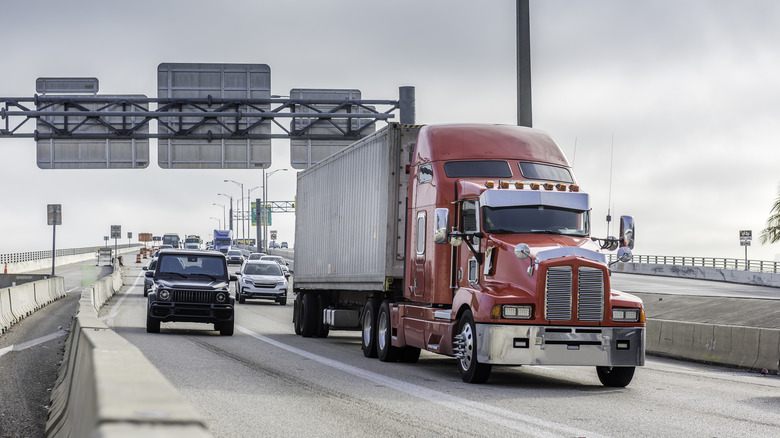
In instances where trucks "must" use the left lane or stay off the shoulder, it's usually a temporary measure. On longer stretches of road, you should eventually see the rule or guideline give way to more traditional requirements — trucks are actually supposed to stay out of the left lanes on multi-lane highways and roads. This is, believe it or not, a direct law in some states, and truck drivers can get ticketed for not following the rules where applicable.
It ties into why you should always pass semi trucks or large trucks on the left versus the right. The blind spot on larger trucks is much bigger on the right hand side, so overtaking on the left is usually safer and a big reason why trucks stay right most times.
Driving in the left lane in affected areas is a 3-point CSA violation. A CSA violation (CSA stands for Compliance, Safety, and Accountability) is a driving infraction managed by the Federal Motor Carrier Safety Administration (FMCSA) that applies to commercial drivers. Most notably, infractions will be assessed during roadside events, including inspections, or any accidents. When points are doled out they remain on record for a carrier, in this case the driver's team or company, and indicate how safe or compliant the related parties are. Higher scores generally mean severe or multiple infractions. Think of it like a safety grade. Insurance providers, brokers, shippers, and other commercial businesses are less likely to work with carriers that have a high CSA score. Drivers typically work hard to earn their CDLs, keep CSA scores down, and mind the laws and regulations during hauls.