

The Amount Of Water It Takes To Put Out An Electric Car Fire Is Shocking
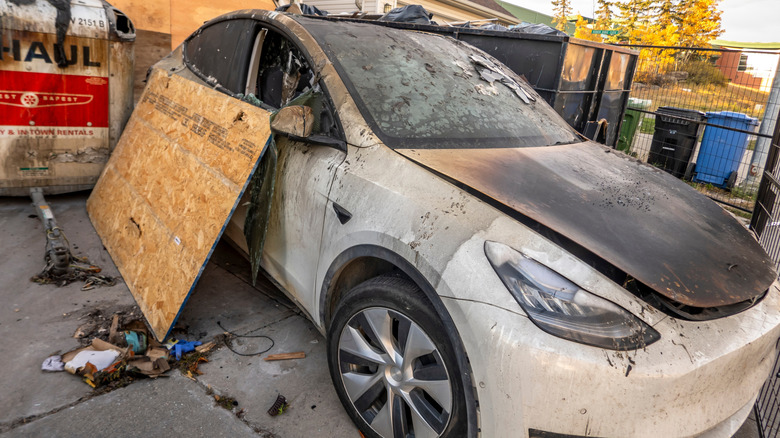
Car fires are dangerous no matter what powers the vehicle, but electric cars can create extra complications for first responders trying to put them out. While there are some common electric vehicle myths, needing more water to extinguish an EV fire isn't one of them. The large lithium-ion battery packs in electric vehicles burn extremely hot (temperatures can reach around 1,832°F), which makes a burning battery rather tough for firefighters to fully extinguish. In fact, compared to internal combustion engine cars that require about 500 to 1,000 gallons of water, electric cars can easily take considerably more to extinguish a fire.
There is no fixed amount of water required to put out an electric car fire, but many incidents show how much it can take. One of the biggest examples is when a Tesla Semi-truck needed 50,000 gallons of water to put out the flames after a freeway crash. Another incident happened in 2023 in Wareham, Massachusetts, where firefighters reported using over 11,000 gallons of water to stop an EV fire. Similarly, an electric car crash in Bedford, New Hampshire, required over 6,000 gallons of water to fight the blaze.
Another Tesla car fire happened several years ago in Stamford, Connecticut, where firefighters used 600 gallons of water per minute for 40 minutes non-stop. Interestingly, in its own emergency response manual for Model S, Tesla states that it can take roughly 3,000 to 8,000 gallons of water poured straight onto the battery pack to completely put out the battery fire. Looking at these numbers, it's clear that an electric vehicle can easily need five to 10 times more water (sometimes a lot more) than a non-electric car to quench the flames.
Why are electric car fires so difficult to extinguish?
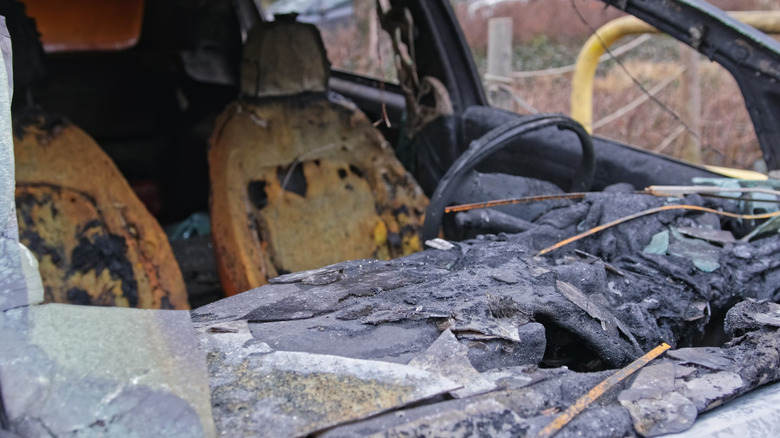
The main reason firefighters have a hard battle putting out electric vehicle fires is the lithium-ion battery pack. If the individual cells get damaged or overheat, they can enter a process known as thermal runaway, where the heat feeds on itself and quickly spirals out of control. Once this chain reaction gets going, dousing the visible flames on top of the car isn't always enough to stop what is happening inside the battery.
Since the cathodes in lithium-ion cells release oxygen as they heat up, a battery fire can keep feeding itself without any outside air. As a result, the damaged cells can keep producing intense heat and venting flammable gas, which can reignite the neighboring cells even when the fire looks like it's completely out. So, to make sure an electric car battery is safe, firefighters have to keep pouring water on it until its temperature drops below 176 degrees Fahrenheit. Electric car batteries are sealed inside tough metal cases. However, this protective shell makes it harder for the firefighters to get the water directly to the overheating cells inside. That combination is why a single EV fire can soak up thousands of gallons of water and keep crews on scene long after the flames disappear.