

Is Google Nest More Secure Than Ring Video Doorbells?
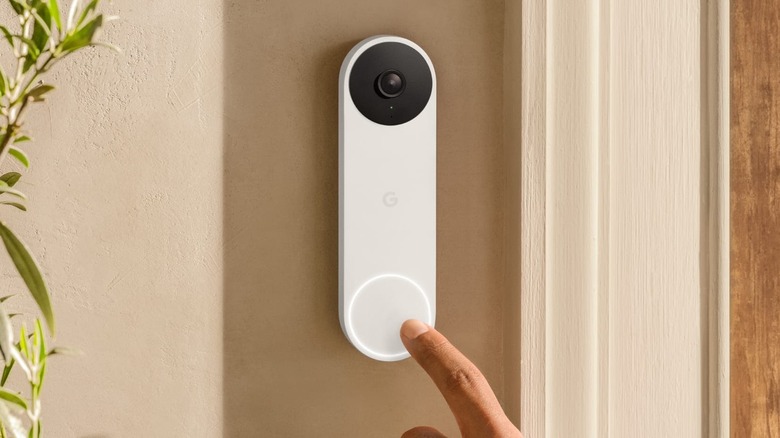
Video doorbells play an important role in modern home security, allowing homeowners to monitor whoever is at the front door while they're away. Among the major doorbell brands, Google Nest and Amazon's Ring are among the most popular, with both companies offering robust security devices. You may be wondering which brand is the better choice for protecting homes? Well, the answer might surprise you: it's Ring and it's because of the type of encryption the company uses.
Both companies utilize strong encryption software for videos recorded through the doorbells. That means external bad actors won't be able to access or hack into your footage. However, Google utilizes 128-bit AES encryption with TLS/SSL (Transport Layer Security/Secure Sockets Layer) for its doorbells, while Ring uses E2EE (end-to-end encryption). Without getting too deep into the weeds, what you need to know about these standards is how they encrypt data.
E2EE, by its very nature, encrypts data on devices before sending it out to an endpoint. No one, not even Ring itself, can access encrypted files — only you. Keep in mind that E2EE is optional. You will need to set up the feature within the Ring app. Additionally, Ring recently implemented TAKE (Throw Away the Keys Encryption), which utilizes "rotating encryption keys" to protect your recordings. The company takes those access keys to process your video for certain support features. According to the official white paper, Ring deletes its keys, leaving only you and other trusted users with access. Conversely, Google's TLS/SSL protocol encrypts data between your device and its servers. This means Google has access to your data, which it uses to improve its services, according to the official Nest Help page.
Ring also offers better smart home value
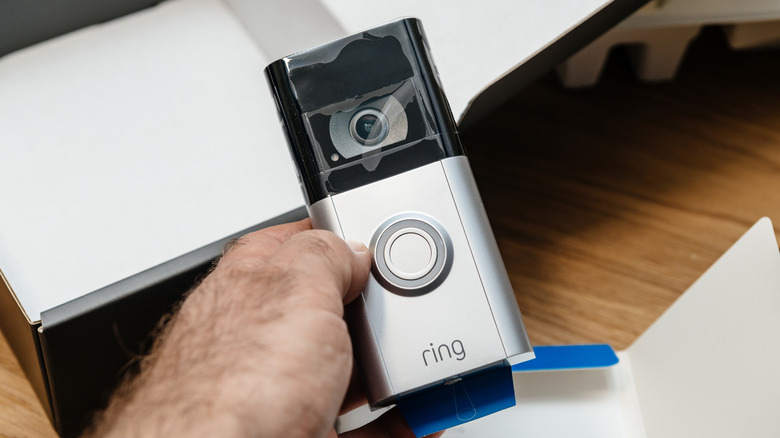
The differences don't stop there, as Ring also excels in two major areas: it has a broader selection of doorbells (in multiple colors) and delivers better value. Google only has two video doorbells: a wired and a wireless battery-powered model. The former records in 2K resolution while the latter can only record HD video (960 x 1280 pixels). Ring, on the other hand, has eight video doorbells, split between wired and battery models, aimed at different budgets. If you want the best that Ring has to offer, you can get the Wired Doorbell 4K Elite for $500. If you're on a budget, you can grab the Battery Doorbell 2K model for $100. Google's options are $200 each.
Both companies also offer paid professional monitoring services, although Ring is better. Ring's Pro Plan, for example, will monitor an unlimited number of devices at your house, provide 180 days of video event history, support Alexa+ greetings, descriptions, alerts, and more, for $20 a month. Google Home Premium is $20 a month too, but its offering pales in comparison. You only get 60 days of video event history, daily summaries, and description notifications. Professional monitoring on Google Nest is done through ADT, and it's $70 monthly.
Hardware and software differences between Google Nest and Ring
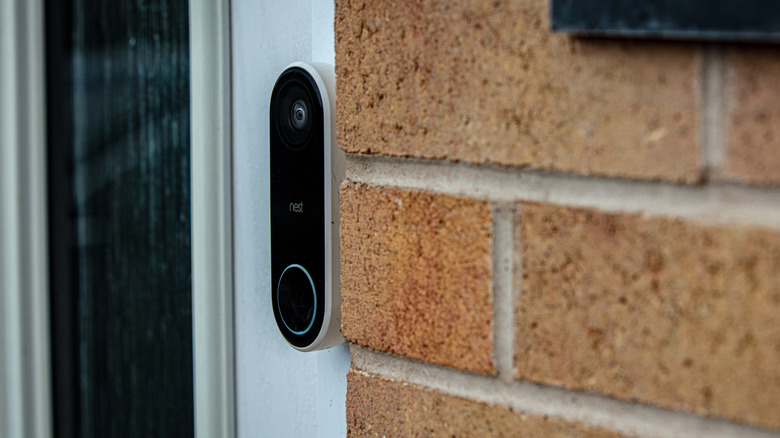
Looking at their features, you will notice that Nest and Ring doorbells have various similarities. Both series have high-resolution cameras, two-way audio, and motion detection, among other tools. But the ways that these features are implemented are unique. Ring sells 4K video doorbells, but Google's wired doorbell only reaches 2K resolution. Nest models have the ability to store up to an hour of on-device footage as backup. Ring's wired doorbells can't do this. If you want offline storage backup with your Ring system, you'll need to make additional purchases: a microSD card, a compatible Ring Protect subscription, and the Ring Alarm Pro Base Station.
Despite the criticisms, Google Nest doorbells are rock solid. They're a good fit if you've already invested in the company's smart home ecosystem. Nest models naturally integrate with the entire Google Home lineup. Through the Google Home app, you can view the doorbell's video feed and seamlessly issue commands to a Nest speaker or a Nest Hub.
Ring video doorbells do much of the same. Through Amazon Alexa, Ring users can enjoy a robust smart home ecosystem supported by Echo Show displays and Echo Dot speakers. Still, Ring is the better choice because of its E2EE support. Unlike Google, Ring will never look at or have access to your footage, and that peace of mind is priceless.