

The OG Honda Crossroad Wasn't Made By Honda - They Just Rebadged This Land Rover
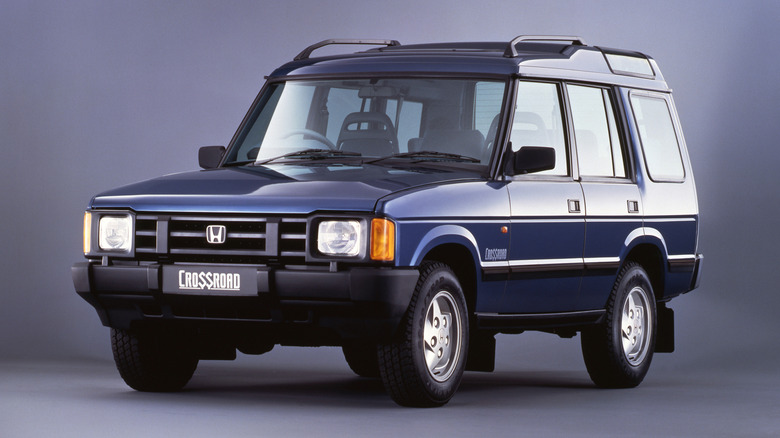
Badge engineering is pretty common in the automotive world, and in theory, it's a win-win situation for both manufacturers involved. The manufacturer that builds the car gets a boost in sales, while the manufacturer that rebadges and sells the car in its dealerships gets a shiny new model without any of the usual development costs. Some automakers like GM are particularly well known for rebadging cars — just look at Pontiac's many badge-engineered models — but Honda isn't one of those automakers. Nonetheless, in the '90s, Honda went through a phase of rebadging models to fill gaps in its lineup, with the first-generation Crossroad being one of the strangest examples.
Changing tastes at the start of the '90s saw SUVs become increasingly popular among Japanese buyers, but Honda was caught out by the new trend. It didn't have any SUVs in development, and building one from the ground up was going to take years. To fill the gap until it could catch up, it turned to its partners. Honda and British Leyland (the parent company of the Rover brand at the time) had been working together since 1979 and signed a joint development agreement in 1983, followed by a manufacturing agreement in 1984. The partnership produced the Honda Legend and the Rover 800, as well as the ill-fated Sterling.
The British automaker launched the Land Rover Discovery in 1989, and Honda saw it as an opportunity to get its foot in the door in the lucrative SUV market. It inked a deal in 1993 to badge-engineer the Discovery and sell it in Japan as the Honda Crossroad, with the goal of selling around 1,000 examples per year.
The Crossroad and the Discovery are extremely similar
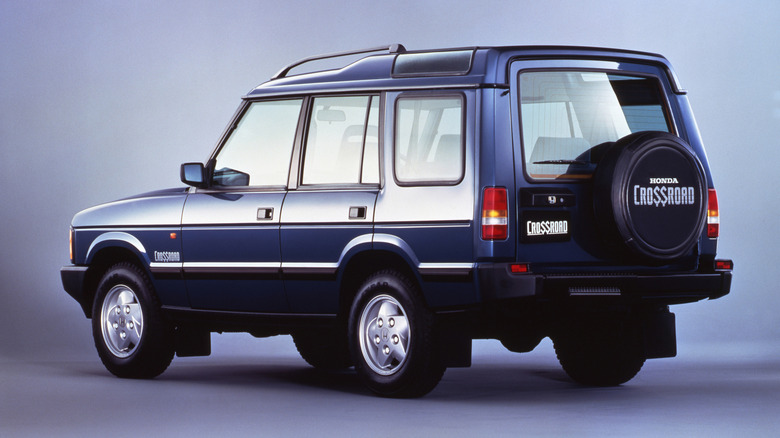
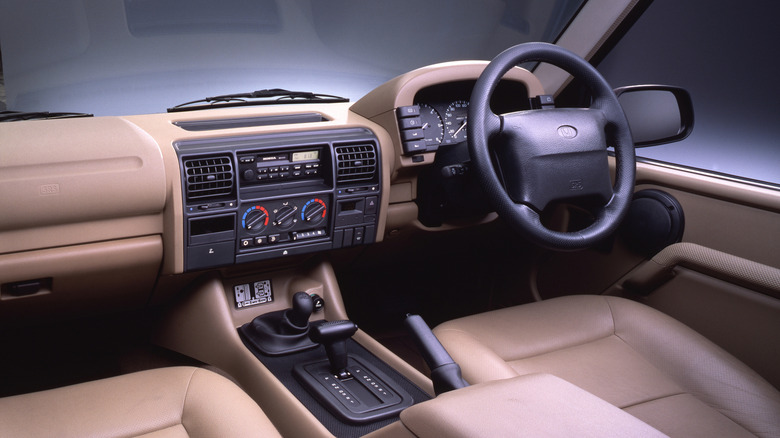
Honda didn't make any substantial changes to the Discovery before importing it from Rover's factory in the U.K. and shipping it to Japanese dealers. The Crossroad's styling changes were basically non-existent, with Honda doing little more than slapping some badges on the Discovery and calling it a day. All of the oily bits were unchanged too: the Honda still featured Land Rover's full-time 4WD system and center differential lock, its suspension, and its 3.9-liter Rover V8 engine.
Launching an SUV with a V8 engine might have been all-new territory for Honda, but the engine itself was a tried-and-tested design. Rover had already been producing its V8 for a couple of decades, originally buying the rights to its design from GM's Buick division before tweaking it to better suit European tastes. Unfortunately, during all those years of production, Rover hadn't ironed out all of the V8's reliability issues, and the V8-powered Discovery proved to be about as reliable as you'd typically expect a Land Rover to be. That is, not very. This was far from ideal for an SUV that carried a Honda badge, but it wasn't a dealbreaker for the Japanese automaker.
The arrival of the Crossroad meant that Honda could attempt to cash in on the SUV trend, and it wasn't the only rebadged SUV in the automaker's Japanese lineup either. The same year that the Crossroad launched, Honda debuted the Jazz SUV, which was a rebadged Isuzu, and it also started selling the Jeep Grand Cherokee in its dealerships.
Honda wasn't done launching new SUVs
By the end of 1993, Honda had added two SUVs wearing its own badge to its Japanese lineup, alongside the Jeeps its dealerships already sold. It wasn't done there, though. In 1994, it introduced the Horizon, another SUV that was a rebadged Isuzu. That gave Honda some breathing room to continue the development of its own in-house SUV, which launched the following year.
That in-house SUV was called the CR-V. After its successful launch in Japan, Honda brought the first-generation CR-V to America shortly after, as well as launching it in many other global markets. It was successful enough that Honda no longer needed to rely on badge-engineered models to get Japanese SUV buyers into its dealerships, which left the automaker with little need for the Crossroad and its Isuzu-built lineup siblings.
Different sources give varying explanations about the Crossroad's demise, with some claiming that it was an unfortunately timed recall that led to it being axed and others claiming that the fallout following Rover's acquisition by BMW was the reason production ended. Either way, the Crossroad was quietly dropped from Honda's Japanese lineup in 1998, bringing to an end one of the most unlikely partnerships of its era.