

Which States Let You Get A Driver's License Regardless Of Immigration Status?
Illegal immigration in the United States is a perpetual political football and, yet, a foundational component to our workforce in sectors like healthcare, agriculture, and the service industry. One key aspect in the debate of how we permit people who are not present in our country legally to live and take part in American society is whether they should be granted driver's licenses.
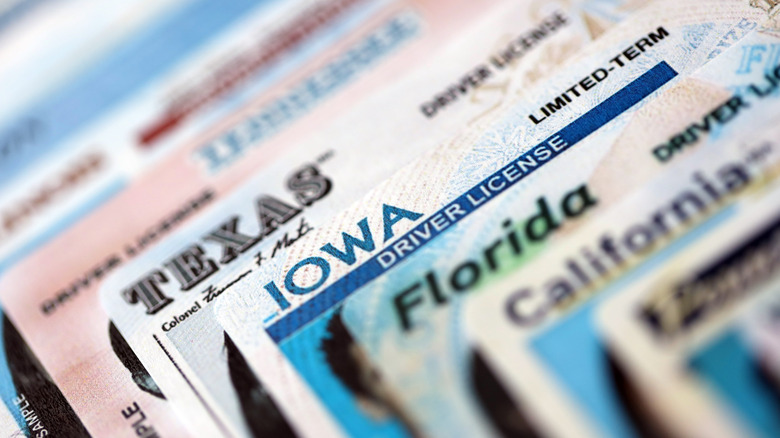
According to the National Conference of State Legislatures, there are 19 states with laws that allow foreign nationals the opportunity to apply for a driver's license: California, Colorado, Connecticut, Delaware, Hawaii, Illinois, Maryland, Massachusetts, Minnesota, Nevada, New Jersey, New Mexico, New York, Oregon, Rhode Island, Utah, Vermont, Virginia, and Washington. It is also the case in the District of Columbia.
The issuance of REAL IDs requires documentation that establishes a person's legal presence in the United States and, thus, immigrants without those credentials cannot apply for a REAL ID-enhanced driver's license in those territories. This means that their license cannot be used to pass through a TSA security checkpoint or enter a similarly-secured federal facility.
The driver's licenses foreign nationals can and can't obtain in the United States
In many states, applicants will apply under a dedicated workflow such as in California for a so-called AB 60 license. Some motor vehicle registries will offer a specific credential class such as in Delaware and Virginia for a Driver or Driving Privilege Card. Driving Privilege Cards may have different validity periods than standard driver's licenses: in Utah, a privilege card must be renewed by the driver's birthday the next calendar year while a driver's license can last for up to 8 years. Massachusetts is one state that issues the same Class D and M licenses for standard passenger vehicles and motorcycles to foreign nationals as it does to legal residents.
Applicants do not need documents that establish their legal presence in the United States, only forms that prove residence in the state or district and one or multiple identifying credentials from a foreign origin — the state of Washington requires four of these documents for some permit seekers.
Immigrants without legal standing in the United States cannot apply for a commercial driver's license. In the past, those who had an Employment Authorization Document (I-766) were allowed to get a special non-domiciled CDL. Overdrive reports that some 60,000 active drivers had one of these CDLs as of July 2025. In September of that year, the Trump administration set rules that limited non-domiciled CDL eligibility to those carrying non-immigrant H-2A, H-2B, and E-2 visas. These rules were finalized with an additional issuance from the Federal Motor Carrier Safety Administration this past March.