

What Is Automatic Transmission Fluid And How Does It Work?
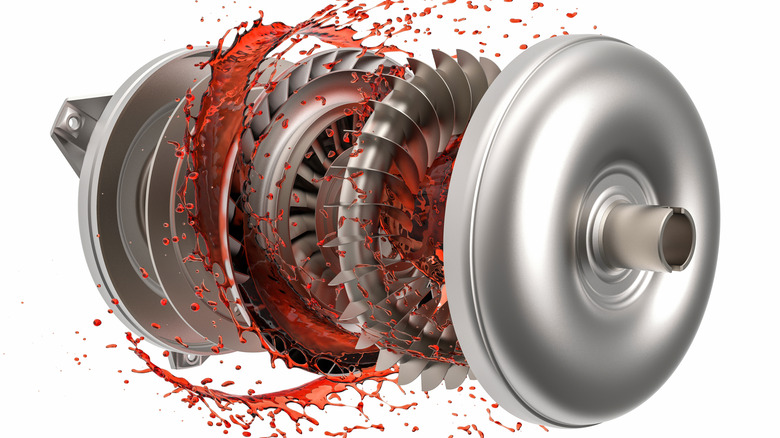
It's pretty much rote for anyone who does their own maintenance — you pop the hood and check all your fluids. And your car does have a lot: Engine oil, for starters. Then you have brake fluid and power steering fluid for older cars, clutch fluid and gear oil for manuals, and so on. Finally, we come to automatic transmission fluid, or ATF for short, possibly one of the more dramatic fluids because of its bright red color — if it leaks, it looks like your car is literally bleeding out all over the road. But what is it, exactly, and what does it do in your car?
The short answer is that ATF is basically a clutch made of fluid. It's responsible for taking the power your engine produces and carrying it to the gearbox, which it does by spinning around in the torque converter.
Okay, it sounds bizarre when it's simplified to that extent, but it's the best method for keeping a car from stalling at low speed. Having fluid instead of a clutch means you have no hard link between the engine and wheels, so when the wheels stop moving, the engine can keep rotating. A clutch pedal is designed to disengage the clutch (thus, decoupling the engine). Transmission fluid does this same job; it just doesn't require you to press a pedal because of the nature of it being, well, a fluid, rather than a solid object that physically joins the engine and drivetrain. It serves other functions on top of that as well, and its composition is quite peculiar, so let's dive in and have a closer look.
What is automatic transmission fluid made of?
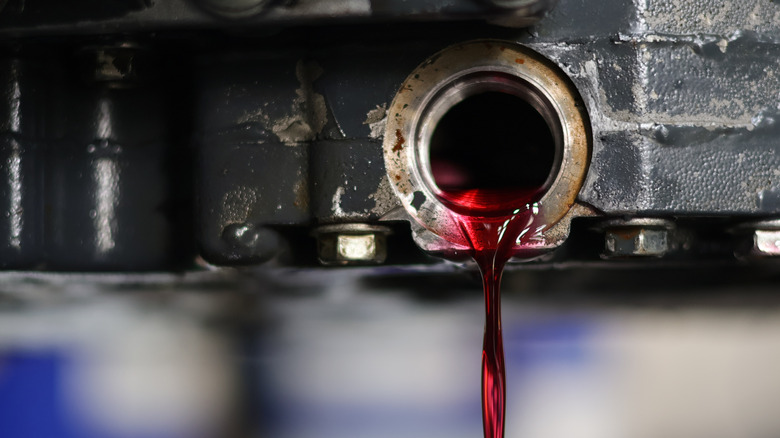
To understand what transmission fluid is designed to do, we must first understand exactly what it's made of, so we know what properties it has. ATF is a form of hydraulic fluid, which itself is different from hydraulic oil, so don't get those mixed up. It's primarily oil-based, typically to the tune of around 70 percent or more of the fluid itself. It then contains various additives suited for the high-speed, high-pressure environment of a transmission at highway speeds. These help the fluid to stick to the gear surface, providing a physical barrier between the working parts and keeping your gears from grinding together.
Other more minor functions of transmission fluid include cooling and decontaminating. Transmissions can get hot; one symptom of bad or leaking transmission fluid is an overheating transmission. Likewise, so is the car sluggishly getting into gear or not staying in gear, among other things. These could also be a sign of old transmission fluid with lots of particles, which is why it goes from a bright red to a deep brown or black over time. You don't want this stuff getting into the torque converter or gearbox itself.
The key here is having a fluid that's incompressible, sticky, and has good heat retention to help draw heat away from the metal components. Because ATF is designed specifically for this environment, it's dyed that bright red so you don't mix it up with, say, brake fluid or gear oil, which while technically are also hydraulic fluids, function in very different ways.
The many hats automatic transmission fluid wears
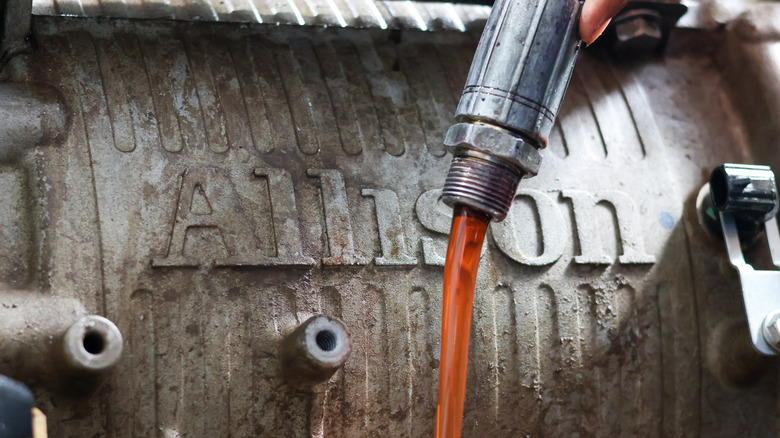
As stated before, the principal function of ATF is to act as a "clutch." A car with an automatic transmission don't have a clutch pedal because the fluid acts as the coupling between the engine and drivetrain, though many do have an internal clutch system that engages when the car is up to speed. But when the car is stopped, the engine keeps spinning the fluid around in the torque converter like a washing machine, sending power to the drivetrain which is arrested by the brakes — that's why automatic-equipped cars creep when in gear.
It's this function which is often most enigmatic, so picture this. Imagine you have a bowl of cake mix. You put in a mixer and it tries to spin the pot, so you have to hold it in-place. That's the same principle at work here. The engine is the cake mixer; it transfers the force into the fluid, and the bowl is connected to the gearbox. All the fluid does, then, is provide resistance so the bowl spins.
Bear in mind that, on top of all that, the transmission fluid must also protect the gearbox from wear. There are many types of gear oil, from manual transmission fluid (MTF) to hypoid gear oil, each designed for specific types of gears. That's also why you have different transmission fluids, because everyone has their own proprietary transmission designs that have specific fluids in mind. Some might need thicker fluids, some might need specific detergents, and so on — be sure to check your manual to see which fluid your car needs.