

5 SUVs That Depreciate Faster Than A Land Rover Discovery
On the whole, luxury vehicles struggle to retain their value, particularly when compared to vehicles from more popular, mass-market brands. This is due to things like high maintenance costs and technology that rapidly ages out of fashion.
CarEdge estimates that your average luxury vehicle will hold 50.6% of its initial value after five years. Meanwhile, more popular brands on average hold 54.6% of that original value for that same length of time. Then there are some luxury brands that significantly fall below these numbers, such as Land Rover. Among the 16 luxury brands measured by CarEdge, Land Rover finished 12th overall, with an average five-year retention percentage of just 39.4%, which is pretty terrible.
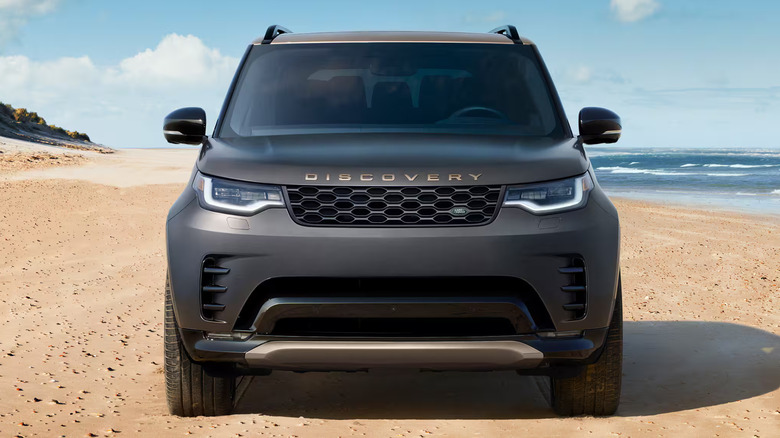
Of the seven Land Rover models in the study, the second-worst rated was the Land Rover Discovery. After five years, it typically holds only 35% of its initial value, occupying the 204th spot on the site's overall ranking of luxury vehicle value retention rates — for reference, there are only 216 models on the list. This is an incredibly poor showing, but remarkably, numerous SUVs have even worse retention rates.
The SUVs we're covering here are mostly luxury models, but there are also ones from popular brands that can't keep their value, too. We're also only focusing on models currently in production, so that means out-of-production examples like the Tesla Model X or Jaguar F-Pace don't qualify, despite their inability to hold value well.
Alfa Romeo Stelvio and Tonale
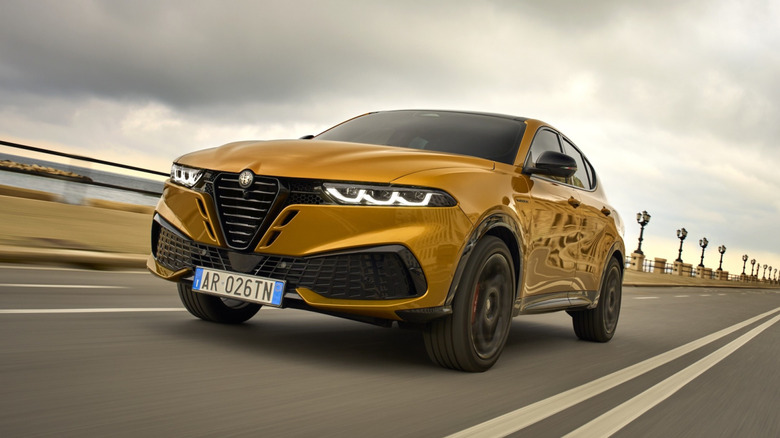
Among the beloved Italian automakers in the luxury vehicle marketplace, Alfa Romeo isn't talked about quite as much as brands like Ferrari or Lamborghini. Its models also aren't as over the top expensive as their other Italian competitors, which maybe doesn't make them quite as appealing to an ultra-wealthy clientele. Regardless, Alfa Romeo has over a century of delivering high performance, stylish vehicles that have many fans around the world, as well as two different SUVs with truly atrocious value retention.
CarEdge estimates that the Alfa Romeo Stelvio and Tonale have the exact same five-year value retention rate of just 32.9%. Out of the 216 luxury vehicles ranked by CarEdge, these two come in at spots 206 and 207. Among all vehicles, they rank 390th out of 401 cars. If you extend that usage period to 10 years, they will hold just 21.9% of their initial value, on average.
For luxury vehicles, these two Alfa Romeo SUVs aren't the most eye-poppingly expensive. The Tonale is the less expensive of the two, starting at $37,495 (plus a $3,250 destination charge). Taking out the destination charge, that means you can expect your Tonale to only be worth about $12,336 in five years. A 2026 Stelvio starts at $49,995 (plus the same destination charge), and after five years, it'll be worth $16,448, disregarding the destination charge. These are nobody's idea of a good return on the used market for luxury vehicles.
Infiniti QX80
If there's one thing vehicles produced by Japanese automakers can do, it's hold their value incredibly well over time. Among popular car brands, the top four of CarEdge's value retention ranking are all Japanese companies with Toyota, Subaru, Honda, and Mazda. If you switch to luxury brands, Lexus, which is Toyota's luxury brand and the most reliable car brand on the market, sits at the top with an average five-year retention of 61.6%, and Acura isn't too far behind it in third place. However, not every Japanese automaker is so lucky, as you have to scroll down to the bottom of the to find Infiniti, which CarEdge ranks as the third-worst luxury car brand for keeping its value.
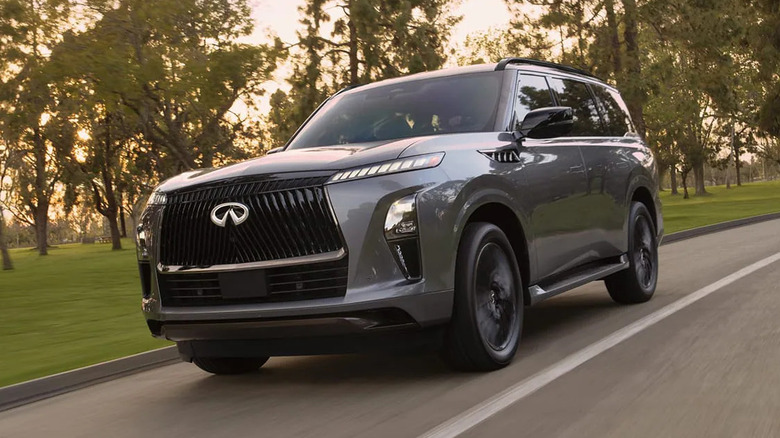
The true low point for the brand is the Infiniti QX80, the company's largest and most expensive model. CarEdge estimates that this SUV will only keep 31% of its initial value after five years, making the 35% for the Land Rover Discovery look like a dream. This ultimately lands the QX80 in 210th place among all 216 luxury vehicles. After 10 years, the value drops to just 18.2% of its original purchase price. The other Infiniti SUVs manage to keep their value a bit better than the Discovery, but it's not a good sign when the best option, the QX50, isn't a model Infiniti makes anymore.
A brand-new 2027 Infiniti QX80 starts at $85,590 (plus a $2,275 shipping and handling fee). If you're willing to spend that much money on a vehicle, you would hope that it would be worth more than just $26,533 after five years, disregarding the extra fee. You'll probably be out of luck.
Land Rover Range Rover
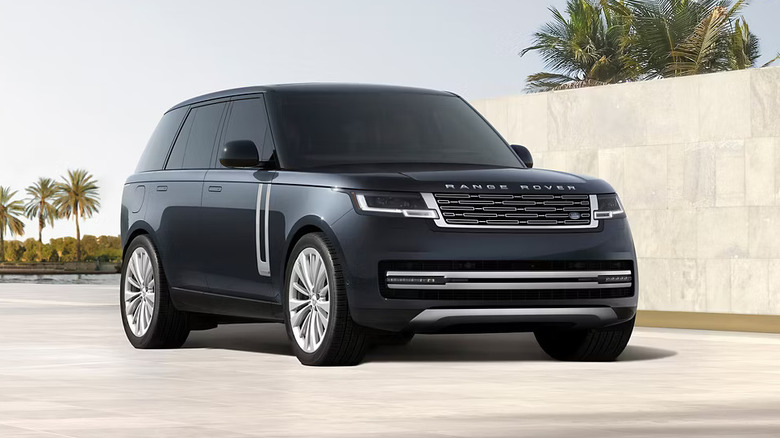
The Land Rover Discovery isn't the only SUV the brand produces with rough resale value. In fact, it isn't even the worst offender of the bunch. That unfortunate honor instead goes to the Range Rover, arguably the brand's signature vehicle. Not only is this the worst for Land Rover, but by CarEdge's estimations, it's the third-worst luxury vehicle for value retention overall, whether it's an SUV or not.
If you have a Range Rover for five years, you can only expect for it to hold about 21.6% of its initial value, according to CarEdge's estimations. That's worse than the 10-year value retention estimation for the Alfa Romeo Stelvio, which already performed below the Discovery after five years. If you tried to sell a Range Rover that's a decade old, you're looking at getting about 13.6% of what you originally paid for it.
The base price of a new Range Rover is $113,300 (plus a $2,450 destination and delivery fee).After five years, that Range Rover will in theory be worth about $24,473, when you disregard the destination and delivery fee. After 10 years, we're looking at $15,409. If you're spending that kind of money on a vehicle, losing this much on the resale market is going to hurt. Considering a new Discovery starts at $64,900 (plus a $1,850 destination and delivery fee) and would wind up being worth around $22,715 after five years, based on CarEdge's 35% estimation, it really shows you just how horribly the Range Rover holds up over time.
Maserati Grecale
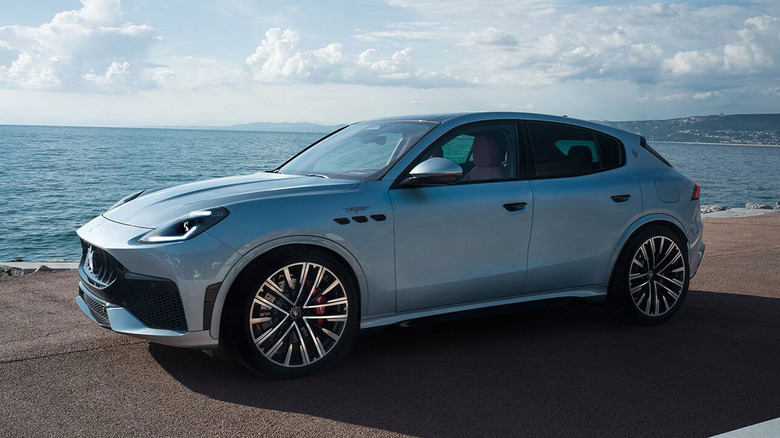
There are luxury car brands that have extremely poor resale values, and then there's Maserati. According to Car Edge, Maserati distantly trails second-worst luxury brand Alfa Romeo's 34.5% retention rate, with an average of just 24.7%. Based on that number alone, it's clear people in the market for a Maserati barely see any value in one that isn't coming straight from the factory. Two Maserati SUVs tied for absolute last place among 216 luxury vehicles. One is the now-discontinued Maserati Levante, and the other is the Maserati Grecale.
Based on the estimations by CarEdge, a Grecale is only going to hold 20.9% of its initial value after five years. The Grecale is only beaten out for the worst value retention of any vehicle by the hydrogen fuel cell-powered Toyota Mirai, which only holds 15.6% of its value after five years. Once 10 years have passed, you're looking at a Grecale holding just 14.1% of that original value.
The starting price for a new Maserati Grecale is $77,900 (plus a $1,995 delivery and destination fee). Based on that MSRP, the Grecale is going to be worth just $16,281 five years from now. You immediately see the value fall off after just one year of owning a Grecale, as it already drops to just 40.3% of what you paid for it in that time, so the prospects of getting a great price years later are pretty terrible.
Nissan Armada
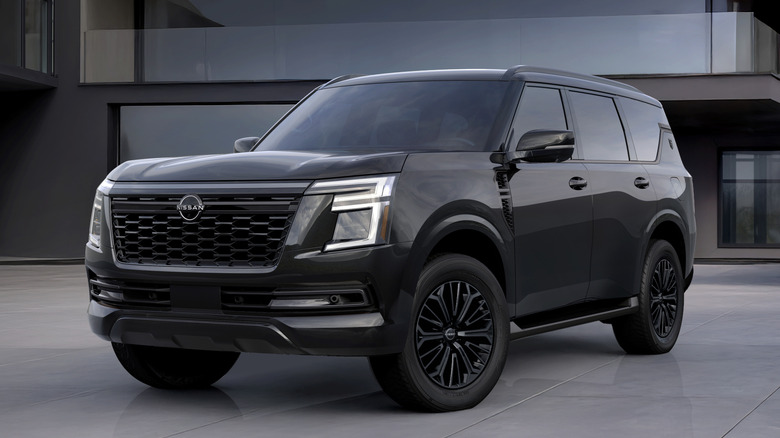
Most of the SUVs with worse resale value than the Land Rover Discovery are luxury models. However, popular mass-market car brands are perfectly capable of producing vehicles with poor value retention. Most don't get quite as low as the Discovery's, except for the Nissan Armada, a big SUV we at SlashGear like, but don't love.
On the whole, Nissan is a below average brand when it comes to value retention, with CarEdge estimating that the average model will hold 49.7% of its initial value after five years. While the brand has high highs, like the Nissan Sentra's five-year value retention of 65.3%, it has very low lows, with three of the five lowest percentages among popular vehicles. The Armada is the worst of the three, keeping only 33.8% of its value after five years based on CarEdge's estimations. The 10-year estimate goes down to 22.5%.
Despite not being a luxury SUV, a 2027 Nissan Armada comes with a hefty price tag, starting at $64,290 (plus a $2,275 shipping and handling fee). That's just a few hundred dollars less than a Discovery. Using the MSRP price, the Armada will be worth $21,730 after five years, which is quite the comedown after what you initially paid for the SUV. When an SUV like the Nissan Kicks is able to keep 64.8% of its initial value after five years, it may make you rethink getting the much larger Armada if you're thinking about the future.