

What Does A Blue Alert Mean On The Highway?
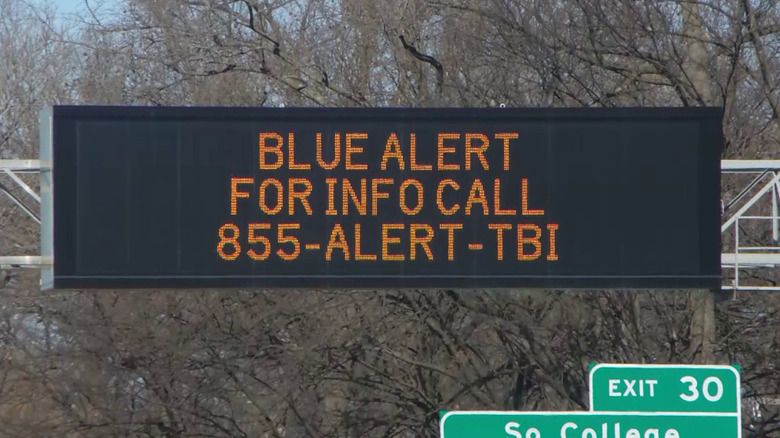
Part of staying safe on the road includes paying attention to highway signs, which often display important information you should know. But these signs can do much more than just provide updates on traffic conditions and can range from being funny to serious. For example, a Blue Alert can appear when certain serious incidents involving members of law enforcement take place. This can include situations in which an officer is mortally wounded or dies while on duty.
A Blue Alert can also mean that an officer cannot be located after disappearing during official duties, or that a suspect is believed to present an immediate, credible danger to officers. These alerts are designed to get important details to the public as soon as possible, helping authorities locate suspects and make arrests. But Blue Alerts don't just appear on highway signs, as they can also be issued through other means, including wireless devices and traditional broadcast methods like TV and radio.
Blue Alerts can be sent directly to the public, as they may have relevant information, as well as to the media and police agencies. But law enforcement departments don't necessarily have to operate without assistance. The Department of Justice's Office of Community Oriented Policing Services (COPS Office) helps participating jurisdictions develop or refine their alert procedures. This is done through a combination of guidance and practical support. As of this writing, the DOJ lists 37 states as having adopted Blue Alert plans.
How blue alerts work and how they began
The Office of Community Oriented Policing Services was tasked with establishing the Blue Alert Network in 2016. This network's goal is to improve coordination between states while also strengthening their Blue Alert programs. The Blue Alert Network keeps a collection of resources that law enforcement agencies can access, including official forms, state laws, policies, and contact information.
The way Blue Alert programs are handled can vary by state. In North Carolina, for example, the Center for Missing Persons administers the Blue Alert System, as outlined in state statute 143B-1773. The process begins when a law enforcement agency recommends the alert. The alert has to meet specific guidelines, which means an officer must be seriously injured, killed, or missing. The agency must then determine that the suspect is a threat and has information that can help locate them, or that a missing officer's circumstances raise safety concerns. The Center can then coordinate with the state's Department of Transportation for displaying Blue Alerts on overhead highway signs.
The Blue Alert Network was implemented after the murder of Rafael Ramos and Wenjian Liu, two New York City police officers. Ramos and Liu were attacked and killed in December 2014, and Congress passed legislation named in their honor just one year later. The Rafael Ramos and Wenjian Liu National Blue Alert Act established the nationwide system that would soon follow, with COPS eventually getting involved as well.