

Which Hyundai SUV Is The Closest Equivalent To The Toyota RAV4?
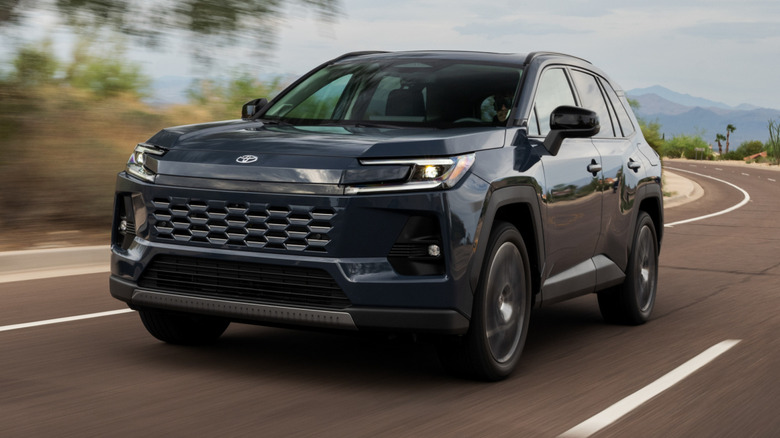
It's difficult to go wrong with a Toyota RAV4. The 2026 model year is available either as a hybrid or a plug-in hybrid (PHEV), with the former offering excellent fuel economy without the hassle of charging and the latter benefitting from a horsepower boost and up to 52 miles of all-electric range. In base form, the 2026 RAV4 starts from $31,900 (plus a $1,595 destination fee), while the PHEV variant is available from $41,500 plus fees.
Even so, there are plenty of competitors out there. Hyundai's closest competitor is the Tucson, which is available in non-hybrid, hybrid, and PHEV form for the 2026 model year. It starts slightly cheaper than the RAV4, with the base non-hybrid available from $29,700 (plus a $1,650 destination fee). The hybrid variant starts from $31,300 plus fees — making it a few hundred dollars cheaper than the Toyota — while the PHEV costs at least $40,675 plus fees.
It isn't just the Tucson's pricing that's similar to the RAV4. Both are also significantly more economical than the average new vehicle, although the Toyota has the edge. According to EPA figures, the most frugal version of the RAV4 should average 43 mpg combined, while the Tucson gets a still-impressive 38 mpg combined.
Both the Hyundai and Toyota are similarly easy to live with
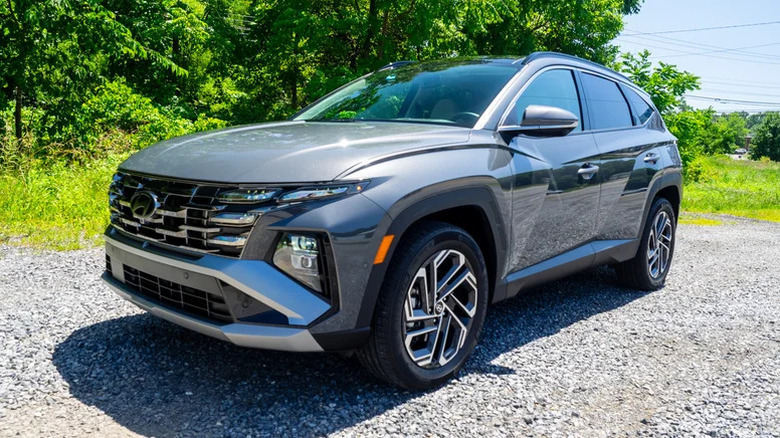
The spec sheets of the two SUVs might be closely matched, but numbers only tell part of the story. Any good family-friendly SUV also needs to be pleasant to drive and easy to live with, but again, both the Hyundai and Toyota score highly in that regard. We tested out the RAV4 PHEV earlier in 2026 and found it to be a very capable all-rounder, with the space and comfort to keep up with everyday hauling duties and more grunt than you might expect when you put your foot down.
Likewise, spending time with the 2026 Tucson Hybrid was a largely stress-free experience. One of our only significant bugbears was the driver monitoring system, which repeatedly falsely accused our reviewer of taking their eyes off the road. An annoyance for sure, but the system can be switched off, and it's not like the RAV4 is any better. A similarly over-active driver monitoring system also led our reviewer to switch the system off altogether while testing out the RAV4 PHEV.
The top trim versions of both the Hyundai and Toyota offer a long list of niceties, although base models aren't short of standard safety tech either. Both are also available with either front-wheel drive or all-wheel drive, depending on which trim buyers pick.
Hyundai has redesigned the Tucson for 2027
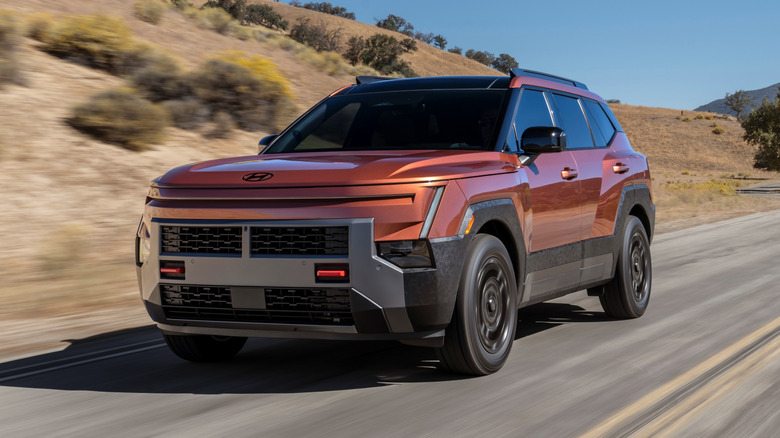
At the time of writing, Toyota has yet to reveal the full details of the 2027 RAV4. However, given that the SUV was redesigned for the 2026 model year, it's safe to assume that any changes for the upcoming model year will be minor. Hyundai, meanwhile, has given the 2027 Tucson a complete overhaul, with futuristic exterior styling and a revamped interior being the two headline changes.
There's a good argument to be made that many new crossover SUVs look too much alike, with designers being unable to challenge conventions because they need to appeal to the widest possible audience. That accusation certainly can't be leveled at the new Tucson. It has one of the most distinctive exteriors of any mainstream crossover in its segment, with a much more angular look than many of its competitors. The new all-terrain oriented XRT Pro trim takes that design language even further, although it remains to be seen how capable it will actually be off-road.
While Toyota's latest iteration of the RAV4 doubles down on electrification, the 2027 Tucson pivots in the opposite direction, with no PHEV variant of the latest generation being offered. There are no plans to add a plug-in version to the lineup either, although a Hyundai executive told us that a range-extended electric version isn't out of the question if the company thinks the demand is there in the future.