

The US Navy's Using Wall-Crawling Robots To Help With Tricky Ship Repairs
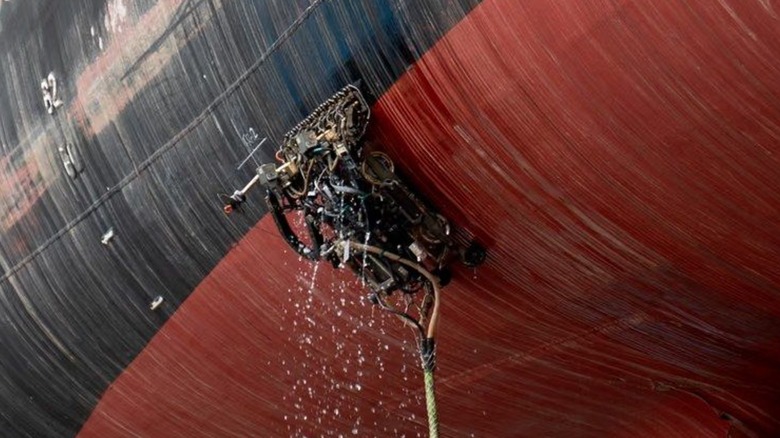
When the USS Abraham Lincoln (CVN-72) returned to port covered in rust in August 2026, a lot of people took notice. As it turns out, rust on a ship at sea for extended periods is perfectly normal and expected. It's something the United States Navy deals with all of the time, as saltwater is highly corrosive and can cause cracks in a hull to form. Finding those cracks before they lead to issues can be difficult, however, which is why a new technology has been developed to try and mitigate this.
In October 2026, the Navy signed a $300 million contract with Gecko Robotics to use the company's artificial intelligence robots to find structural issues on its ships. In Gecko Robotics' release, the company explained that its technology "can save the U.S. Navy up to $8 million in repair costs per ship and return vessels to sea quicker by identifying structural issues up to 50 times faster than traditional methods — reducing inspections from months to days."
Ship repairs are a constant occurrence throughout the Navy, so streamlining the process to reduce overall costs and save time would be ideal. Not only does Gecko Robotics use AI-powered drones, but they also climb the walls of the ship and use sensors to gather as much information as possible to find things like structural issues or cracks. The company's Komodo machine system can even analyze deck coatings through scans without having to physically dig into them.
What to know about the Gecko Robotics Komodo
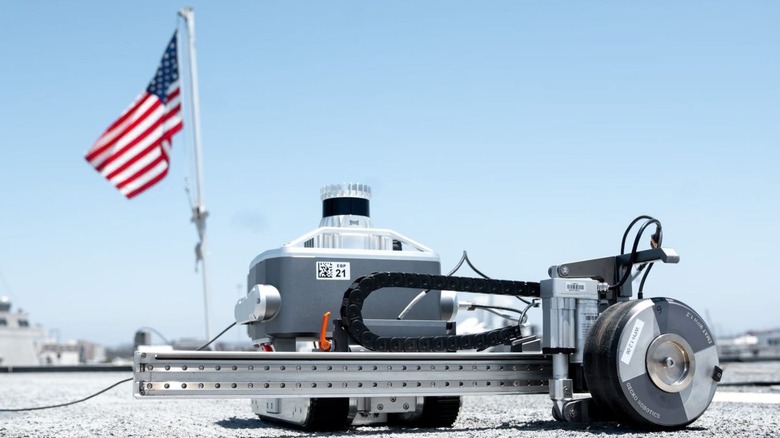
The Navy is no stranger to drones and has used all kinds, including a large uncrewed surface vessel (USV). What you rarely hear about are the drones that assist in repairs, and the Komodo system from Gecko Robotics offers some amazing capabilities in that regard. Normally, technicians have to scrape paint from random spots on the hull to determine if repairs need to be made, but Komodo makes that task no longer necessary. The system's sensors can scan the entire hull plate while a ship is in drydock, working through the paint and the panel along frames and seams.
As of this writing, Komodo is limited to ships in drydock, but Gecko Robotics is working on a new tool called Axolotl, which will have the capability to operate similarly below the waterline. This will enable full inspections without having to take a ship into a dry dock or something like the Auxiliary Floating Dry Dock Medium (AFDM).
The sensor it uses is called EMAT, or Electromagnetic Acoustic Transducer. It uses ultrasonic waves that it electromagnetically conducts through a ship's hull. EMAT can see through layers of paint, rust, and up to 150mm of metal plating, so it's far better at detecting defects than the naked eye. Another benefit of Komodo is that it can reach tight spaces people cannot, or at the very least, can't reach comfortably. Each scan is recorded and remains with the ship, keeping an ongoing log of inspection data for future repairs. All of this helps to explain why the Navy spent $300 million on the technology.