

This 694-Foot Vessel Is Built To Sink And Resurface While Holding Navy Destroyers
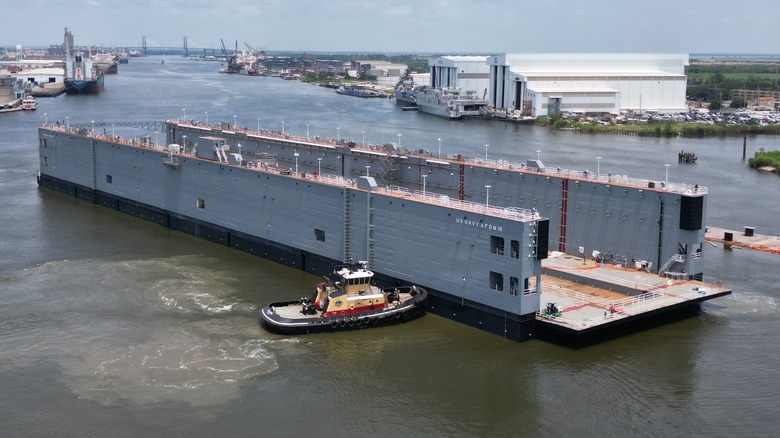
The United States Navy has utilized a lot of different types of vessels since its inception in 1775, with everything from the USS Constitution, better known as "Old Ironsides," to the USS Gerald R. Ford, the largest warship ever constructed. While most people today are familiar with aircraft carriers, submarines, cruisers, and destroyers, there are far more vessels the Navy uses for a variety of purposes. One of the most peculiar-looking of these isn't your typical ocean-going vessel, as it's used to facilitate repairs of destroyers, cruisers, Freedom-variant Littoral Combat Ships, and Whidbey Island and Harpers Ferry Dock Landing Ships.
On July 28, 2026, Austal USA launched the U.S. Navy's Auxiliary Floating Dry Dock Medium (AFDM), and it's easily one of the strangest-looking vessels used by the service. As you can see from the picture, it's not shaped like a traditional ship because, well, it isn't one. Instead, the AFDM is known as a Rennie-type floating dry dock, featuring continuous wing walls and pontooned sections reaching 65 feet high from the baseline to wing deck.
The AFDM weighs 12,000 tons and measures 694 feet long with a deck that has a working surface area of 90,800 square feet. The AFDM has a lifting capacity of 18,000 long tons (LT), making it more than capable of lifting destroyers and cruisers. A newly modernized Arleigh Burke-class destroyer displaces 8,558 LT, while a Ticonderoga-class cruiser displaces 9,600 LT. To function as a dry dock, the AFDM sinks itself below a target ship, secures it in place, and lifts it to facilitate repairs, making it an incredibly useful, if unusual-looking, vessel.
This unique vessel has historical roots
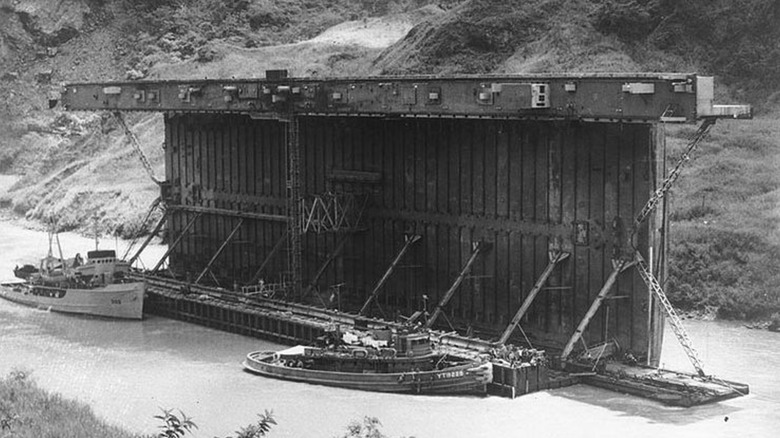
It's easy to look at the AFDM and think that it's something entirely new, but it's merely the latest in a line of similar vessels used by the U.S. Navy over the years. The service has used variations of auxiliary floating dry docks for decades, as they're incredibly useful. They work by submerging beneath a ship that requires repairs, using buoyancy to do so. Once they're beneath the vessel, water is pumped out, causing the AFDM to rise, taking the captured ship along for the ride.
Typically, this type of floating dry dock has no engines of its own, requiring tugs to move it into place. When World War II kicked off for the United States in 1941, the Navy already had three such vessels, the YFD-2, the YFD-1 (USS Dewey), and the USS ARD-1. Over the course of the conflict, more than 150 floating dry docks were constructed to facilitate repairs of ships in overseas areas, and they were absolutely needed. There have been many different types utilized by the Navy over the years, each of which was distinguished by its lifting capacity.
The first of these built for the U.S. Navy was the YFD-2, which stands for Yard Floating Dock. It was the first of its kind and began serving the Navy in 1902. It was among the ships sunk during the Japanese sneak attack on Pearl Harbor on December 7, 1941, but was raised, repaired, and placed back into service for the war effort. The AFDM is an unusual-looking vessel, to be sure, but it's also a member of a long line of auxiliary floating docks that has served the Navy well for over a century.